
Powering the UK Data Boom: The Nuclear Solution to the UK’s Data Centre Energy Crunch
Commissioned by Nuclear Industry Association
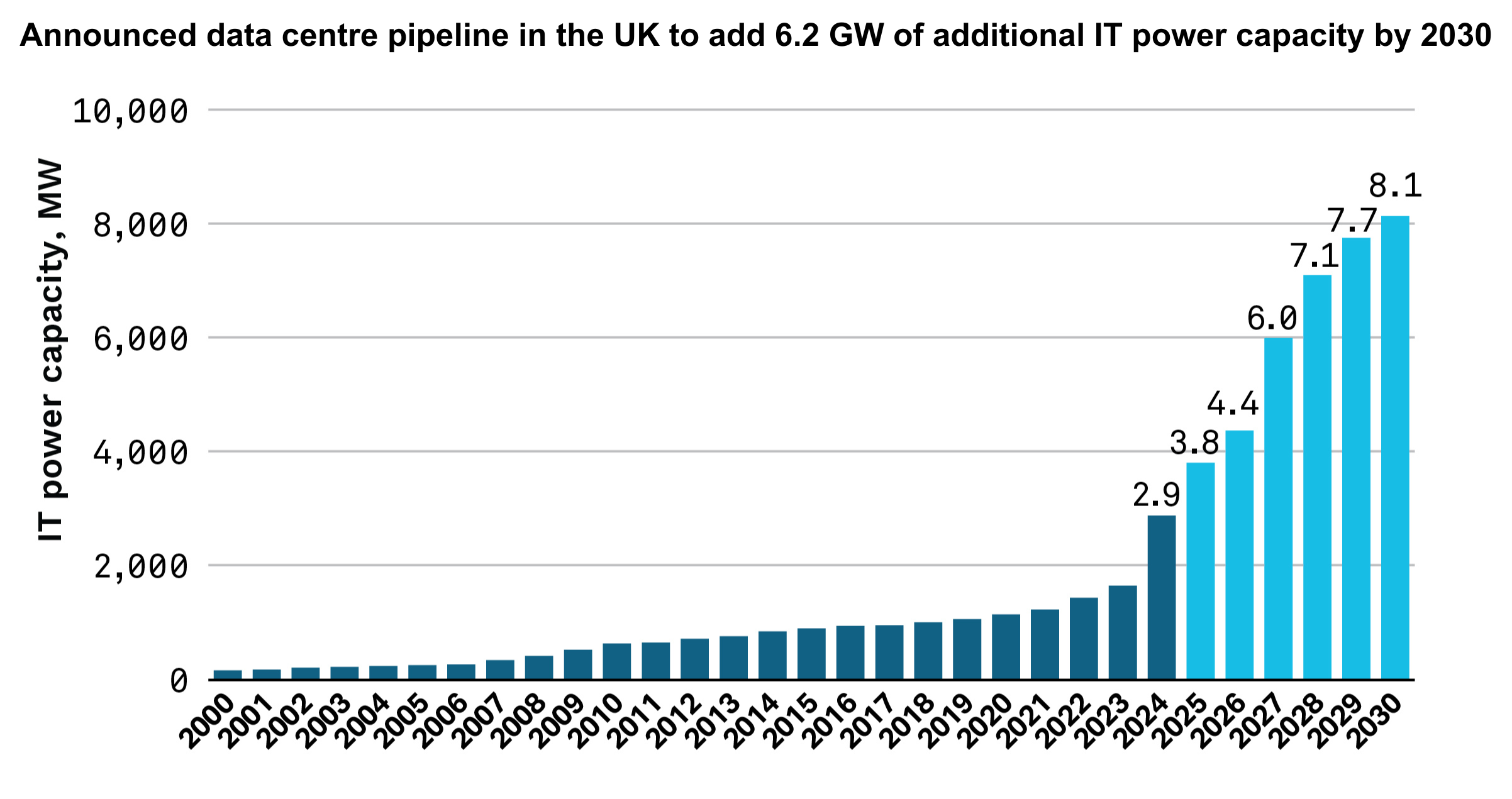
The UK’s data centre sector is expanding rapidly, driven by digitalisation, cloud computing, and artificial intelligence (AI). These facilities are essential to the UK’s digital economy but are also extremely energy intensive. In this report for the NIA, we forecast the electricity demand of data centres in the UK, and analyse why nuclear energy is well positioned to meet this growing demand.
In 2023, UK data centres consumed an estimated 5.0 terawatt hours (TWh) of electricity—around 2% of total national demand. We forecast that this will rise at least fivefold to over 26 TWh by 2030, or more than 9% of projected national electricity demand. Nuclear energy is uniquely positioned to meet this growing demand. Data centres require continuous, always available electricity—24 hours a day, 365 days a year. Nuclear generation provides firm, round-the-clock, low-carbon power that matches the reliability and sustainability standards required by global technology firms. Leading technology firms are already recognising nuclear’s strategic fit.
The mismatch between data centres’ rapid deployment timelines and the pace of advance nuclear rollout presents a challenge. The report suggests that developing data centres adjacent to decommissioned or soon-to-retire nuclear sites or other power plants presents a viable interim strategy. This approach leverages existing grid infrastructure and licensed land, while enabling a future transition to Small Modular Reactors (SMRs) and Advanced Modular Reactors (AMRs) once they become commercially available. Notably, there is a downside risk of increased reliance on gas-powered generators in the short term, if new nuclear is not expedited.
The report also identifies several competitiveness challenges facing the UK—such as high industrial electricity prices, delayed grid connections, and a relatively carbon-intensive generation mix—which risk pushing new data centre investment to other markets offering cheaper, cleaner, and faster energy access.
The experts behind the research
-
 Clarissa Hahn
Economist
Clarissa is an Economist on the Industry team at Oxford Economics, specializing in tailored economic analysis, including industry outlooks, customized models, strategic assessments, and economic impact studies. Before joining Oxford Economics, she worked as an economic researcher at the European Investment Bank and the United Nations. She holds an MA in Economics from the University of Cambridge.
-
 Andy Logan
Director of Industry Consulting
Andy Logan leads our Consultancy offer on different industries for clients. He undertakes studies forecasting the demand for company’s products, analysing the drivers of different industries growth, and assessing the size of different markets and industries. He also investigates the competitive pressures and opportunities facing industries now and in the future. Another area, where he has a keen interest is in studies assessing the demand and supply of labour for different industries and occupations, identifying potential skill shortages and implications for migration.
He has worked with clients in most industries, and in many countries of the world.
Prior to joining Oxford Economics, Andy worked in a variety of economist roles at the Bank of England for 15 years. His research focused on the labour market, commodity and producer prices, UK trade flows, and the performance of UK banks. He holds an MSc. and BA. degrees from the universities of London and Leicester.
Get in touch
Learn more about this report or how our team could support you: