
Tariffs 101: What are they and how do they work?

What are tariffs?
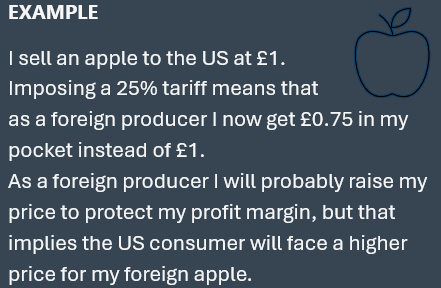
Tariffs are taxes imposed by a government on goods and services imported from other countries. Think of tariff like an extra cost added to foreign products when they enter the country. They’re usually a percentage of the price of the goods. The level of the tariff will affect the significance of its impacts.
Why do governments impose tariffs:
- Raise government revenue– tariffs serve as a source of income for governments.
- Protect domestic industries and correct trade imbalances– tariffs shelter domestic industries from foreign competition and discourage consumption of imported goods.
- Political tool for negotiations– tariffs can be used to apply pressure on the foreign government they are imposed on, as part of a trade negotiation or a political tool.
For example, the Trump administration has justified imposing tariffs on Canada, Mexico and China, to pressure foreign governments into addressing illegal immigration and drug trafficking, while also addressing the size of the country’s trade deficit.
See how Oxford Economics can help you navigate the tariff changes
Get in touchWhat impact do tariffs have on the economy imposing them?
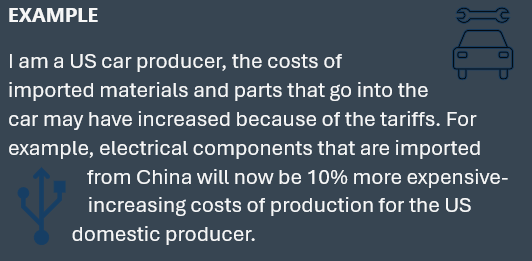
Domestic industries may benefit from reduced foreign competition. If foreign goods are now relatively more expensive, this would drive up demand for domestic products, allowing domestic industries to expand and increase production.
However, some domestic industries have global supply chains that rely on imported materials and parts. As prices of imported materials and parts increase, domestic producers may face higher costs of production. If the domestic producers pass higher costs of production onto consumers, it will also push up prices of domestically produced goods.
Notably, the economies that are initially ‘tariff imposers’ may end up facing retaliatory tariffs, which has been the case in the current climate. Below we highlight some potential tariff impacts on the economies tariffs are imposed on.
What impact do tariffs have on the economies they are imposed on?

In the country that tariffs are imposed on targeted industries will face lower export demand. As their goods have become relatively more expensive in the importing country, it will lead to lower sales and lost market share, as consumers switch to relatively cheaper domestic goods. The degree of this decline depends on the price elasticity of demand, how much consumers adjust their purchases of imports in response to the higher prices caused by the tariffs. This may be the case for example if there are few alternatives in the domestic market, or consumers have a strong brand preference.
The extent of the impact will depend on how much of the country’s production is exports, and particularly, exports to the country imposing the tariff. In Canada, for example, exports make up 33% of Gross Domestic Product and exports to the US specifically are 20% of Gross Domestic Product.
Industries in countries that tariffs are imposed on may adjust their export strategies to minimize losses, by seeking other markets to sell to with more favourable tariff regimes. Yet, redirecting trade to alternative markets comes with its challenges: including regulatory barriers, logistics and distribution costs – establishing new supply chains takes time and investment, and existing competition may be well established in alternative markets.
For latest reports on trade and tariffs, please visit our topic page.
Related content

Tariffs take a toll despite easing trade hostilities
Global tradeflows remain under pressure despite easing tariff tensions. Recent US–China agreements reduce select import taxes and support China’s 2026 outlook, yet US imports continue to fall and supply chains pivot toward Asia and Europe. Containerised trade is set to expand, while bulk shipments soften alongside weaker industrial demand.
Find Out More
Global trade is losing momentum
Trade disruptions spread across autos and pharma sectors, with EU tariff exemptions giving Europe a competitive edge amid global slowdown.
Find Out More
Why have China’s exports held up so well under higher US tariffs?
China's exports have adapted, rather than retreated, under higher US tariffs. It will be difficult for businesses and consumers to decouple from Chinese exports or China-linked supply chains.
Find Out More
ASEAN growth opportunities following US-China Tariffs
Using sectoral production data from Oxford’s Global Industry Service, we have been able to quantify which countries and sectors have the greatest potential for production migration. Applying this framework across Asia reveals meaningful industrial depth in Vietnam, Thailand, and Malaysia in trade-intensive segments, and a distinctive, more resource-heavy footing in Indonesia and India.
Find Out More
Trends are reinforcing the strength of major cities
Leading cities like London, New York, and San Jose are thriving through technology, knowledge industries, and demographic advantages. As global shifts and AI reshape urban economies, which cities will stay ahead in the coming years?
Find Out More
Construction across sectors hitting record highs now and by decade’s end as economy slowly gains momentum
Australia’s construction sector is entering a defining decade. At the Australian Construction Outlook Conference 2025, Oxford Economics Australia explored the transformative trends shaping growth to 2030 – from AI-driven data centers and electrification projects to government-funded infrastructure and rising demand for social and retirement living.
Find Out More
Risk pendulum swings from inflation fight to trade tensions, economy to gradually gain momentum.
Economic Outlook Conference 2025 brought together business leaders and policymakers in Sydney & Melbourne where Oxford Economics Australia shared key insights on tariffs, investment, productivity, and sectoral trends shaping the nation’s economic outlook.
Find Out More
Eurozone outlook 2025-26: A clearer path for Eurozone growth but tariffs will still bite
The Eurozone economy has held up against geopolitical challenges but faces lacklustre growth in the near term, with global demand and uncertainty weighing on exports and investment. GDP growth is forecast at 0.8% in 2026, below consensus.
Find Out MoreTags: