
COP30 in focus: How to bridge the implementation gap?
By Geoffroy Dolphin, Charlie Muir and Daniel Parker
The 30th Conference of the Parties (COP30), the annual UN climate change conference, will open in Belem, Brazil, on November 10. This COP will mark the 10th anniversary of the Paris Agreement and is expected to confirm a much-needed shift of focus from the definition of emissions targets (ambition) to their implementation and operationalisation.
This blog, the first of our series on COP30, sheds light on countries’, industries’ and cities’ progress on the path to decarbonisation and where stronger action is urgently needed.
Slowing momentum on climate mitigation
When governments and civil society gather in November, it will be against a backdrop of slowing global momentum.
In recent years, much of that momentum had been provided by the US and the EU, both of which are, to varying degrees, in retreat. The US has yet again notified the UN of its withdrawal from the Paris agreement, and is exerting pressure on other countries in some fora against emissions regulations; the EU is struggling to finalise agreement on its 2035 and 2040 emissions target among its Member States.
Yet national and global action is needed more than ever. According to the latest update of the World Emissions Clock, global greenhouse gas emissions will again surpass 60 Gt this year, and show no sign of aligning with Paris-compatible emissions pathways.
Unlock exclusive climate and business insights—sign up for our newsletter today
The ambition gap vs. the implementation gap
This trajectory is in stark contrast with countries’ pledged emissions targets, as specified in their nationally determined contributions (NDCs). And there are signs that countries are responding to the urgency of climate change mitigation by pledging more ambitious emissions reductions in this round of NDCs.
While this reduces the ambition gap by bringing the global NDC emissions trajectory closer to the Paris agreement target, it raises the implementation gap as countries fail to detail or follow through on measures that would align their emissions trajectory with their stated target. This undermines their credibility, as we highlighted earlier this year, and stresses the need to close the implementation gap.
The COP30 Presidency’s Action Agenda aims to address this issue by directing efforts and discussions toward practical solutions across sectors and technologies. Furthermore, the Presidency has launched a Granary of Solutions, whose objective is to increase the availability of information on emissions reduction or adaptation solutions that have been adopted around the world.
The slow progress observed at the global level partly reflects practical difficulties encountered at the sectoral and local level, as the move from ambition to implementation forces households and firms to grapple with the cost of emissions reduction and the operational difficulties of at times untested technological solutions.
Rewiring industry for a low-emission future
This challenge is most pronounced in manufacturing and construction, whose global CO2 emissions have risen significantly since 2000. 45% of this increase comes from emissions associated with the electricity and heat consumed by these sectors (Scope 2); direct (Scope 1) CO2 emissions increased until 2010 but have broadly flatlined since then.
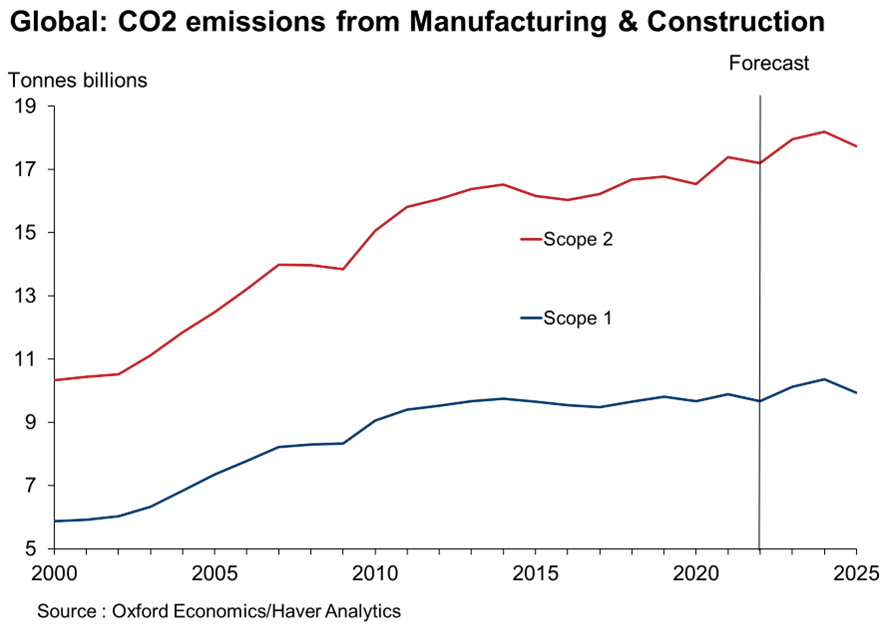
Despite efficiency gains, process emissions (those inherent to chemical reactions, e.g., in cement or steel production) remain hard to abate and have not declined materially. Technological solutions to decarbonise industry do exist. Our own research into available technology shows that the vast majority of industrial heating processes could be significantly electrified using current, commercially available, technology.
However, the electrification of industrial processes remains hampered by high electricity prices, especially in Europe. Many countries continue to experience higher wholesale electricity prices than before the invasion of Ukraine by Russia and overall power system cost is likely to remain high as the transition to renewable power generation calls for substantial renewal and expansion of the electricity grid. It is also held back by broader competitiveness concerns associated differing levels of ambition and policy stringency across countries.
In the meantime, recent technological advances are helping accelerate the decarbonisation of other sectors. This is the case of electric vehicles, a welcome development that owes much to China’s efforts over the last decade, with its technology being rolled out domestically, with substantial impacts on domestic fossil fuel demand, and exported internationally.
The adoption of electric vehicles has the potential to accelerate GHG emissions reductions as well as further reduce emissions of local pollutants such as particulate matters, whose concentration in cities has negative health impacts on their residents.
Cities at the frontline of climate mitigation
The broader issue of tackling climate change at the city-level has become even more salient over recent decades. In 2024, a third of the global population was represented by the 1,000 major cities considered in our service—a striking testament to the size and importance of these urban centres. Given their scale and density, urban areas are the largest contributors to climate change, producing up to 70% of global greenhouse gas emissions, despite covering only 2% of the Earth’s surface.
This highlights cities’ paradoxical position: they drive environmental degradation but are also among its most vulnerable victims, facing rising temperatures, air pollution, and more frequent climate-related disasters. For some, these issues are further compounded by the urban heat island effect, making cities even hotter and more hazardous.
Sustainability and climate mitigation at the city-level appear to be indisputable issues requiring urgent action. However, as previously mentioned, some major national governments have recently deprioritised these matters. Despite this, many cities remain committed to the cause. In some cases, local governments have bypassed national inertia to lead the charge on sustainable practices and climate resilience. As highlighted above, this leadership is driven largely by necessity, given the outsized role cities play in the global economy and their environmental footprint.
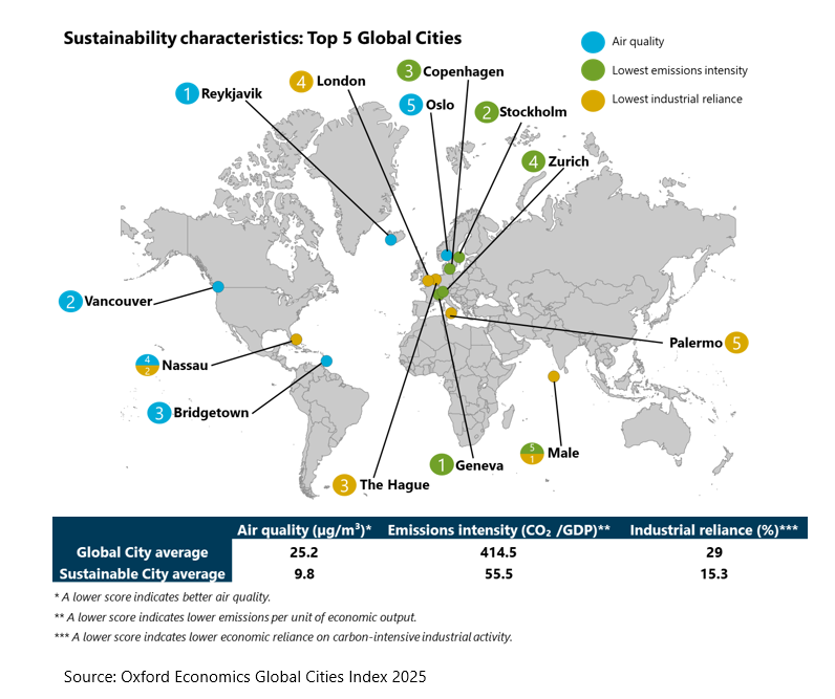
Against this backdrop, and despite sometimes significant rollbacks at the national level, many cities remain committed to climate and sustainability agendas. Our research identified 63 cities as Sustainable Cities, based on indicators such as air quality, emissions intensity, political stability, and economic reliance on carbon-intensive industries.
We find that many European cities lead global urban sustainability, while some Island cities are also emerging as leaders, driven by climate vulnerability and investment in renewable energy and adaptation. Major cities in Australia and New Zealand have adopted progressive sustainability policies that have gone beyond national directives, while North America lags behind—with only Vancouver meeting sustainability benchmarks. Meanwhile, Latin American cities like Montevideo and San José show that progress toward sustainable development is possible even amid economic and policy constraints.
The Paris Agreement endures, but COP30 must deliver
As global emissions continue their upward trajectory, reaching an all-time high in 2024, and policy priorities shift in major economies, doubts about the Paris Agreement’s effectiveness are understandable. Yet the agreement has proven more durable than many expected, weathering shifting political winds and even two US withdrawals.
This durability matters now more than ever. Policy support in advanced economies has weakened, but the global transition is far from stalled. New centres of momentum are emerging elsewhere, as developing economies expand clean energy, industries invest in low-carbon technologies, and cities accelerate climate action on the ground.
COP30 offers a welcome opportunity to share and build on the lessons of effective emissions reductions implemented around the world at the national, industry, and city level.
What will these changes mean for you and your business?
The next phase of climate action will move from pledges to implementation, reshaping markets, investment flows and competitiveness. Businesses that anticipate these shifts and quantify their exposure will be best positioned to thrive through the transition.
At Oxford Economics, we help you assess the impact of mitigation policies across every facet of your business. Request a trial of our Climate Services and gain access to forecasts, scenarios and expert insight, along with our latest updates from COP30 today.
Tags:
Related Reports

Silver, the next generation metal
This report highlights the critical role silver plays in data centres and artificial intelligence (AI), automotive and electric vehicles (EVs), and solar energy photovoltaics (PVs). With these sectors expected to expand significantly over the coming years, we expect future silver demand to be strong.
Find Out More
Key take-aways from COP30
COP 30’s agenda had placed a strong emphasis on countries’ implementation of their emissions reduction target and, for the first time, several workstreams included discussions on unilateral trade policies.
Find Out More
Flooding risks diverge across UK cities, sectors and economies
Climate-linked flooding is becoming more severe, reshaping risks for UK cities, real estate, and local economies. Which areas face the greatest impact—and why?
Find Out More
COP 30 in focus: How to stay the course on the path to Net Zero
EMDEs are projected to account for 70% of global CO₂ emissions by 2050, making accelerated emissions reductions in these economies essential. Yet gaps in AE leadership—such as US policy rollbacks and insufficient climate finance—risk slowing the global transition.
Find Out More