
Why do governments favour building new cities?

With the Kingdom of Saudi Arabia’s NEOM megaproject, Egypt’s New Administrative Capital, the UK’s New Towns, and the relocation of Indonesia’s capital to Nusantara, interest in new urban developments is back and more exciting than ever. The 20th century was rife with such developments, ranging from the establishment of new capital cities, such as Brazil’s Brasilia and Australia’s Canberra, to the construction of new urban spaces to better manage population growth, such as Milton Keynes in the UK and Chandigarh in India. These new cities have allowed countries to reinvent themselves by putting a lid on political discontent, enabling opportunity to spread beyond legacy centres, and creating growth zones designed to meet the industrial challenges of the modern age.
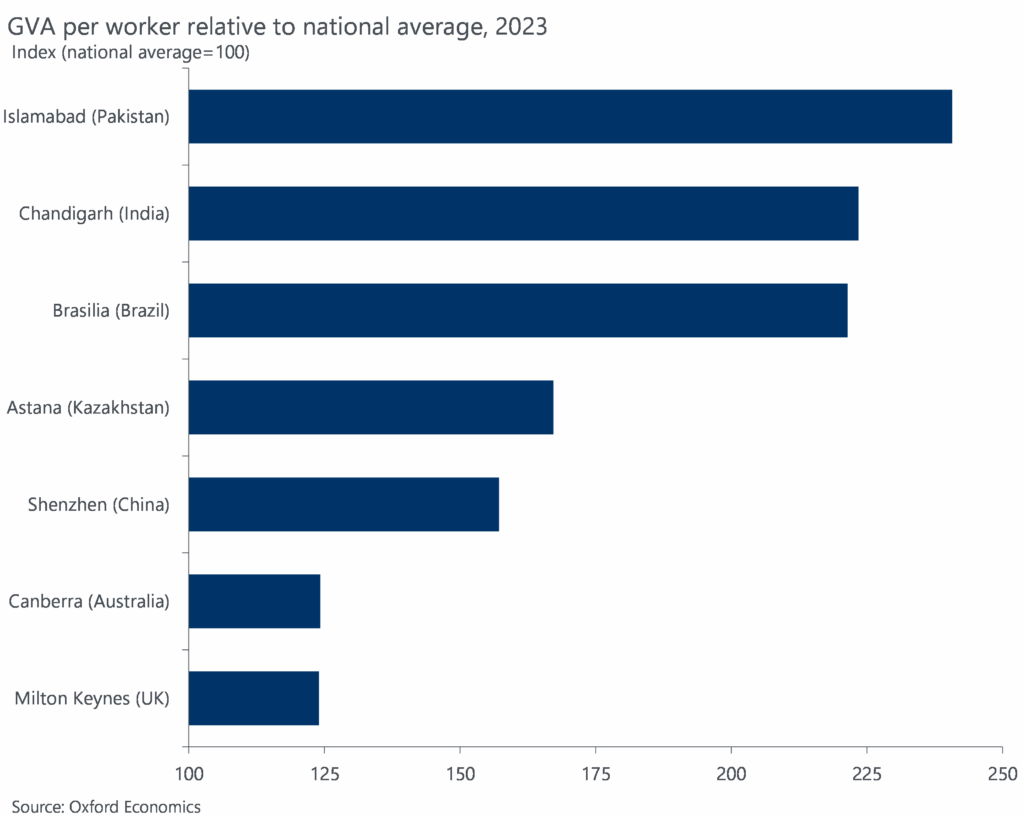
So, given their clear appeal, how do new cities of the past perform today? Well, actually, very well. An analysis of nine newly developed cities from the recent past shows that each significantly outperforms the national average in total productivity (Chart 1). In fact, two of the more recent examples of new cities—Nigeria’s capital, Abuja, and Myanmar’s capital, Naypyidaw—had to be left off the chart below because their performance was so off the scale. For example, Abuja has a productivity rate almost 10 times that of Nigeria as a whole, while Naypyidaw’s is over three times that of Myanmar. As productivity is a key element of living standards, very similar trends to those seen in Chart 1 can be seen for household income across these cities.
Chart 1: New cities outperform their national average across key economic indicators such as productivity
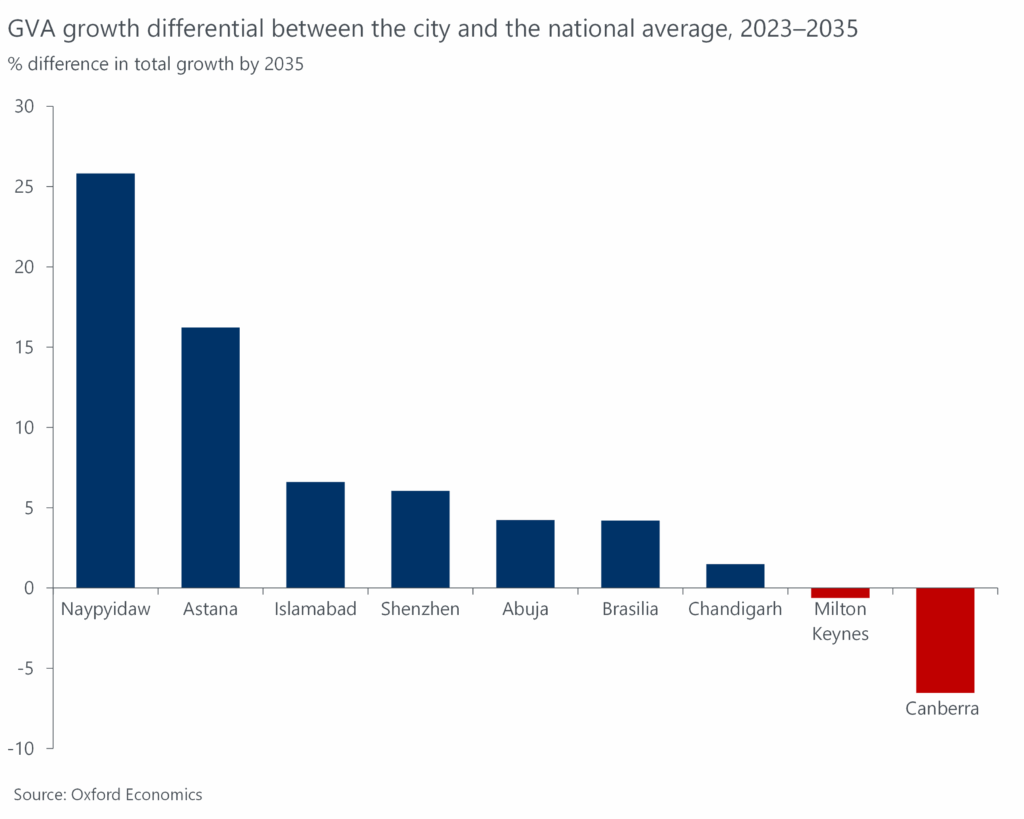
With the exception of Canberra—and to a lesser extent, Milton Keynes—all of these cities are projected to maintain strong growth, with their GVA growth between 2023 and 2035 outpacing the national average (Chart 2). This shows that not only do new cities typically have much higher living standards, as witnessed by their high levels of productivity and income levels, but they also tend to grow faster than average.
This trend is perhaps unsurprising given that many new cities were designed with the express purpose of enabling population growth, while ensuring that the land and resources available were sufficient to support a growing economy. It also partly explains why new cities tend to outperform in terms of productivity, as their design and development was focused on ensuring strong infrastructure and living conditions for would-be residents and businesses. This was particularly the case for new cities that became administrative capitals, such as Islamabad, which benefitted from an immediate surge in high-skilled, relatively high-paid jobs in the public sector on completion.
Unlock exclusive economic and business insights—sign up for our newsletter today
SubscribeChart 2: Growth prospects across the majority of new cities are strong and point to continued economic success
And it isn’t just administrative capitals like Islamabad that are profiting. Each new city clearly benefits from a blank slate on which to base development off, with issues relating to property rights and local opposition to development having a much more limited impact than if one was to simply regenerate or expand an existing city. Each of the new cities perform well in terms of infrastructure, transport, and housing delivery, enabling them to leapfrog some of the challenges facing older cities in their country, such as ageing infrastructure, overcrowding, and existing poverty traps. This can be seen in the Global Cities Index, where most new cities perform stronger in the rankings than their in-country peers, particularly against environmental and quality of life indicators.
Overall, new cities are often hubs of prosperity and opportunity within their countries, characterised by high productivity and income levels, and above-average GVA growth. A key driver of this success is substantial capital deepening early in their development, with transformational investments in infrastructure—such as well-planned housing and integrated transport systems—significantly boosting output. Many new cities are also built around targeted industrial strategies: for example, Shenzhen on China’s south coast has centred its growth on electronics exports, while Milton Keynes has leveraged its strategic location to become a hub for logistics and technology. Other cities, like Abuja and Astana (Kazakhstan), serve primarily administrative functions, benefitting from clusters of high-productivity public sector jobs and the private firms that emerge around them.
What is clear is that, after a period of rapid productivity growth, employment and population levels increase significantly—putting downward pressure on productivity levels but substantially boosting economic growth rates as the infrastructure is increasingly utilised by larger numbers of people. These new cities offer hope for the ambitions of many policymakers across the globe today. But remember, these are the cities that were delivered—spiralling costs, lack of realism, and environmental hurdles meant that many others were not so fortunate.
Subscribe to our newsletters
Tags:
Related Reports

The rise of Southern India’s business service hubs
Over the next five years, India is set to be one of the fastest-growing major economies across Asia Pacific, lead by the performance of its IT and business services. The Southern states of Karnataka and Telangana are at the forefront of this success as they are home to two of India’s most rapidly growing cities and productive cities—Bengaluru and Hyderabad.
Find Out More
London’s productivity slump highlights Manchester’s momentum
The UK’s productivity performance has been lacklustre since the 2008 global financial crisis—both historically and relative to its international peers.
Find Out More
Amsterdam outlook 2025-2029
The European economy has endured a challenging year in 2025, but we expect Amsterdam to hold up relatively well.
Find Out More
Southern metros stand to lose the most from the government shutdown
The federal shutdown that started on October 1st is on course to be one of the longest in years and could have a significant impact in a handful of mostly southern metros.
Find Out More