
Blog | 08 Mar 2023
The energy transition – how fast and how far?

Abby Samp
Director, Industry Subscription Services

The age of renewable energy could be closer than you think. Across the world governments and policy makers have announced billions of dollars in investment to transition away from fossil fuel use. The US Infrastructure Investment and Jobs Act, for example, has earmarked more than $65 billion in investment in the clean energy transmission, and the UK government aims to fully decarbonise its electricity grid by 2035.
In our previous blog, I discussed how climate mitigation and adaptation policies would influence sectorial growth, and why the transition away from fossil fuel use by sector is key to understanding these dynamics. In this piece, I will dive into two areas that are central to energy transition, the greening of the electricity grid and the shifts in industrial energy use.
The path towards greener electricity use
The greening of the electricity grid is a key theme behind the climate transition. But the starting point varies significantly across countries. In Europe, for example, the share of nuclear and renewables used in electricity generation in 2020 ranged from 18% (in Poland), to above 95% in Norway, Sweden, and Switzerland, with an average of 57% across all European countries covered in our service. In contrast, several major emerging markets are still heavily reliant on coal to generate electricity—coal’s share of electricity generation in 2020 in India and China was 72% and 64% respectively.
In our baseline forecast, all countries are expected to significantly decarbonise their electricity grid by 2050. However, fossil fuels are still expected to play a role in electricity generation in most countries—and still significantly in some cases. In China, for example, coal is still forecast to account for about 26% of electricity generation by the end of the forecast period.
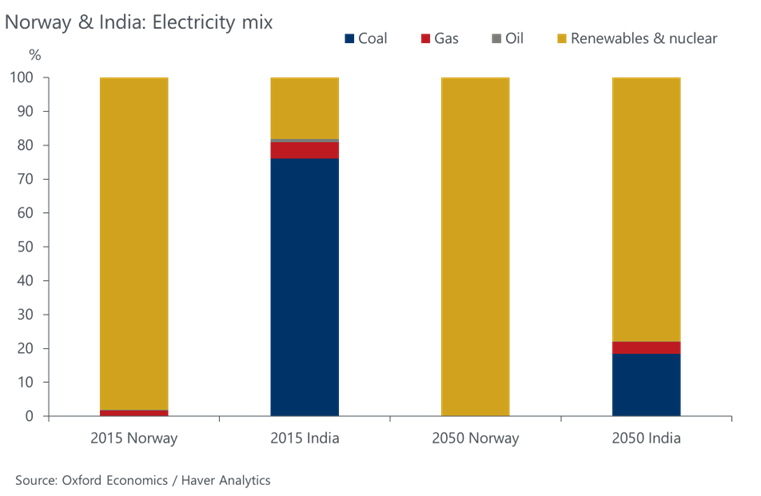
Differences in the electricity generation mix mean that some countries are more vulnerable than others to the price shocks implicit in climate transition scenarios. A country like Norway, which already generates nearly all of its electricity from renewables and nuclear, will see a much smaller shock through electricity prices in response to carbon taxation than a heavily fossil-fuel dependent country like India, which has implications for the competitiveness of manufacturing activity in both economies.
Shifts in industrial energy use
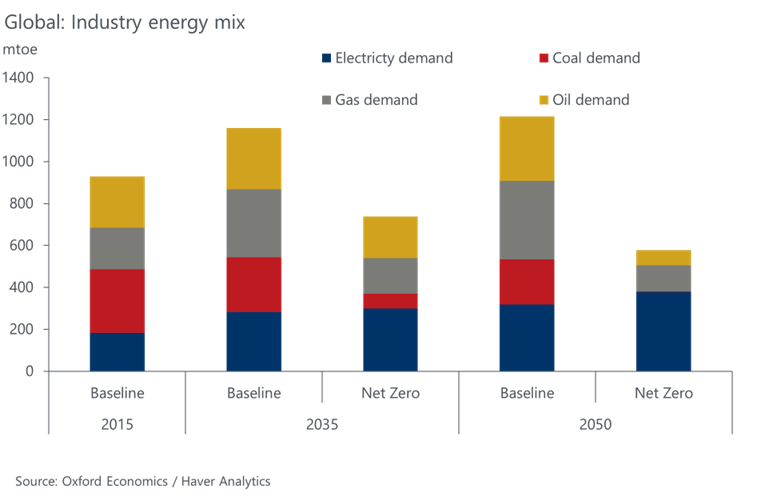
Along with the greening of the electricity grid, industrial energy use is expected to transition towards (greener) electricity consumption. In our baseline forecast, electrification happens more slowly for industry relative to the services and household sectors. While electricity use rises significantly from current levels, by 2050, it is only expected to account for 26% of total industrial energy use.
In our Net Zero scenario, industrial reliance on fossil fuels falls significantly. Globally, electricity accounts for 65% of industrial energy use by 2050, with sectors such as chemicals and refining proving especially difficult to electrify. In addition to higher electricity demand, the scenario leads to a significant decline in total energy use, owing to the steep decline in fossil fuel use and the relative efficiency of electricity as an energy source, leading to more than an 80% decline in industrial carbon emissions relative to our baseline scenario.
To download our full analysis on the sectoral winners and losers from the energy transition, please click here.
Author
Abby Samp
Director, Industry Subscription Services
Abby Samp
Director, Industry Subscription Services
London, United Kingdom
Abby is the Director of Global Industry Subscription Services, where she oversees service developments, helps shape the global industry overview and monitors and updates the forecast for the high-tech sector. Abby manages developments to Oxford Economics’ Global Industry Model (GIM), has extensive experience in modelling and scenario-based project work.
Abby has a BASc in Economics from McGill University in Montreal, where she graduated with great distinction and received the Hubert Marleau prize for top marks in economics. She also holds an MSc in Econometrics and Mathematical Economics from the London School of Economics and Political Science, where she graduated with distinction.”
Tags:
You may be interested in

Post
Key take-aways from COP30
COP 30’s agenda had placed a strong emphasis on countries’ implementation of their emissions reduction target and, for the first time, several workstreams included discussions on unilateral trade policies.
Find Out More
Post
COP 30 in focus: How to stay the course on the path to Net Zero
EMDEs are projected to account for 70% of global CO₂ emissions by 2050, making accelerated emissions reductions in these economies essential. Yet gaps in AE leadership—such as US policy rollbacks and insufficient climate finance—risk slowing the global transition.
Find Out More
Post
COP30 in focus: The economic cost of a warmer world
As COP30 approaches, we explore the economic cost of a warmer world and why adaptation and resilience must be at the heart of climate action.
Find Out More