Blog | 03 Jul 2018
Combatting illicit trade – consumer motivations and stakeholder perspectives

Thought Leadership Team
Oxford Economics
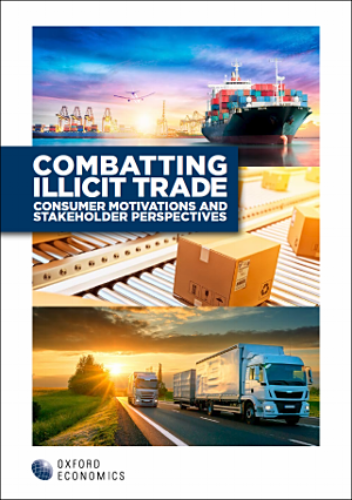
Illicit trade is a persistent and growing threat, as technology, the global economy and e-commerce open new opportunities for counterfeit products to infiltrate supply chains and provide consumers with illicit products. Many understand the risks—that illicit trade can cause serious public health issues, and that the proceeds from illicit sales fund other criminal activities. Others view some form of illicit trade as the soft underbelly of the global economy— the price to be paid for frictionless trade.
A new study from Oxford Economics seeks to understand this evolving issue better—specifically, the attitudes and behaviours of those that influence the demand and the supply for illicit goods, so that illicit trade can be contained. We surveyed more than 37,000 consumers, across 37 European countries, buying five products; cigarettes and tobacco, alcoholic drinks, films, music and games, clothing and accessories and medicines.
This research helps to dispel four commonly held misperceptions about illicit trade:
- Consumers know that are buying illicit goods: Our survey showed, consumers increasingly find it difficult to confirm their purchases are genuine even when they buy through trusted sources.
- Illicit goods are mainly bought through illicit channels: Our survey showed illicit trade passes through many retail channels and undermines consumer confidence in legitimate goods. Official online channels, with high volumes and easy access to illicit goods, may pose a bigger long-term risk than criminal sites on the dark net.
- Illicit trade is mostly carried out by people on low incomes: Our survey showed Illicit trade occurs across all levels of society. As illicit trade expands to more products and is increasingly online, it becomes easily accessible to a wider population. There are many reasons why people buy illicit that aren’t related to income level.
- Consumers buy illicit goods because they are cheaper: Our survey showed consumers buy illicit goods for many reasons. Though price is clearly a key factor, there are several other strong influences relating to both the product offering and the implications of illicit trade on society.
This report introduces a new way of segmenting consumers of illicit goods by analysing their motivations as well as their complicity to participate in illicit trade to create four distinct segments: Bargain Hunters, Opportunists, Critics, and Activists. From these profiles we can identify how the spread of consumers and their receptiveness to different policy responses varies by country and product.
In addition, we surveyed more than 8,000 businesses, policy officials and law enforcers (collectively referred to as “stakeholders” working to combat illicit trade. By comparing with the results of the consumer survey we highlight some areas where their perspectives appear not fully aligned; for example in how to influence consumers, the extent to which consumers are aware of the risks and the implications of illicit trade, and the lack of confidence in the legitimacy of goods bought online. This points to specific policy and strategic responses, such as more attractive business models, improved product authentication, action to secure e-commerce supply chains, and public awareness campaigns. Stakeholders seem aware of the shifting nature of illicit trade and are refocusing their priorities. Implementation, however, is patchy, with many businesses, policy-makers, and law enforcement agencies recognising that there is much more to be done. It’s difficult to secure resources, particularly when competing against other initiatives and priorities.
There are plenty of reasons to be optimistic, however. The study reveals a strong preference among consumers for the security of legitimate goods and authorised channels, and concern about the implications and victims of illicit trade that could be reinforced through public awareness campaigns. This study aims to provide detailed information, by product, country, and several demographic factors, to help guide efforts to both improve enforcement actions and steer consumers away from buying illicit goods.
Click here to see the research home page, where you can access the main findings report, spotlight reports for each country, and use an interactive dashboard to explore the survey results by product and country.
Tags:
You may be interested in

Post
Global Key themes 2026: Bullish on US despite AI bubble fears
We anticipate another year of broadly steady and unexceptional global GDP growth, but with some more interesting stories running below the surface.
Find Out More
Post
US Bifurcated ꟷ Economic backdrop deepens racial disparities
Black and Hispanic households have experienced more inflation than other groups since the reopening of the economy from the pandemic lockdowns. Although there've been many phases of high inflation, some have disproportionately hurt these minority groups, such as the jump in energy prices following Russia's invasion of Ukraine, with the ensuing surge in rental inflation further setting them back.
Find Out More
Post
China and AI underpin stronger global trade outlook
Global trade is set for a stronger-than-expected rebound, supported by lower US tariffs, continued AI-driven investment, and China’s renewed export push. Our latest forecasts show upgrades to both nominal and volume trade growth in 2025–26, even as legal uncertainty surrounding US tariff mechanisms and evolving geopolitical dynamics pose risks to the outlook.
Find Out More