
Ungated Post | 03 Oct 2018
The impact of independent schools on the UK economy
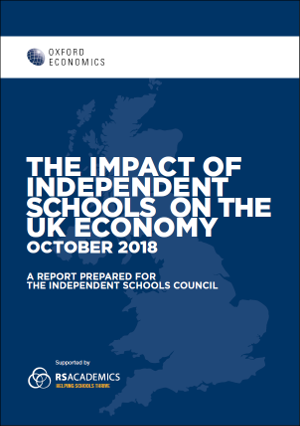
Independent schools support £13.7 billion of UK GDP annually, associated with over 300,000 jobs and £4.1 billion of yearly tax revenues. They help the exchequer further by providing an alternative to state-funded education, and boost the economy’s long-term productive potential by improving educational outcomes.
In total, around 620,000 school pupils – some six percent of the national total – attend independent as opposed to state schools in the UK. Taking into account associated ‘indirect’ (supply chain) and ‘induced’ (wage-funded spending) impacts, these schools’ activities support £13.7 billion of GDP, 300,000 jobs, and £4.1 billion of taxation, via their impact on demand. The also save the UK taxpayer £3.5 billion per annum, as 530,000 of these pupils would otherwise be eligible for a state-funded school place. The schools also make a positive contribution to the economy’s supply-side.
As the sector’s educational outcomes are above-average, we estimate that they could boost the UK’s long-term growth rate by around 0.07% per annum, taking into account OECD research. As this growth shortfall is compounded year-on-year, the impact on annual GDP could be quite marked after several decades.
Our economic consulting team are world leaders in quantitative economic analysis, working with clients around the globe and across sectors to build models, forecast markets and evaluate interventions using state-of-the art techniques. Lead consultants on this project were:
Oxford Economics’ team is expert at applying advanced economictools that provide valuable insights into today’s most pressing business, financial,and policy issues.
To find out more about our capabilities, contact:
EMEA
Sam Moore
+44 (0)207 803 1415
Email
Americas
Hamilton Galloway
+1 (646) 503 3068
Email
Asia
Peter Suomi
+65 6829 7198
Email
Related Services
Post
Socioeconomic Impact of DP World in Senegal
Oxford Economics Africa conducted a socioeconomic impact assessment of DP World Dakar covering 2022–2024. We assessed DP World’s operations in Senegal, quantifying its economic footprint, the activity supported through trade facilitation and evaluating social and environmental outcomes, while mapping how value is created for key stakeholders: employees, customers, suppliers, partners, and communities.
Find Out More
Post
From Farm to Table: The Philippine Agri-Food Economy in 2025 and the Road to Competitiveness
This report assesses the Philippines’ agri-food system, from agricultural production and food and beverage (F&B) manufacturing, to the wholesale, retail, and hospitality distribution networks that bring F&B to market. We quantify the economic contribution of the local agri-food sector, document the challenges faced by Philippine agri-businesses due to the tightening operating environment and shifting trade patterns, and outline a practical path to navigate these headwinds.
Find Out More
Post
Economic benefits quantum computing can bring to Sussex and Greater Brighton
This report focuses on the quantum computing sector in Sussex and Greater Brighton, and its potential contribution to the South East and wider UK economy.
Find Out More