OE Logo
Research Briefing | May 24, 2021

India | Slow vaccination to prolong lockdowns, lower growth
Ipad Frame (41)

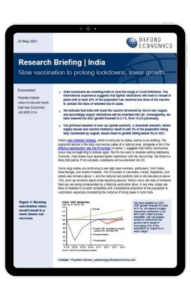
India’s new lockdown strategy, which is being led by states, seems to be working. The sustained decline in the daily coronavirus cases at a national level, alongside a fall in the effective reproduction rate, suggests that India’s coronavirus curve may be beginning to plateau again. But it’s too early to consider exiting lockdowns. Currently, most states have decreed tighter restrictions until the end of May. We think it is likely that partial, if not complete, lockdowns will be extended into Q3.

Read more

Research Briefing | May 24, 2021

India | Slow vaccination to prolong lockdowns, lower growth

Ipad Frame (41)

India’s new lockdown strategy, which is being led by states, seems to be working. The sustained decline in the daily coronavirus cases at a national level, alongside a fall in the effective reproduction rate, suggests that India’s coronavirus curve may be beginning to plateau again. But it’s too early to consider exiting lockdowns. Currently, most states have decreed tighter restrictions until the end of May. We think it is likely that partial, if not complete, lockdowns will be extended into Q3.

Read more

Research Briefing | May 24, 2021

Australia | Alternate recovery paths shaped by key risks

Copy of Ipad Frame (23)

Vaccine programs across the world are well underway and should enable  a sustained and meaningful easing of restrictions in mid-2021. But as we have seen in Australia, vaccine rollouts have not been immune to supply disruptions and efficacy concerns, which are threatening to keep international borders restricted for longer. Using our Global Economic Model, we consider three alternate recovery scenarios.

Read more

Ungated Post|22 May 2021

Trusted. Travel. News: Eye on Travel

Scott Livermore
Scott Livermore
Chief Economist & Managing Director
Trusted. Travel. News: Eye on Travel

Scott Livermore Chief Economist of Oxford Economics Middle East, speaks about how the UAE and Israel are leading the Middle East in terms of reopening to travel with high vaccination rates. He also talks about  the importance of governments employing the right policies regarding COVID-19 in order to instill confidence to get people traveling once again.

He then discusses the economic impact that reopening could have on people that have been saving their money thanks to government programs that kept them employed and are now ready to travel and spend money once again. He also believes that the countries that were hit the hardest will recover the best as they have the most to gain. 

Read more

Research Briefing | May 21, 2021

Sweden | Country Economic Forecast May

Ipad Frame (2)-May-24-2021-02-49-11-64-PM

The Swedish economy grew by 1.1% in Q1 according to the flash estimate, the best performance in western Europe. Monthly indicators show that this was driven by household consumption, which rose 3.1% q/q, and private sector output, up by 1.4%.

Read more

Research Briefing | May 21, 2021

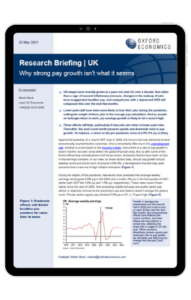
UK | Why strong pay growth isn’t what it seems

Ipad Frame (1)-May-24-2021-02-36-01-23-PM

UK wages have recently grown at a pace not seen for over a decade. But rather than a sign of nascent inflationary pressure, changes in the makeup of jobs have exaggerated headline pay, and comparisons with a depressed 2020 will compound this over the next few months.
Lower-paid staff have been more likely to lose their jobs during the pandemic, cutting the weight of these jobs in the average pay calculation. And as people on furlough return to work, y/y earnings growth is likely to hit a record high.

What you will learn about:

  • Pandemic effects will distort headline pay numbers for some time to come
  • The post-Covid world presents upside and downside risks to pay growth.
  • The post-Covid world could see some slight reversal of the power imbalance between employers and their employees

Read more

Research Briefing | May 21, 2021

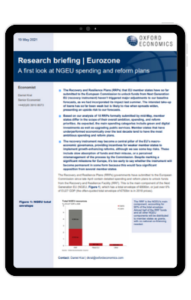
Eurozone | A first look at NGEU spending and reform plans

Ipad Frame - Eurozone - A first look at NGEU spending and reform plans

The Recovery and Resilience Plans (RRPs) that EU member states have so far submitted to the European Commission to unlock funds from Next Generation EU (recovery instrument) haven’t triggered major adjustments to our baseline forecasts, as we had incorporated its impact last summer. The intended take-up of loans has so far been weak but is likely to rise when spreads widen, presenting an upside risk to our forecasts.

Read more

Cape Town
Blog|21 May 2021

Increased digitisation could exacerbate inequality in Southern Africa

Increased digitisation could exacerbate inequality in Southern Africa

The imposition of lockdown regulations to prevent the spread of Covid-19 forced millions of people across the globe to work from home. The transition was far smoother for “knowledge workers” (employees who sell their intellectual labour) than those who sell their manual labour. The shift was also obviously easier for those who have internet access: Only an average of 28% of national populations have internet access in Southern Africa, which is well below the world average of 51%, according to the United Nations International Telecommunication Union (ITU).

Read more

Research Briefing | May 21, 2021

US | Recovery Tracker gave back some gains in early May

Ipad Frame (40)

The US Recovery Tracker fell 0.5ppts to 91.1 in the week ending May 7, the second decline in three weeks. With four of the six subcomponents dropping, we believe this illustrates the bumpy road to a full recovery. Encouraging health conditions, warmer weather, and healthy household finances should power a historic summer boom.

Read more

an old building and streamers showing a mexican flag
Research Briefing | May 20, 2021

Recovery Tracker showed largest gain so far this year

Recovery Tracker showed largest gain so far this year - iPad

Our Latin America Recovery Tracker (LART) climbed 3.4pts during the week ending May 14, the largest weekly gain since last September. All countries experienced large improvements amid eased restrictions after the third wave slowed

Read more

Research Briefing | May 20, 2021

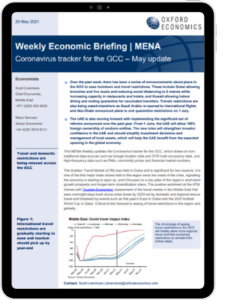
MENA | Coronavirus tracker for the GCC – May update

Coronavirus tracker for the GCC – May update

Over the past week, there has been a series of announcements about plans in the GCC to ease lockdown and travel restrictions. These include Dubai allowing brunches and live music and reducing social distancing to 2 metres while increasing capacity in restaurants and hotels, and Kuwait allowing indoor dining and ending quarantine for vaccinated travellers. Travels restrictions are also being eased elsewhere as Saudi Arabia re-opened to international flights and Abu Dhabi announced plans to end quarantine restrictions on 1 July.

Read more

Podcast|20 May 2021

The Future of Australian Infrastructure: Utilising infrastructure stimulus

The Future of Australian Infrastructure: Utilising infrastructure stimulus

The current investment in Australian infrastructure is barely keeping pace with demand. To meet future demand we will need to invest more but also, crucially, build and operate major assets more efficiently.

Transport accounts for an incredible 50% of all the infrastructure engineering construction work done in Australia. Over the past 30 years we have added over 100,000 km of roads to our network and more than doubled the annual spend on rail. We are travelling more and unfortunately spending relatively more time doing so.

What will the infrastructure that is funded, designed and built in 20 years’ time look like? We interview industry heavyweights to provide their views in our Future of Infrastructure video series.
 
Utilising Infrastructure Stimulus 


Interview with Adrian Hart, Associate Director, BIS Oxford Economics by MinterEllison.

Part 3: Adrian shares his view on what needs to be in place for Australia to make the most of the infrastructure stimulus.

Read more

In partnership with SIA, Oxford Economics has quantified the economic contribution of the U.S. semiconductor industry by using an economic impact analysis at the national level in the U.S. This technique highlights the importance of the semiconductor industry to the U.S. economy in terms of jobs, wages, and GDP.

Blog|19 May 2021

Why critics of President Biden’s American Rescue Plan are getting it wrong

Why critics of President Biden’s American Rescue Plan are getting it wrong

With the American Rescue Plan, US President Biden is implementing a stimulus program of historic proportions. Coming on top of the highest debt-to-GDP ratio the US has ever seen, this is raising fears that the government could be spending too much, entailing more negative than positive consequences. Even economists that had, until now, very prominently called for increases in public spending seem to be intimidated by the magnitudes of money now involved (most notably former Treasury Secretary Larry Summers and former IMF Chief Economist Olivier Blanchard).

Read more

Solar panel
Research Briefing | May 19, 2021

The Sustainable Supply Chain Paradox

The Sustainable Supply Chain Paradox - report

In the early months of 2021, Oxford Economics, in partnership with SAP, surveyed 1,000 supply-chain executives globally. Our goal was to identify necessary measures to pivot toward greener supply chains, while balancing the need for Covid recovery and growth. Discussing topics such as visibility, technology, and balance, we’ve found main issues and solutions.

Read more

Research Briefing | May 19, 2021

Canada | Recovery Tracker ends a cruel April on a hopeful note

Canada Recovery Tracker ends a cruel April on a hopeful note - iPad

The Canada Recovery Tracker (CRT) edged up 0.3ppts to 86 in the week ended April 30 as increases in six of seven subcomponents led to the first gain in six weeks. Despite falling 5.2% in April, the CRT ended the month with some upward momentum. The health index has now improved in back-to-back weeks, and the recent drop in the reproductive rate below 1, along with continued progress on vaccinations, should support further gains on the health front in May-June. We remain hopeful that a better health situation will allow for restrictions to ease and economic activity to accelerate in H2 2021.

Read more

Research Briefing | May 19, 2021

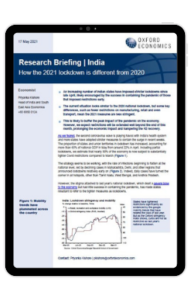
India | How the 2021 lockdown is different from 2020

Ipad Frame (34)

As we feared, the second coronavirus wave is playing havoc with India’s health system and more states have adopted stricter measures to contain the surge in recent weeks. The proportion of states and union territories in lockdown has increased, accounting for more than 65% of national GDP in May from around 22% in April. Including partial lockdowns, we estimate that nearly 80% of the economy is now subject to substantially tighter Covid restrictions compared to March.

Read more

Podcast|19 May 2021

The Future of Australian Infrastructure: Australia’s Global Competitiveness

The Future of Australian Infrastructure: Australia’s Global Competitiveness

The current investment in Australian infrastructure is barely keeping pace with demand. To meet future demand we will need to invest more but also, crucially, build and operate major assets more efficiently.

Transport accounts for an incredible 50% of all the infrastructure engineering construction work done in Australia. Over the past 30 years we have added over 100,000 km of roads to our network and more than doubled the annual spend on rail. We are travelling more and unfortunately spending relatively more time doing so.

What will the infrastructure that is funded, designed and built in 20 years’ time look like? We interview industry heavyweights to provide their views in our Future of Infrastructure video series.


Interview with Adrian Hart, Associate Director, BIS Oxford Economics by MinterEllison.

Part 2: Adrian discusses the global competitiveness of Australia’s infrastructure market, particularly compared to the mature markets of APAC and Europe.

Read more

Research Briefing | May 18, 2021

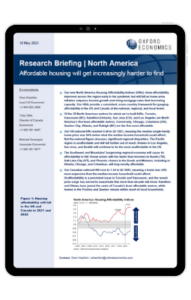
North America | Affordable housing will get increasingly harder to find

Ipad Frame (1)-May-18-2021-03-29-26-02-PM

Our new North America Housing Affordability Indices (HAIs) show affordability improved across the region early in the pandemic but will fall as home price inflation outpaces income growth and rising mortgage rates limit borrowing capacity. Our HAIs provide a consistent, cross-country framework for gauging affordability in the US and Canada at the national, regional, and local levels.

What you will learn in this comprehensive 4 page report:

  • Housing affordability will fall in the US and Canada in 2021 and 2022
  • Housing demand is meaningfully outpacing the stock of homes for sale
  • Housing is least affordable in Vancouver, Toronto, and several US West Coast metros

Read more

Oxford Economics surveyed 3,000 global business executives during the global pandemic of 2020 about how internal and external business operations are evolving.

Research Briefing | May 18, 2021

Global Coronavirus Watch: Time for a re-think on inflation?

We think that recent inflation surprises are not evidence of a regime shift in price-setting behaviour. But the path for inflation over the next few months is highly uncertain and depends on several difficult-to-predict factors, ensuring that every development will be intensely scrutinised.

Read more