OE Logo

Sustainability is a multifaceted challenge, shrouded in complexity. It can make navigating the complex landscape of sustainability daunting, with organisations often struggling to understand their unique challenges and find effective solutions or meet their reporting and disclosure requirements. Why, are companies struggling, even though 97% of businesses consider sustainability a top priority?

Taxes

New tax operating models in the last five years delivered value to businesses, our survey shows. The next five years will add even more.

Electric vehicle wind turbine

Price forecasts for lithium, cobalt price and palladium are now added to our Global Climate Service. This valuable enhancement will enable you to more effectively monitor commodity prices, particularly in the context of the ongoing energy transition.

Map Africa

Mastering the appropriate skills will become increasingly important as the global economy evolves to a more sophisticated, interconnected and digital landscape. Africa currently underperforms on a number of human capital measures, and runs the risk of falling further behind if decisive and effective action is not taken.

Two people discussion on construction measures
Research Briefing | Mar 1, 2023

Untangling the different construction measures
Untangling the different construction measures 
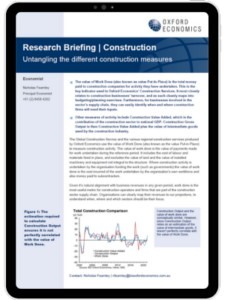
The value of Work Done (also known as value Put-In-Place) is the total money paid to construction companies for activity they have undertaken. This is the key indicator used in Oxford Economics’ Construction Services. It most closely relates to construction businesses’ turnover, and as such cleanly maps into budgeting/planning exercises. Furthermore, for businesses involved in the sector’s supply chain, they can easily identify when and where construction firms will need their inputs.

Read more

Research Briefing | Mar 1, 2023

Untangling the different construction measures

Untangling the different construction measures 
The value of Work Done (also known as value Put-In-Place) is the total money paid to construction companies for activity they have undertaken. This is the key indicator used in Oxford Economics’ Construction Services. It most closely relates to construction businesses’ turnover, and as such cleanly maps into budgeting/planning exercises. Furthermore, for businesses involved in the sector’s supply chain, they can easily identify when and where construction firms will need their inputs.

Read more

The global green economy

As each year passes, the climate emergency facing the planet becomes ever more alarming. But this trajectory is increasingly being met by the rapid emergence of new technologies and expertise that are focused on tackling it. As a result, we can now discern the emergence of a future green economy; one that harnesses human ingenuity to protect the planet’s future.  

Supply chain

Despite sluggish demand growth prospects, advanced economies (AEs) automotives production growth is forecast to accelerate in 2023 as easing supply chain disruptions allow producers to meet large order backlogs and bring inventories at dealerships back up to normal levels.

Following a hard winter, we expect the Nordic economies to rebound from mid-2023 as falling inflation turns real incomes positive, alleviating uncertainty, boosting confidence, and allowing central banks to end policy tightening.

Africa

Much of the economic weakness we are currently witnessing will likely spill over into 2023. African economies’ ability to deal with this weakness differs widely. Although global inflation should fall back sharply next year on the back of weaker commodity prices, slowing world growth, and easing supply chain constraints, we expect a somewhat slower pace of disinflation in Africa, owing in part to currency depreciation. Moreover, monetary conditions are likely to be challenging, with more monetary policy tightening anticipated.

Research Briefing | Dec 2, 2022

Global Scenarios Service: Housing Market Crash


Global economic prospects have deteriorated further. 

Since we published the Q3 Global Scenarios Service in August, we have reduced our baseline world GDP forecast for 2023 to 1.2% in 2023. A worse near -term outlook for Chinese GDP growth means that we now expect a technical global recession, with per capita GDP falling in both Q4 2022 and Q1 2023.

Read more

The MPC and OBR both judge that UK potential GDP has fallen outright since Q4 2019 and will register only meagre growth in the coming years.

Eurozone

The energy crisis will shape the macroeconomic outlook again in 2023, keeping the eurozone economy in recession at the start of the year and leading to a full-year contraction in GDP. We expect a gradual recovery once the energy emergency eases, as declining inflation should allow household real incomes recover. But energy rationing will be a key risk to the outlook if Europe fails to secure enough gas or adjust its demand ahead of the 2023 winter.

With negotiations extending into the weekend amid fears of a stalemate, COP27 delegates finally agreed to set up a fund to help pay for losses and damages brought on by climate change. This fund relieves the fiscal burden on poorer nations recovering from natural disasters.

This study examines whether silver should be viewed as a distinct asset class that warrants a strategic investment allocation within an efficient multi-asset portfolio.

CEE
Research Briefing | Sep 5, 2022

Why wage-price spirals will not persist in the CEE

The acceleration in nominal wage growth rates in Central and Eastern European (CEE) economies over the past couple of quarters has sparked growing fears of wage-price spirals taking hold in the region. We think such fears are overblown. That said, while we don’t expect the self reinforcing cycles of higher inflation and wage growth to persist, earnings growth is likely to remain elevated, keeping core inflation in the CEE higher for longer. Several factors mitigate the probability of wages keeping pace with – not to mention exceeding – inflation in the near-term.

Read more

Research Briefing | Sep 5, 2022

Why wage-price spirals will not persist in the CEE

The acceleration in nominal wage growth rates in Central and Eastern European (CEE) economies over the past couple of quarters has sparked growing fears of wage-price spirals taking hold in the region. We think such fears are overblown. That said, while we don’t expect the self reinforcing cycles of higher inflation and wage growth to persist, earnings growth is likely to remain elevated, keeping core inflation in the CEE higher for longer. Several factors mitigate the probability of wages keeping pace with – not to mention exceeding – inflation in the near-term.

Read more

MENA Region
Research Briefing | Aug 31, 2022

Fossil-fuel subsidies hinder the clean energy transition in the MENA

Inflation heats up in GCC but is less troubling than elsewhereThe MENA region is a key player in the energy sector as a large producer of oil and gas, but over time, it has also come to be a significant energy consumer. Growth and development in Middle East and North Africa (MENA) countries have fuelled an appetite for energy, much of it satisfied by oil and natural gas. This carbon-intensive mix has been enabled by low fossil-fuel energy prices thanks to generous government subsidies. Removing subsidies is politically challenging and difficult in a high-price fossil fuel environment. 

Read more

Research Briefing | Aug 31, 2022

Fossil-fuel subsidies hinder the clean energy transition in the MENA

Inflation heats up in GCC but is less troubling than elsewhereThe MENA region is a key player in the energy sector as a large producer of oil and gas, but over time, it has also come to be a significant energy consumer. Growth and development in Middle East and North Africa (MENA) countries have fuelled an appetite for energy, much of it satisfied by oil and natural gas. This carbon-intensive mix has been enabled by low fossil-fuel energy prices thanks to generous government subsidies. Removing subsidies is politically challenging and difficult in a high-price fossil fuel environment. 
Read more

Housing in Europe
Research Briefing | Aug 23, 2022

Owner-occupied housing costs to have disinflationary effect in the Eurozone

Owner-occupied housing costs to have disinflationary effect in the EurozoneOur modelling suggests incorporating owner-occupied housing costs would lower eurozone headline inflation from Q3 2022 by 0.3ppts, with negative contributions persisting into 2023. Owner-occupied housing costs (OOH) are excluded from the eurozone’s key inflation measure (HICP), but one of the ECB’s flagship measures from last year’s strategy review was to better account for them when setting monetary policy.

Read more

Grain
Research Briefing | Aug 22, 2022

Analysing the likely effects of the Istanbul grain deal

Ipad Frame instanbul

If successful, the Turkey-brokered deal between Russia and Ukraine to unblock Ukraine’s ports and facilitate grain exports would be highly beneficial for the Ukrainian and global economies. However, numerous risks – both political and operational – may jeopardise the success of this deal in the medium term.

Read more

gas pipeline
Research Briefing | Aug 18, 2022

Power of Siberia 2 is no replacement for pipelines to Europe

Power of Siberia 2 is no replacement for pipelines to EuropeAfter the West and its allies imposed sanctions on Russia for invading Ukraine, President Putin announced a radical rehaul of the country’s development strategy, with a pivot towards Asia. For now, though, Russia is stuck with a gas pipeline system built to supply Europe. If a resolution to the European gas crisis is not reached, then a lot of Russian gas may remain in the ground.

Read more

drought
Research Briefing | Aug 18, 2022

Understanding Africa’s climate risks

climate change africaWe have expanded our climate transmission channels on the Global Economic Model to include more sub-Saharan African economies. Through scenario analysis, we can better understand the climate risks faced by Botswana, Ghana, Kenya, Mauritius, Mozambique, Nigeria, Tanzania, Uganda, and Zambia.

Read more