


Global Economic Model
The world’s most comprehensive model for economic forecasting and scenario analysis.
Overview
In a world shaped by constant disruption, from trade tensions and energy shocks to the climate transition and AI adoption, organisations need to quantify uncertainty and plan for multiple possible futures.
The Global Economic Model (GEM) is the most widely used, transparent and trusted global forecasting and scenario tool available. Linking 87 economies, it enables you to simulate shocks, test assumptions and explore how risks ripple through the global economy and impact your business or investments.
Key features
The Global Economic Model combines extensive coverage, global linkages and an intuitive platform to enable robust forecasting, scenario modelling and decision-making.
Global coverage
Model 87 economies in detail, with the rest of the world covered in six regional blocks. The forecasts extend to 2060 and are updated twice monthly to reflect the latest developments.
Predefined and custom scenarios
Run ready-made scenarios or build your own by adjusting assumptions and simulating shocks across more than 70,000 variables.
Global Scenario Tool
Solve the model using alternative equations to quantify the implications of major top-down GDP shocks with options to determine the level of global spillovers.
World Economic Prospects report
Monthly overview of key forecast updates and macro developments to contextualise results.
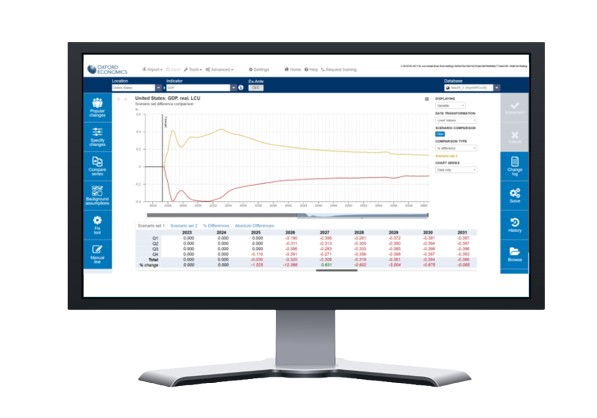
With over 40 years of development and testing, we continuously maintain and enhance our model, ensuring consistency, control, and analytical credibility.
Global linkages
Country models are linked through shared global assumptions on trade, prices, competitiveness, exchange and interest rates, as well as commodity markets, capturing the interdependencies of the global economy.
Flexible delivery and workflow integration
Access the model via a secure online platform, with an Excel plug-in and APIs that support automated analysis.
Intuitive software and visualisation
Flexibly adjust assumptions and export results through an intuitive interface, using clear, easy-to-read charts.
Automate model workflows
Solve scenarios and export data at the click of a button using our online model API or desktop command-line tool.
You can optionally link to our Global Industry Model to translate macroeconomic shocks into sector-level outcomes. Speak to us to learn more.
Why Oxford Economics?
Trusted by policymakers and regulators
Built on over four decades of global economic modelling, the Global Economic Model is used by central banks, finance ministries, international organisations, financial institutions, and corporates across the globe.
Real-world economic interlinkages
Our model links macroeconomic variables across 87 economies to reflect how economies interact. It captures the ripple effects of shocks, policy changes, and structural shifts, so that you can understand their full impact.
Transparent and auditable methodology
Fully documented model structure and assumptions support internal validation, audit processes, and regulatory review.
Dedicated support
Draw on the expertise of specialist and local teams worldwide, at every stage of the process.
What you can do with economic modelling
In an increasingly unpredictable world, economic modelling provides a structured way to quantify uncertainty, identify resilience, and assess vulnerability—not just for today, but for years to come.
Our clients use the Global Economic Model to:
Stress test economies under upside and downside scenarios
Assess how shocks such as interest rate changes, geopolitical disruptions, or commodity price volatility affect growth and financial conditions across countries in a consistent framework.
Example usage includes global recession scenarios modelled by the World Bank, China rebalancing analysis by the ECB, and research on China slowdown spillovers by the Reserve Bank of Australia.
Support long-term strategic planning
Evaluate how structural forces such as climate change, demographic shifts, automation, and trade realignment shape long-run growth trajectories. Identify emerging risks and opportunities to inform data-driven investment decisions, operational planning, and risk mitigation.
Our modelling has been used to assess how AI will change the world economy and how weaker demographics may impact the economy.
Assess policy impact
Quantify the effects of fiscal, monetary, and structural policy changes on growth, inflation, trade balances, and public finances, with robust, evidence-based insights.
Examples of applications include IW Köln assessing the impact of public investment on the German current account, the Italian Treasury comparing estimates of fiscal multipliers, and the WIFO evaluating the ECB’s crisis management.
Meet climate stress testing and regulatory requirements
Assess the economic effects of physical and transition risks through a dedicated damage function and electricity module, supporting climate scenario analysis.
For instance, the OECD has used our model to analyse the implications of climate change on growth.
Inform investment decisions
Model key financial market variables, including interest rates, bond yields, equity prices, and credit conditions, to support investment analysis and portfolio stress testing.
Example usage includes research conducted with the Investment Management Corporation of Ontario (IMCO) on the impact of persistent low interest rates and deglobalisation on asset prices and investment strategies.
Latest insights






Testimonials
“We rely on Oxford Economics’ data on a daily basis. We leverage their economic model to create tailored forecasts to underpin our macroeconomic analyses.”

We’ve been long-time subscribers of Oxford Economics’ macroeconomic services, which we use regularly as part of our global and sectoral analysis and forecasting toolkit. Their team consistently delivers high-quality, structured insights across major economies and long-term structural themes, which we find particularly valuable for both internal planning and strategic discussions.
Beyond the content, we’ve always appreciated the interaction with their analysts and the responsiveness of the commercial team, who understand our needs and make the most of the collaboration.
Oxford Economics remains a key partner in our effort to anticipate macroeconomic and geoeconomic shifts with rigour and perspective.

Request a demo
If you would like to find out more about our models, please fill in the form. A member of the team will be in touch with you as soon as possible.
By submitting this form you agree to be contacted by Oxford Economics about its products and services. We will never share your details with third parties, and you can unsubscribe at any time.
