
2026-27 Australian Budget review
A tightrope walk on budget night, balancing economic challenges with the case for broad tax reform.
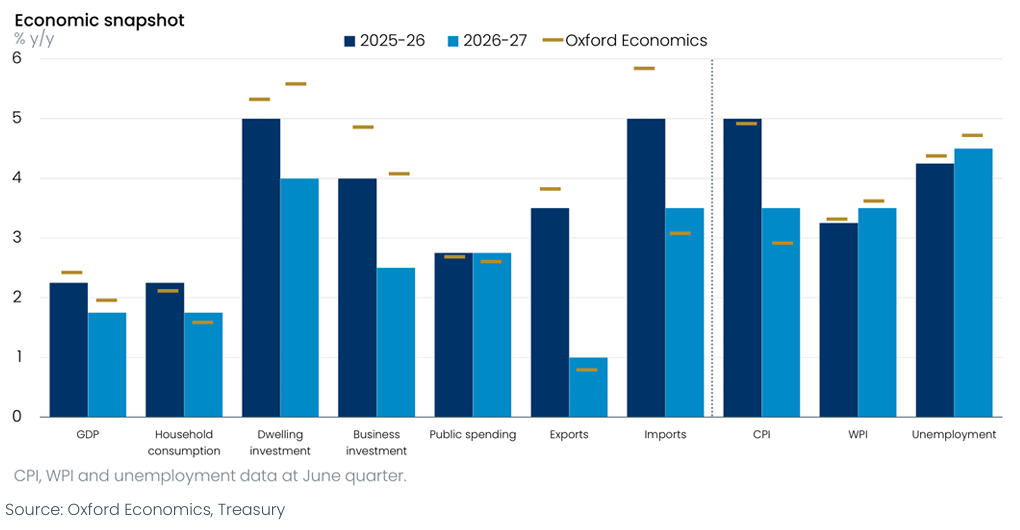
Treasurer Jim Chalmers walked a tightrope on budget night, outlining the challenges facing the economy while also making the case for broad tax reform. The timing is tricky. High oil prices are colliding with Australia’s already resurgent inflation. Interest rates have risen in response, dashing consumer and business confidence. Against the backdrop, the reform agenda is ambitious, even if we would have liked it to go further.
Surging inflation and commodity prices have meaningfully improved the budget’s bottom line. An underlying cash deficit of $28.3bn is expected this financial year, an $8.5bn improvement on Treasury’s MYEFO forecasts in December. That story continues over the forward estimates, with the economy handing the budget an extra $36.6bn in receipts through to 2029-30, driving the bulk of the $44.9bn improvements in cumulative underlying cash balance.
On the civil engineering construction front, the budget affirms our outlook for elevated engineering construction with $8.6bn over 10 years allocated for road and rail projects, including the Suburban Rail loop and work relating to the Westport development. Funding has also been allocated toward the development of the High-Speed Rail between Newcastle and Sydney, although we don’t expect construction until 2034-35.
The big-ticket housing item was the changes to capital gains tax (CGT) and negative gearing for existing dwellings, while there was continued, but modest, action on the supply side. There were a few new announcements for non-residential buildings, with the focus on locking in and topping up previously mooted funding for defence, public hospitals, and aged care.