

RESEARCH BRIEFING
13 May 2026
What the Middle East conflict has changed, and what it hasn’t
The US-Israel war with Iran reinforces a long-standing narrative but rewrites a few key chapters.
The US-Israel war with Iran reinforces a long-standing narrative but rewrites a few key chapters.
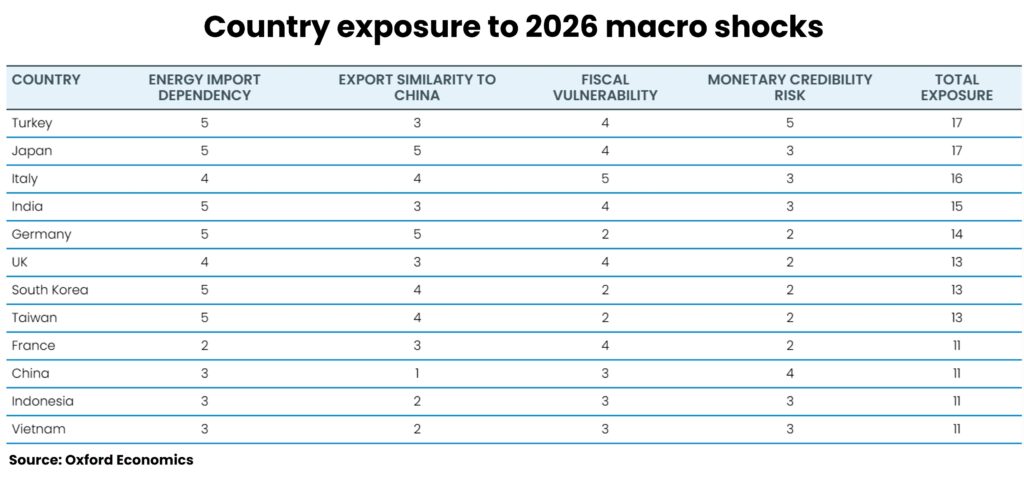
Country exposure is still highly differentiated across the four binding constraints of energy import dependence, fiscal space, monetary credibility, and export overlap with China. And the hierarchy matters: Turkey, Japan, Italy, and India look the most vulnerable; the US, Canada, and Australia appear best positioned. Although global fragmentation has intensified, the relative performance map across regions hasn’t, despite downward revisions to global GDP.
What you will learn:
- What has changed is the transmission of Chinese deflation and the emergence of AI supply-chain vulnerabilities tied to petrochemical inputs and energy-dependent fabs in Taiwan, South Korea, and Japan.
- The policy mix has also shifted, with a bigger fiscal impulse, more active central banks, and downside-skewed risks.
- Monetary policy now plays a slightly bigger role – the European Central Bank is expected to hike twice in 2026, the Federal Reserve will likely cut only once this year and once in early 2027, and the Bank of England is anticipated to hold with an elevated risk of hikes.
You might also be interested in
Tags:
