

Workforce pressures facing the food & grocery manufacturing sector
Oxford Economics Australia examines growing workforce gaps across five critical occupations, modelling supply and demand dynamics out to 2035 to help the industry and government plan ahead.
Background: Australia’s Food Supply Chain Is Under Workforce Pressure
Australia’s food and grocery manufacturing sector is a critical part of the national economy, employing tens of thousands of people across production, logistics, and management. The sector accounts for around 2% of total employment and is concentrated in labourer (28%) and technician and trades worker (17%) roles – occupational categories that are disproportionately exposed to workforce shortage conditions.
The Australian Food and Grocery Council (AFGC) commissioned Oxford Economics Australia to provide an independent, evidence-based assessment of workforce pressures across five occupations critical to sector operations, and to model workforce supply and demand dynamics out to 2035.
Challange: An Ageing Workforce and Retention Failures Are Driving Gaps That Will Intensify
The sector faces a structural problem that cannot be solved by short-term recruitment alone. Across five key occupations – food and drink factory workers, packers, forklift drivers, purchasing and supply logistics clerks, and manufacturing production managers – demand is projected to outpace supply over the coming decade. The challenge is not simply one of numbers: it is a compound problem of ageing, attrition, and leakage into other industries.
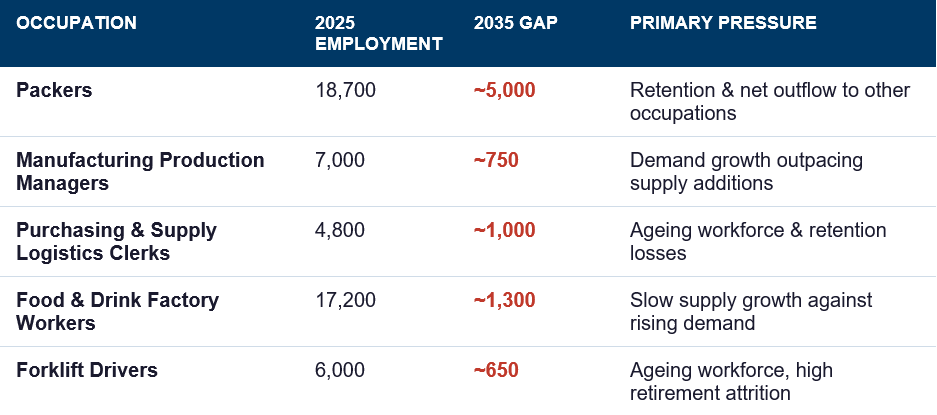
Across nearly all five roles, the older age structure of the current workforce is a primary driver of projected shortfalls. In some occupations, more than 40% of the current workforce is expected to leave within the decade through retirement-related attrition. For forklift drivers, that figure reaches 60% – around double the national average. New entrants through education and migration pipelines exist across most roles, but they are not sufficient to offset the compounding effects of retirements and the movement of workers into other industries.
The packers present the most acute risk. While new joiners continue to enter through education channels, around half of the 2025 workforce – approximately 9,100 workers – are expected to leave the occupation through net movements into other roles. Combined with attrition, this creates a projected gap of approximately 5,000 workers by 2035, despite relatively stable employment demand.
Solution: Oxford Economics Australia Delivered the Evidence Base for Workforce Policy Reform
Oxford Economics Australia developed a comprehensive, evidence-led analysis for AFGC to support discussions with government and stakeholders on workforce challenges and potential policy responses. The analysis combined occupational demand and supply modelling, labour market data, and scenario-based projections to quantify the scale and nature of workforce gaps across five key roles.
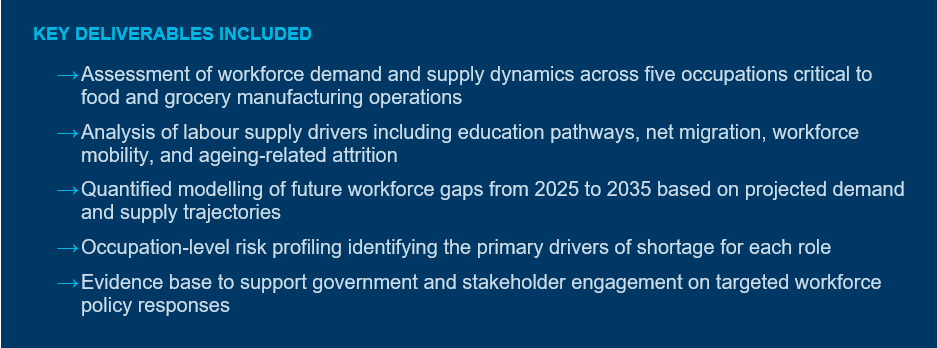
The result is a commercially significant evidence base that enables AFGC to engage government and industry stakeholders with rigorous economic analysis behind the policy ask – moving the conversation from anecdote to quantified risk.
The experts behind the research
-
 Emily Dabbs
Head of Macro Consulting, OE Australia
Emily leads Oxford Economics Australia's Macro Consulting team. She has over 10 years of economic analysis and consulting experience, focusing on macroeconomic forecast and analysis. Emily regularly provides strategy support and briefings, and presentations to clients and key stakeholders to support a broader understand of the economic environment and the impact on their business.
