
How the Iran war is hitting consumer spending worldwide
By William Spain
The Iran conflict is increasingly weighing on the global consumer. Rising energy and commodity prices, tighter financial conditions, and growing uncertainty are already squeezing household purchasing power and appetite, prompting us to cut our 2026 real consumer spending growth forecast.
While this would still represent growth, it marks a sharp slowdown from the robust post-pandemic consumer expansion seen in recent years. And the risks remain skewed to the downside.
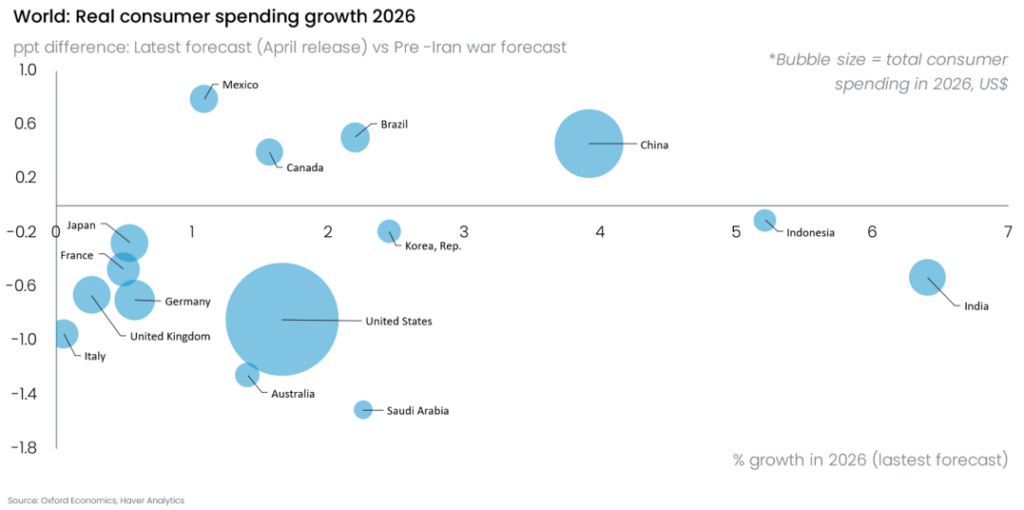
The primary driver is inflation. Higher oil and gas prices are feeding directly into household energy costs, from petrol to electricity, while also filtering through more gradually into food, goods, and services via higher transport and fertiliser costs.
Overall, we expect the drag on consumer spending growth to bottom out in the second half of this year before recovering gradually in 2027. But much depends on how long disruption in the Middle East persists.
How the Iran war could impact consumers
Higher inflation will squeeze purchasing power. The Iran war will dampen consumer spending in several ways, with the most immediate blow coming from higher inflation, which erodes households’ purchasing power. Consumers are already feeling the first-round impact of elevated oil and gas commodity prices through consumer energy prices, from petrol to electricity. Secondary effects, including rising costs for fertiliser and transport, will make their presence felt across food, other goods, and services, but filter through to consumers more gradually.
Tighter monetary policy will increase borrowing costs. Many central banks will look to learn from the lessons of the inflationary period of 2021-2023 and take pre-emptive action to combat rising prices. We now expect to see many central banks postpone planned rate cuts, with some opting to raise rates. This would tighten financial conditions further and increase borrowing costs for households.
Financial market volatility could hit affluent consumers. Although markets have so far avoided sustained declines, supply-driven energy shocks typically weigh on equities. This matters particularly in the US, where spending among higher-income households has been supported by strong asset market performance over recent years.
Consumers may choose to save rather than spend. Our expectation for most economies is that households will draw down savings in the near term to support consumption as purchasing power falls. However, there’s a risk that households will do the opposite — build up precautionary savings rather than spend. This risk will intensify the longer the conflict persists.
Lower-income households face the greatest pressure. The impact of the energy shock will also be uneven across income groups. Lower-income households spend a larger share of their income on essentials such as fuel and groceries, leaving them more exposed to rising prices. As a result, discretionary spending is likely to weaken first among lower-income consumers.
The Iran war’s impact on consumers will not be evenly distributed
The impact of the Iran war won’t be uniform across regions.
The Middle East has faced the most severe spending growth revisions, with geopolitical risk dragging several economies into recession this year. Asia Pacific is also acutely exposed due to its dependence on energy imports from Gulf countries, with rationing already underway in some markets. Europe faces similar but softer pressure. In the US, gasoline prices will put household incomes under pressure. Africa’s import-reliant economies remain vulnerable, whereas Latin America is the best insulated region.
We see risks as skewed toward a prolonged disruption. A prolonged conflict would severely amplify the downside risks to the global economy and trigger widespread turmoil. In a scenario we ran through our Global Economic Model, where we assumed oil prices would stay above $150 per barrel for four months alongside energy shortages, global inflation hit 7.7% and many advanced economies tipped into a recession.