
Concrete’s role in meeting housing and infrastructure demand to 2050
By Ryan Lee and Adrian Hart
Our new research for the Global Cement and Concrete Association (GCCA) explores how global megatrends are reshaping infrastructure demand and highlights the critical role of cement and concrete in supporting economic development, improving living standards and building a more sustainable future.
The world is entering a period of unprecedented demand for infrastructure and housing.
Our latest research forecasts that global construction activity will increase by more than 70% by 2050, reaching US$16.6 trillion annually, up from US$9.7 trillion in 2025. Emerging economies across Asia, Africa and the Middle East will be major engines of growth. Delivering these assets will create substantial opportunities across the construction industry.
However, infrastructure need does not automatically nor quickly translate into funded projects. Capacity constraints and financing pressures can slow delivery, while expanding materials supply requires capital and long lead times. This creates a difficult investment decision: committing too early risks underused capacity, while waiting too long can mean supply is unable to respond when projects proceed.
For investors, infrastructure owners and policymakers alike, this means that understanding when and where this growth will occur, and the barriers to delivering it, is essential to planning ahead and capturing the opportunity.
Five megatrends are reshaping global construction demand
The report identifies five interconnected forces that are driving the next generation of infrastructure investment.
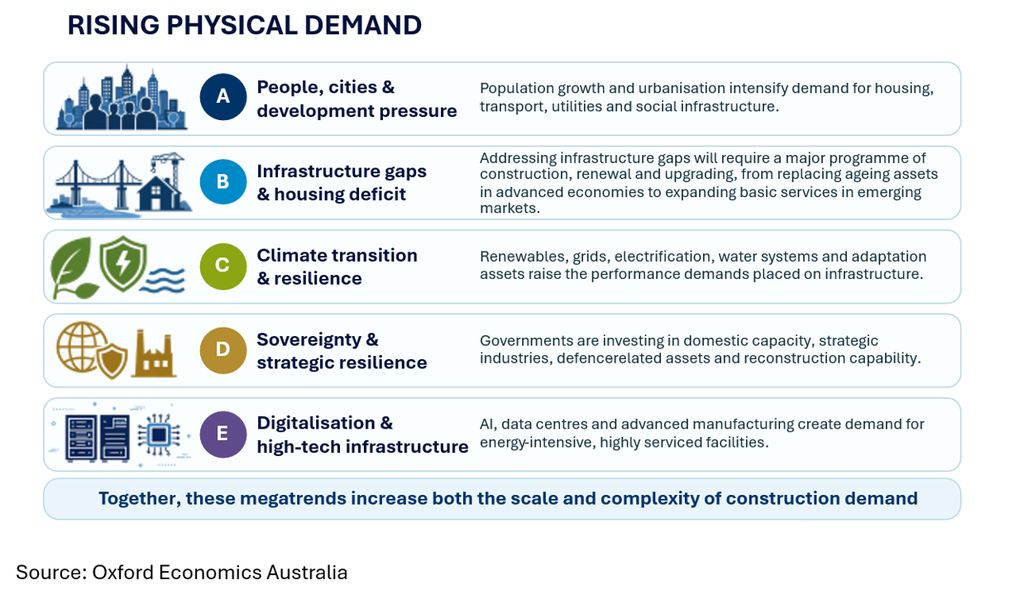
The practical implication is that companies need to understand which sectors will expand, how quickly projects can proceed and whether their capabilities match the work coming through. Policymakers and asset owners need to anticipate where competing demands will stretch delivery capacity.
Cement and concrete have a critical strategic role to play in the built environment
Cement and concrete sit at the centre of this outlook. Concrete’s durability, scalability and local availability make it essential to delivering the infrastructure underpinning modern economies.
Our research estimates that annual concrete demand from key infrastructure sectors will reach around 20 billion tonnes by 2050, demonstrating the scale of future opportunities for construction materials producers and suppliers. Transport sectors (roads, and rail and ports) stand out with faster demand growth than other sectors. Nevertheless, the utilities sector remains a large source of demand in absolute terms.
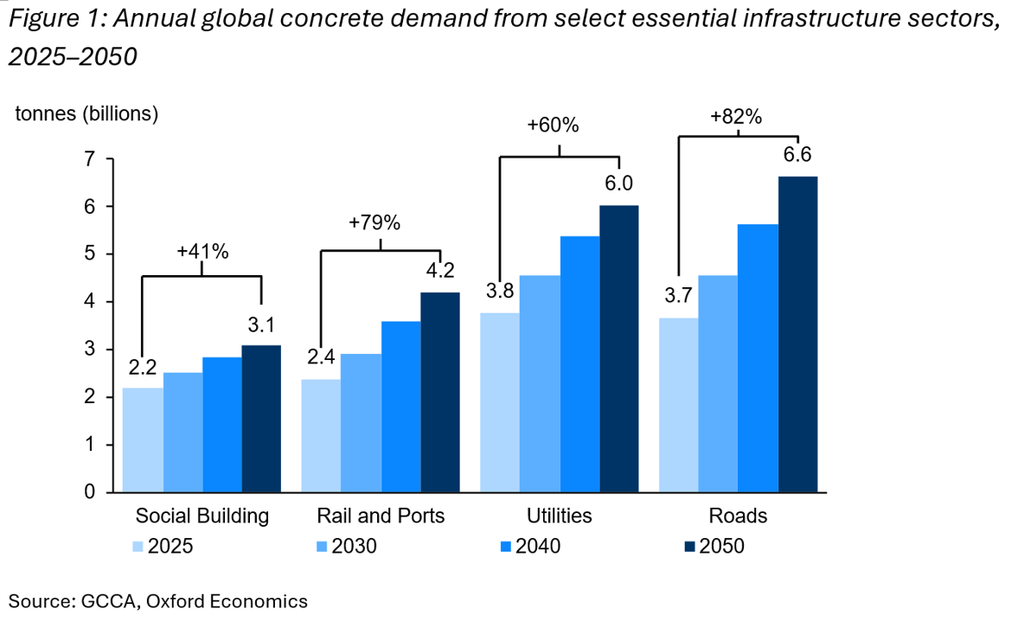
The report also highlights the important contributions the cement and concrete industry make beyond its physical applications. Importantly, these include its contributions to regional economic development and industrial capacity, as well as its crucial role in supporting the transition to a lower-carbon economy through resilience and whole-life asset performance.
Turning rising demand into sustainable delivery
The outlook presents a substantial opportunity, but meeting infrastructure needs will require more than expanding production. As the report details, growing infrastructure investment will need to meet increasingly demanding expectations for affordability, resilience and sustainability.
Innovation in materials, construction methods and circular economy practices will be essential in improving delivery. Clearer and more credible project pipelines and procurement arrangements can give suppliers greater confidence to invest. The opportunity is to deliver more infrastructure and economic value per tonne of concrete, per unit of carbon and per worker.
Understanding where demand is emerging, what could constrain delivery and how requirements are changing will help organisations make better decisions about the capacity, capabilities and assets needed over the coming decades.
The full Oxford Economics report exploring the global megatrends, economic evidence and strategic implications for infrastructure investment and the cement and concrete industry is available here. For the wider construction market outlook, explore our subscription-based Global Construction Service. For bespoke research tailored to your business needs, fill in the form on this page to contact our expert team.
You might also be interested in
The experts behind the research
-
 Adrian Hart
Head of Construction & Infrastructure Consulting, OE Australia
Adrian has over 23 years of economic analysis and consulting experience with Oxford Economics Australia, focusing on the infrastructure, building, maintenance and mining industries. Adrian has undertaken a wide range of consultancy projects for the public and private sector based on his detailed understanding of construction, mining and maintenance markets, their drivers and outlooks, the range of organisations operating in this space and the issues they face.
This work includes deeper industry liaison, contractor and competitive analysis, pipeline analysis, demand and cost escalation forecasting, and industry capacity and capability projects for the public and private sector. He is the lead author of major reports but also undertakes briefings and workshops for senior management, board members and industry associations, leads in-depth stakeholder consultation, and facilitates and chairs roundtables between government and industry.
-
 Ryan Lee
Economist, OE Australia
Ryan is an Economist currently responsible for supporting the production of the Asian Construction Service. He has experience in econometric modelling and consulting and holds a Bachelor's degree in Commerce and Economics (Honours), majoring in econometrics and finance.
