

Data centres: A construction boom meets an infrastructure constraint

Australia is entering a major data centre construction boom, with construction activity expected to rise sharply over the rest of the decade. But the scale of the announced pipeline is not a guarantee of delivery, as power, grid capacity, workforce and other constraints will determine which projects proceed, where and when. For investors, governments and the construction sector, the key question is increasingly how much of this pipeline will translate into real construction, infrastructure demand and economic activity.
Data centres are emerging as one of the largest sources of construction investment in Australia. Demand for cloud computing has been growing for more than a decade, but the rapid adoption of AI has pushed the sector into a new phase.
Oxford Economics Australia’s project tracking indicates that the current development cycle is still in its early stages, with around $5.3 billion in construction work done in FY26. By FY29, construction work done is expected to peak at around $14 billion (in constant 2023/24 prices — or over $18 billion in nominal prices) making data centres the largest non-residential building sector that year and the seventh-largest construction sector overall. That represents a rapid rise from 28th among construction sectors in FY23 and 18th in FY26. This outlook is underpinned by our project-level tracking, which follows developments from announcement and approval through to construction and completion.
Figure 1: Data centres will become the 7th largest construction sector by FY29
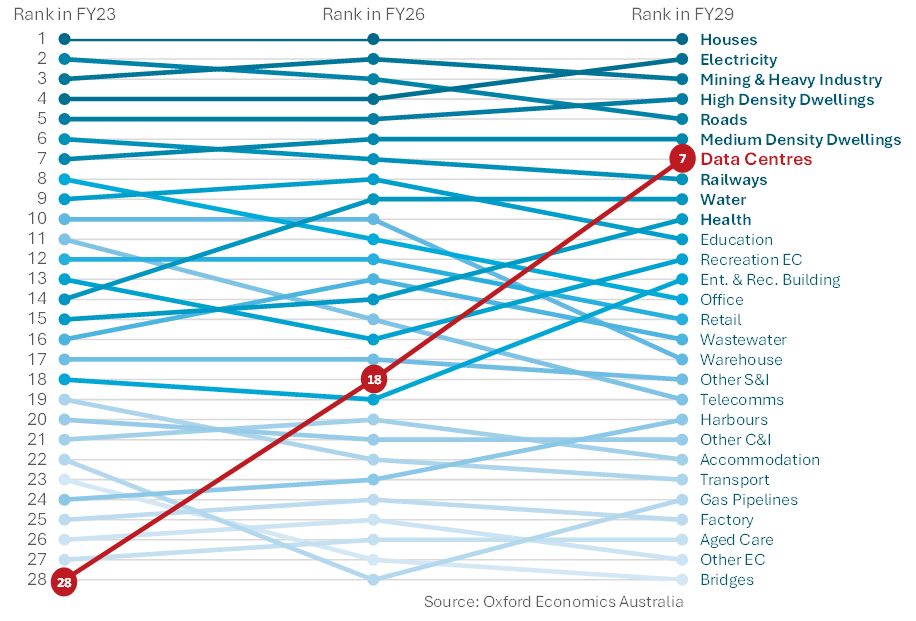
The scale of this construction boom has implications well beyond the building sector. The ranking chart also highlights the rapid expansion underway in electricity infrastructure, which rises from the fourth largest construction sector in FY26 to the second largest by FY29. Yet even with this investment, access to sufficient power and grid capacity remains one of the key constraints on data centre development. The key question is increasingly whether the infrastructure, workforce and resources required to deliver this pipeline can keep pace.
Power availability will increasingly shape where projects get built
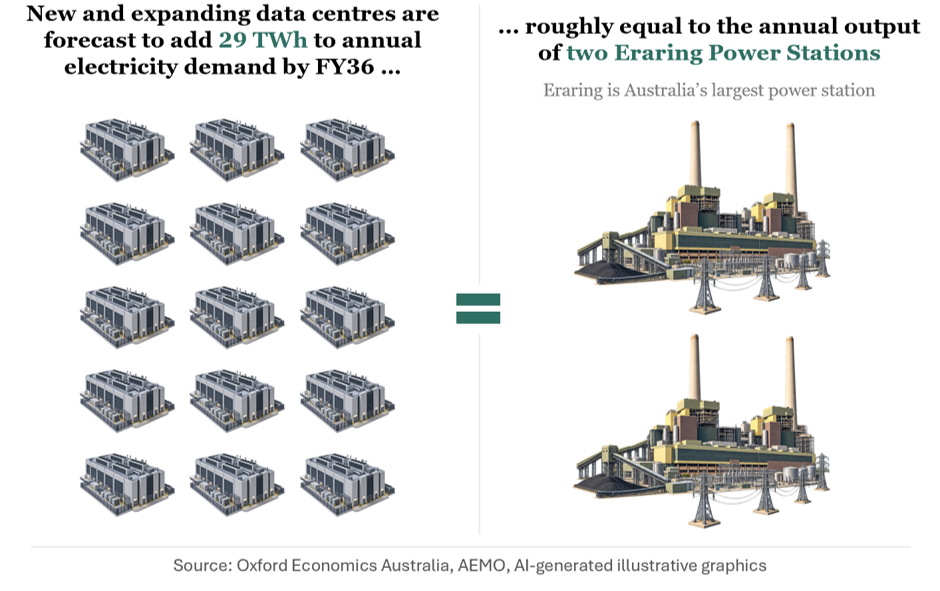
Data centres require large amounts of reliable electricity. Oxford Economics Australia and AEMO forecast national data centre electricity consumption to rise from around 5 TWh in FY26 to almost 34 TWh by FY36 under the central outlook. That would lift data centres from 2.8% to more than 13% of electricity consumption in the National Electricity Market. Power availability will therefore increasingly shape where projects are built and how quickly they can proceed.
Figure 2: Data centre electricity consumption to rise dramatically
Announced capacity is not the same as realised demand. Projects can be delayed, downsized or cancelled, while new facilities can take years to ramp towards mature loads. The underlying AI investment cycle is another source of uncertainty, as weaker-than-expected returns, tighter financing conditions or less capital-intensive computing could slow investment. The size of the announced pipeline therefore cannot be treated as a definitive forecast of either future construction activity or resource demand. Understanding what is likely to proceed, when it will be delivered and how quickly facilities will ramp up is critical to interpreting the outlook.
The infrastructure challenge extends beyond power
Power is the most visible constraint, but it is not the only one. Large concentrations of data centre investment will also compete for water, land, specialist equipment, construction labour and materials, potentially putting pressure on costs and delivery capacity. Governments and communities are also asking harder questions about who pays for supporting infrastructure and whether the economic benefits justify the resources required.
This means the locations with the largest announced pipelines will not necessarily see the most development. Translating project pipelines into demand for labour, plant, equipment and materials can identify where capacity constraints are likely to emerge, and where they may drive construction costs higher or delay projects.
Headline CAPEX is not the same as domestic economic value
The scale of investment also needs to be interpreted carefully. Much of the high-value IT equipment inside data centres is imported, so headline CAPEX can overstate the amount of activity retained within Australia.
The construction figures discussed above are also narrower than the broader measure of data centre investment, which includes servers, other IT equipment and land acquisition costs. On this broader measure, annual investment is expected to exceed $60 billion by the end of the decade. But that headline number should not be interpreted as an equivalent amount of Australian construction activity or domestic economic value.
The composition of investment will also change. Data centre buildings can remain in service for decades, while servers and other ICT equipment generally need to be replaced much more frequently. The current cycle is therefore particularly construction intensive. Over time, a greater share of investment will shift towards replacing servers and other technology. Long-term data centre CAPEX should not be read as an equivalent construction pipeline.
The wider opportunity spans construction, engineering, electricity infrastructure, but continues well beyond the initial development phase. Once operational, data centres generate ongoing demand for operations and servicing, facilities management, maintenance and equipment replacement, alongside opportunities across local supply chains and the digital services the facilities enable. Economic impact analysis can distinguish the headline investment number from the value that ultimately remains in Australia through jobs, supply chains, operations and wider economic activity.
The challenge is understanding what actually gets delivered
For investors, operators, utilities, governments, contractors and suppliers, the announced pipeline is only the starting point. The more important questions are which projects are likely to proceed, where constraints in power, grid capacity, water, workforce and construction markets will emerge, how changes in AI adoption, financing and technology could alter the outlook, and where the resulting economic value will ultimately be captured.
Answering these questions requires more than tracking announced capacity. Oxford Economics Australia brings together project-level intelligence, energy-demand modelling, construction-market analysis and economic-impact capabilities to assess the likely timing and delivery of projects, the infrastructure and construction requirements they create, and the economic opportunities that follow.
For organisations exposed to the sector, the opportunity therefore extends beyond the headline construction pipeline. What matters is the scale and timing of real construction activity, the infrastructure needed to support it, and the ongoing demand created through operations, servicing, maintenance and facilities management once these centres are built.
Request a free trial
Complete the form and we will contact you to set up your free trial. Please note that trials are only available for qualified users. We are committed to protecting your right to privacy and ensuring the privacy and security of your personal information. We will not share your personal information with other individuals or organisations without your permission.
