
Australia’s data centre boom: three lessons for capturing economic value

Oxford Economics forecasts data-centre investment in Australia will jump from under $10 billion per annum in 2025 to over $60 billion by 2030.
Input-output modelling can be used to assess the impact on the Australian economy, by tracing how expenditure flows, measuring the direct activity associated with a project and the indirect activity supported through its suppliers and their supply chains. Oxford Economics Input-Output modelling suggests data centre construction spending could contribute $65 billion to GDP and support over 350,000 job-years over FY26-FY30. But the headline numbers only tell part of the story. Three lessons emerge from looking at where the spending goes, who benefits, and what the infrastructure ultimately enables.
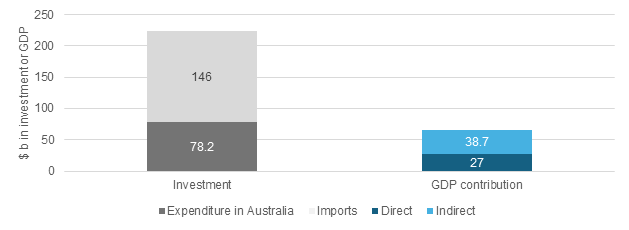
Figure 1 Economic impact of data centre construction ($ billion FY26-FY30)
Source: Oxford Economics
Lesson 1: Assess how much of the investment will be spent within Australia
Of the $224 billion in cumulative capex over FY26–FY30, only $78.2 billion (about 35%) is retained onshore. The other $146 billion leaks offshore. Including opex, about 38% of the $242 billion total spend stays in Australia.
The reason is the composition of spending. IT hardware (chips, servers, storage) is about half of the investment pipeline by 2030, and only 5-15% of it is expenditure in the Australian economy with the remainder imported. Power and cooling fit-out is also import-heavy, at 25-45% Australian. By contrast, the shell (70-80%) and site infrastructure (60-80%) are largely local, as are land, approvals, utilities and facility operations. Assessing a project’s economic contribution requires a breakdown of how much expenditure will occur within Australia and how much will flow overseas.
Lesson 2: The construction-related impact extends across geographies and the supply chain.
Much of the economic contribution from data centre investment occurs beyond the site itself. Our modelling suggests suppliers account for around 59% of the GDP contribution from capital expenditure, $38.7 billion of the $65.7 billion total, and around 65% of the 353,000 job-years supported over FY26–FY30.
During construction, demand flows through construction services, wholesale trade, engineering and professional services. Once facilities are operating, electricity networks, maintenance, cleaning and telecommunications benefit from recurring expenditure. Australian suppliers serving these markets operate in metropolitan and regional locations, creating opportunities for expenditure and employment beyond the cities hosting the major developments.
For developers, this makes local procurement and supplier development important considerations from the outset. For Australian businesses, it creates opportunities across a much wider range of industries. Understanding the timing and composition of the pipeline can help suppliers prepare their workforce and capacity to meet that demand.
Lesson 3: The longer-term prize is productivity and new Australian capabilities.
Building and operating data centres makes a substantial economic contribution, but that is only part of their potential value. Input-output modelling measures the activity supported by expenditure; it does not estimate the net economic benefit or the wider productivity gains enabled by the infrastructure.
The longer-term opportunity lies in how Australian businesses use that computing capacity. Applications in ore-body modelling, medical imaging and precision agriculture could improve productivity while creating Australian expertise, intellectual property and export opportunities. Australia could develop specialised models using local industry data, adapt existing open models for tasks such as mineral exploration or medical imaging, deploy smaller models on devices at remote mines and farms, and build secure models for sensitive government, defence and healthcare applications. Imported hardware and global AI models can support these gains, particularly when combined with local data and industry knowledge.
Realising this opportunity requires affordable access to compute, skilled workers, access to suitable data and pathways to commercialisation. For policymakers and developers, the task is to connect infrastructure investment with researchers, suppliers and businesses that can turn it into useful applications. Success should be measured through the capabilities and productivity improvements that grow around the facilities, alongside the investment and jobs supported by their construction.
You might also be interested in
Book a complimentary consultation with our economists