
Global diesel crunch sends cost pressures down the supply chain
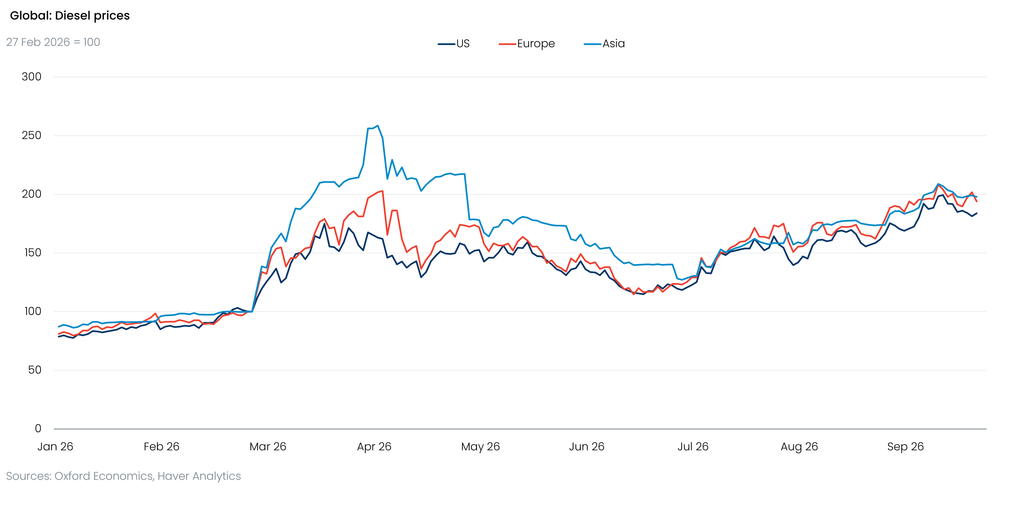
Global diesel markets have tightened sharply over the last month, with both US and European diesel prices hit record highs in mid-September, and Asian prices also rising sharply. Given diesel’s wide-ranging use across transport, construction, agriculture, and industry, the downstream impacts are likely to be large.
Chart 1: Diesel prices have doubled since the war began
Diesel shock ripples from transport through supply chains
At the industry level, the direct impact of the diesel shock is concentrated in a relatively narrow group of fuel-intensive activities. Table 1 shows that land and water transportation stand out as particularly exposed across the economies for which comparable data are available. Mining and agriculture also face significant exposure through diesel-powered machinery and off-road vehicles, while the direct burden is substantially smaller across most manufacturing and service industries.
The cross-country results show that sector exposure varies with a country’s economic structure. India’s land transport sector, for example, is very diesel-intensive, reflecting a reliance on diesel-powered road freight and relatively low fuel efficiency. Differences in transport networks, vehicle efficiency, production methods, and diesel-intensive activity therefore make the shock highly uneven both across industries and within the same industry across economies.
Table 1: Diesel shock hits transport hardest, but exposure varies (diesel use in ktoe per $bn of real gross output)
| Country | Land Transport | Water Transport | Agriculture, Forestry & fisheries | Construction | Metals, mining, quarry & related svs | food, beverages & tobacco | Non-metallic minerals |
| United States | 170.1 | 60.3 | 13.9 | 6.7 | 6.2 | 0.2 | 1.7 |
| Mexico | 103.7 | 472.8 | 45.3 | 1.4 | 5.5 | 0.8 | 0.3 |
| European Union | 240.4 | 7.8 | 33.3 | 3.0 | 16.0 | 0.5 | 2.1 |
| United Kingdom | 183.9 | 37.9 | 14.6 | 0.5 | – | 0.4 | 0.9 |
| China | 79.1 | 157.3 | 6.6 | 1.6 | 10.6 | 0.1 | 4.5 |
| Japan | 89.0 | 27.9 | 54.7 | 2.3 | 87.2 | 2.5 | 10.3 |
| South Korea | 155.7 | 3.6 | 11.4 | 2.7 | 1.2 | 0.0 | 0.1 |
| India | 477.7 | 221.5 | 17.3 | 0.7 | 27.2 | – | 5.5 |
Source: Oxford Economics, IEA; – = data unavailable
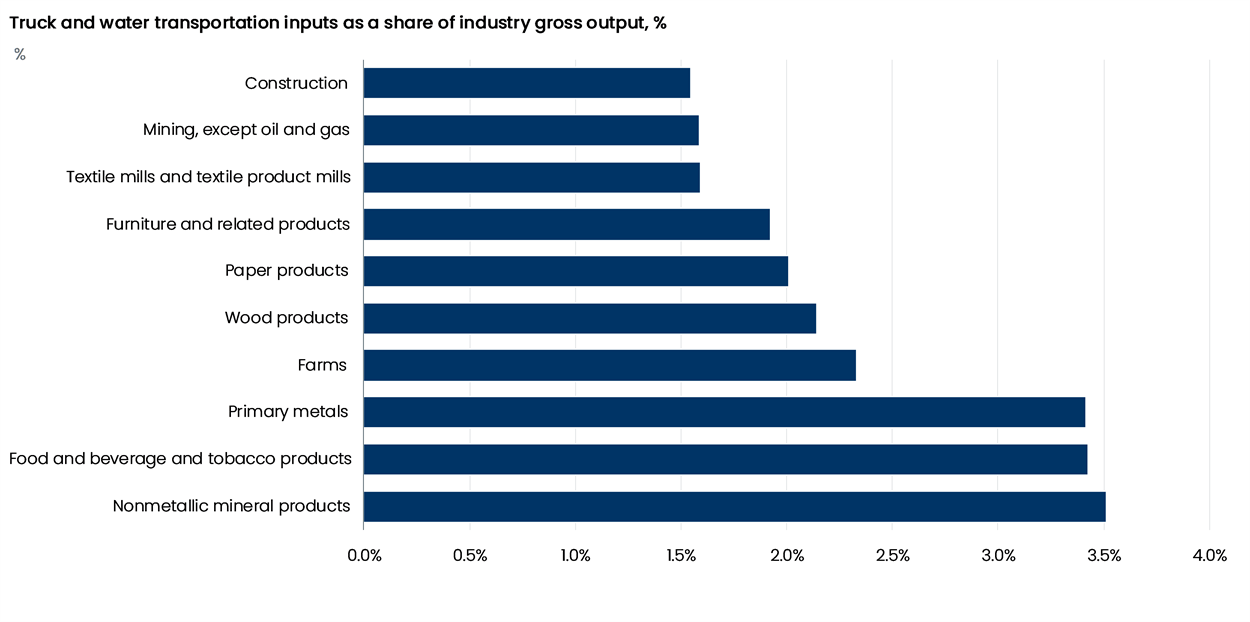
And the economic impact does not stop with industries that purchase diesel directly. Goods must be transported through supply chains to reach businesses and consumers, meaning higher diesel costs can spread across the economy as carriers pass them on through higher freight rates.
The precise scale of this indirect exposure will vary with each country’s transport mix and supply chain structure. Industries relying heavily on road freight will generally be more sensitive than those served by less diesel-intensive transport modes, while higher fuel costs build in long or fragmented supply chains before goods reach their final destination.
Chart 2: Higher freight costs leave heavy and frequently transported goods most exposed downstream
Sources: Oxford Economics, Bureau of Economic Analysis
Some industries are exposed through both channels. Agriculture and mining, for instance, combine direct reliance on diesel-powered machinery with substantial freight use, while food manufacturers and producers of heavy materials are more exposed through the indirect transportation channel. This distinction matters because the initial fuel shock does not necessarily remain with the industry that purchases the diesel, as part of the increase can instead be transferred to customers through higher freight and product prices.
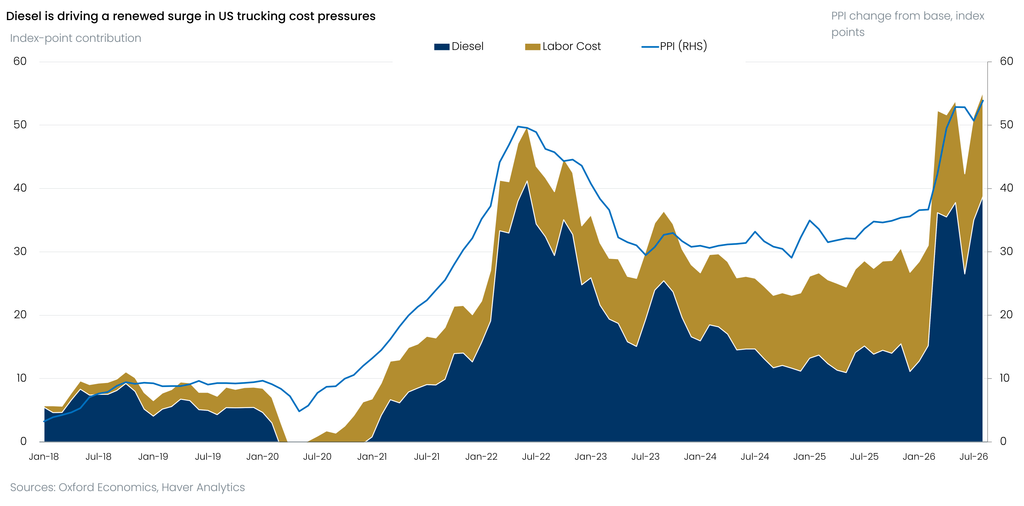
There are already signs that this transmission is taking place. Chart 3 shows a renewed surge in operating-cost pressures for US trucking in 2026, driven overwhelmingly by diesel, while freight trucking producer prices have also begun to rise. This suggests carriers are passing at least part of the fuel shock onto customers rather than absorbing it entirely through margins, shifting some of the burden toward the freight-intensive industries identified above.
Chart 3: Rising diesel costs are feeding through to US trucking prices
The effect on margins will depend on firms’ ability to pass higher diesel and freight costs downstream. This is determined by competitive pressures, contract timing, and pricing flexibility. Trucking firms face substantial direct exposure but can recover some costs from consumers through fuel surcharges and frequent repricing. Construction firms are less flexible in the near term, especially for projects contracted before prices increased. Farmers face similar pressure, as their limited pricing power in commodity markets leaves them unable to offset higher production costs.
The industries suffering the largest margin squeeze may therefore not be those consuming most diesel directly. Instead, the greatest pressure is likely where high direct or indirect exposure coincides with fixed-price contracts, weak demand, intense competition, or other constraints on firms’ ability to pass higher costs downstream.
Domestic supply can cushion shortages, but not global price shocks
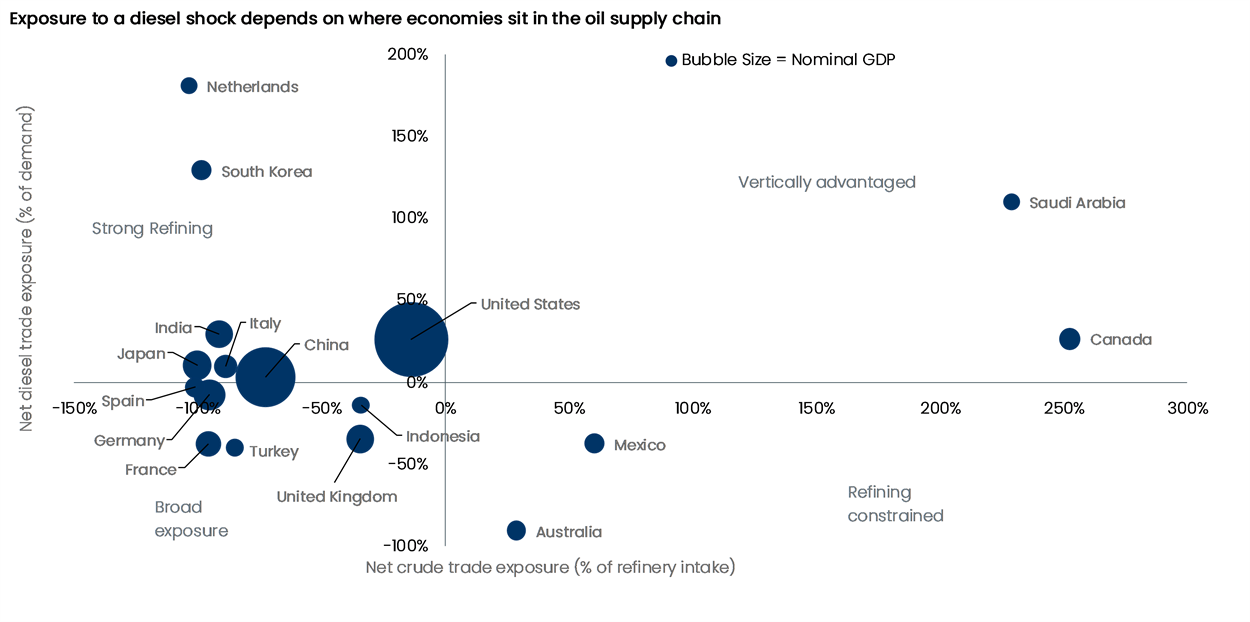
The size of the shock reaching these industries also differs across economies. Countries enter the disruption from different positions in the oil supply chain, depending on their domestic crude production, refining capacity, and reliance on imported refined products (Chart 4). Major crude producers with substantial domestic refining capacity, such as Saudi Arabia and Canada, are structurally better positioned to absorb a supply shock, while economies dependent on both imported crude and imported diesel face greater exposure.
Even so, domestic crude production provides less insulation from the price shock than it might initially appear. Indeed, unlike natural gas, where infrastructure constraints can create regional price fragmentation, crude oil and refined products trade in highly integrated global markets. A disruption to oil supply in one region propagates rapidly through international prices. Even large producers such as the US and Canada remain exposed to higher global crude and diesel prices despite having greater domestic supply security than major importers.
Refining capacity creates another important distinction. For example, the Netherlands, South Korea, and India operate large refining systems and are normally significant diesel exporters, despite relying heavily on imported crude. However, while this provides them with some protection against fuel shortages, it does not shield refiners nor domestic users from higher global feedstock costs. India has responded to the current disruption by sharply increasing duties on diesel exports, helping keep domestically refined barrels in the local market rather than allowing high international prices to pull more supply overseas.
The relevant distinction is therefore between physical supply vulnerability and price exposure. Domestic crude production and refining capacity can reduce the risk that an economy is unable to obtain fuel, but in a globally integrated oil market, they cannot fully insulate domestic businesses from an international price shock.
Chart 4: Crude supply and refining capacity determine economies’ vulnerability to the diesel shock
Sources: Oxford Economics, Joint Organizations Data Initiative (Jodi)
Request a free trial
Complete the form and we will contact you to set up your free trial. Please note that trials are only available for qualified users. We are committed to protecting your right to privacy and ensuring the privacy and security of your personal information. We will not share your personal information with other individuals or organisations without your permission.
