
Oil shock, interest rates and credit risk: What has changed for our IFRS 9 and CECL scenarios?

Q3 ended against a challenging backdrop. That is, further disruption to Middle East energy supplies, renewed increases in oil and refined-fuel prices, and a more hawkish turn from central banks across the world. With renewed attacks on Saudi energy infrastructure compounding existing constraints on regional exports, the outlook has deteriorated again just as many institutions are finalising their quarter-end expected credit loss calculations.
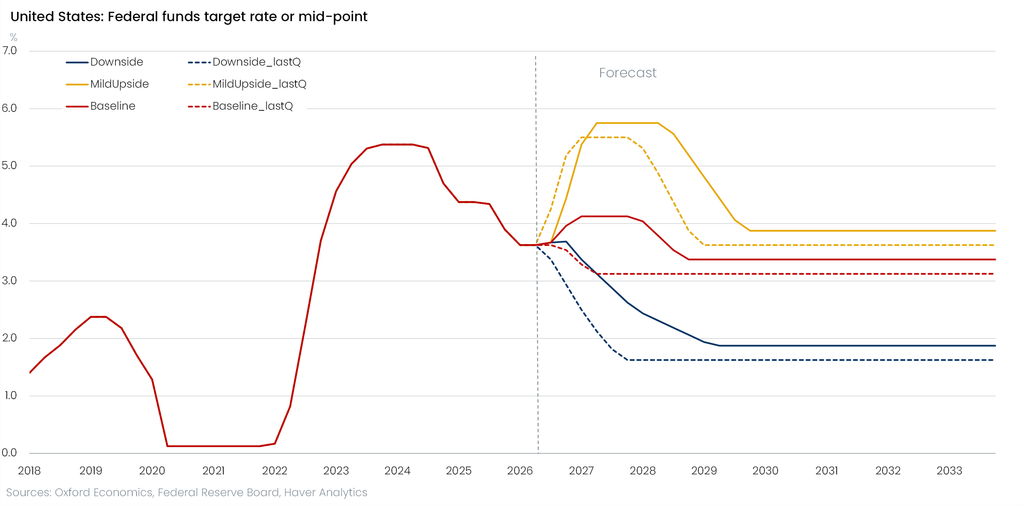
This matters because the shock does not stop at oil. Higher energy costs are feeding into inflationary dynamics, while bond yields and borrowing costs have risen further. In September, the US Fed unanimously voted to raise interest rates by 25bps to 3.75%-4%, its first increase since 2023. In our latest forecast, we expect a further hike later this year, with the energy shock also prompting a more hawkish response from several other major central banks. We do not, however, see this shift as the start of a prolonged global tightening cycle. Rather, the additional tightening acts as insurance against a temporary inflation shock proving more persistent. Even so, the balance of risks has shifted towards rates remaining somewhat higher for longer than we previously expected. Beyond the near-term policy response, we have also revised up our estimate of neutral interest rates, reflecting stronger investment associated with the AI buildout and the resulting increase in demand for capital.
So, what does this mean for banks and lenders? Higher energy prices and tighter financial conditions affect borrowers through several channels at once – from household purchasing power and corporate margins to debt-servicing costs and asset valuations. Capturing these complex interactions consistently is particularly important when macroeconomic conditions shift close to quarter-end and at a global scale.
Our Q3 IFRS 9 scenarios incorporate these latest developments both in the baseline and in the distribution of risks around it, while balancing responsiveness to changing economic conditions with stability across quarterly updates. We begin with our updated global forecast and the latest market pricing, before using our rigorous statistical methodology to generate a consistent range of upside and downside paths across economies and financial and economic variables. This statistical approach allows scenario severity to evolve as the outlook changes, without the need for subjective overlays to probability weights or requiring us to construct a new narrative around each emerging risk. When faced with these challenges, many other approaches to IFRS 9 scenarios have been found to be unsatisfactory as the global outlook has become more difficult to predict in recent years.
The renewed focus on inflation highlights the value of our approach. Before the pandemic, the challenge for many advanced economies was persistently weak inflation. Since then, higher inflation and policy rates have repeatedly resurfaced as prominent downside risks, although they have not been a constant source of concern. In fact, prior to the latest inflationary shock, attention had started to return towards how quickly inflation and interest rates would normalise. Rather than adapting our methodology to the most topical risk at any given moment, our distribution-driven approach focuses instead on the underlying relationship between demand, inflation and interest rates.
As a result, in our IFRS 9 scenarios inflation remains primarily demand driven. In a downside scenario, for example, weaker economic activity and rising unemployment reduce inflationary pressures, prompting central banks to adopt a more accommodative stance and cut policy rates. Lower policy rates do not necessarily signal less borrower stress, however. Measures such as insolvencies, write-off rates and debt burdens still deteriorate, capturing the combined effects of weaker incomes and employment, falling asset prices and tighter credit conditions.
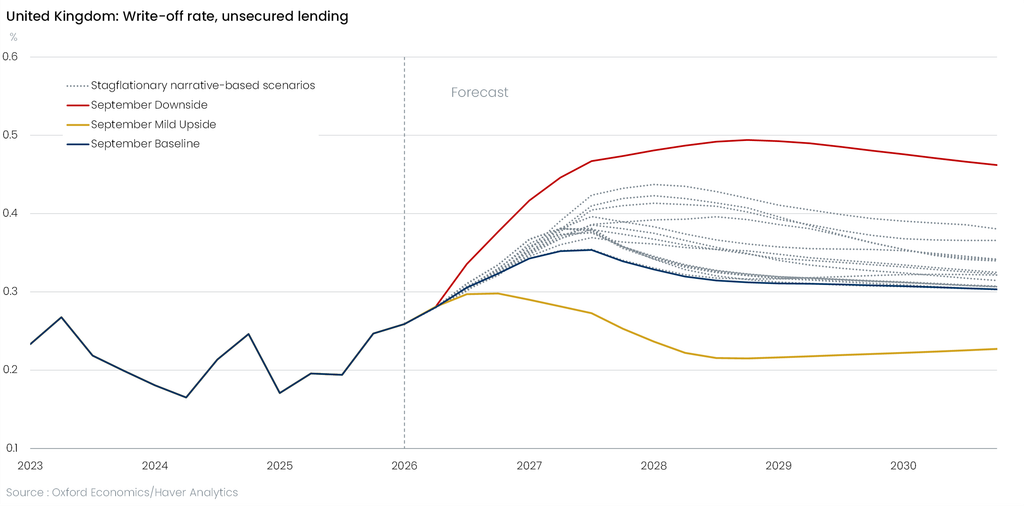
For clients that want to test a specific stagflationary or geopolitical scenario, our Global Scenarios Service provides a complementary approach, with scenarios built around topical narratives including our Sustained Disruption scenario. We can also develop bespoke scenarios for portfolio risk analysis, ICAAP and regulatory stress testing exercises.
Click here to learn more about our IFRS 9 service and here for our CECL service.
