
The top cities in Central Asia and the South Caucasus in 2026
By Swayam Tanna
Often overlooked in favour of the rapidly growing cities in China and India, and far from matching the economic might of those in North America and Europe, Central Asia and the South Caucasus rarely feature in discussions of the world’s leading city economies. Yet, a closer look at the region’s major cities in our 2026 Global Cities Index reveals strengths that should not be ignored, including impressive standings across Human Capital and Economics metrics.
An overlooked region with strengths that should not be ignored
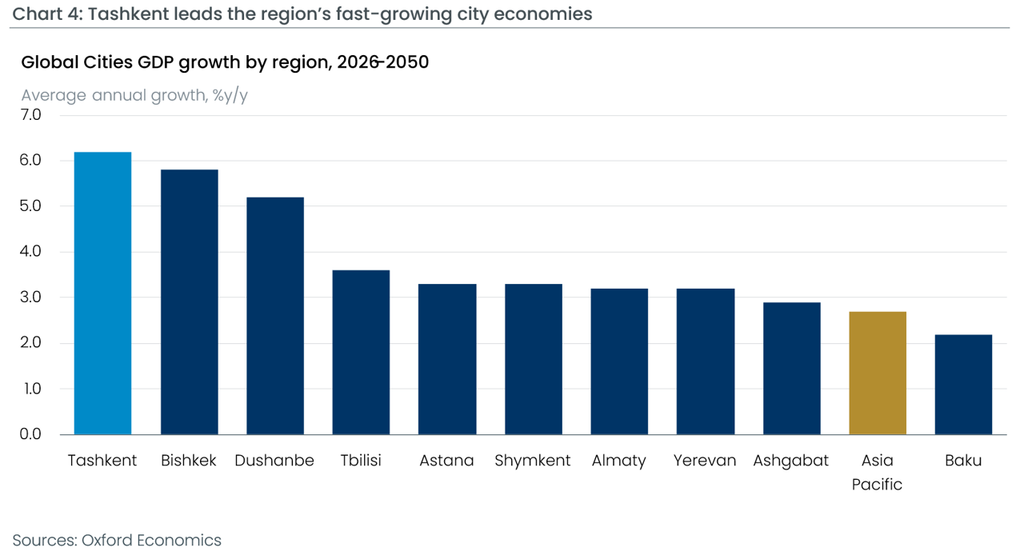
While rarely recognised as such, the major cities of Central Asia and the South Caucasus are among the most dynamic urban economies in the world. Over the next 25 years, we forecast real GDP growth across 10 of the region’s largest city economies to average 4.1% per year, well ahead of the 2.7% average across Asia Pacific’s cities. This growth is led by some of the fastest-expanding cities anywhere globally, with Tashkent (Uzbekistan) and Bishkek (Kyrgyzstan) both ranking among the top 10 of the 1,000 cities covered in our 2026 Global Cities Index. By 2050, we forecast the region’s combined city GDP to be more than two and a half times what it is today.
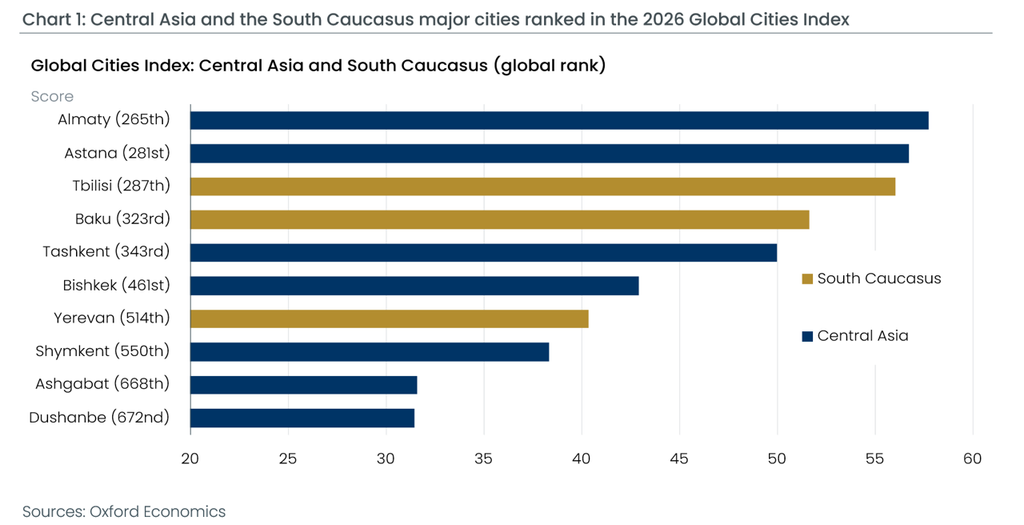
Yet, the region’s cities are far from matching the economic might of megacities in North America, Europe, and Asia Pacific, and have remained outside the upper reaches of our 2026 Global Cities Index, held back by weaker Governance and Environment scores. But with the region taking on a growing role as a key trade route between China and Europe, a closer look reveals strengths that should not be ignored. Robust economic growth is augmented by impressive standings across Human Capital, reflecting a large, growing, and increasingly skilled population that is set to underpin its rise in the decades ahead.
Human Capital: a young, growing, and skilled population sets the region apart
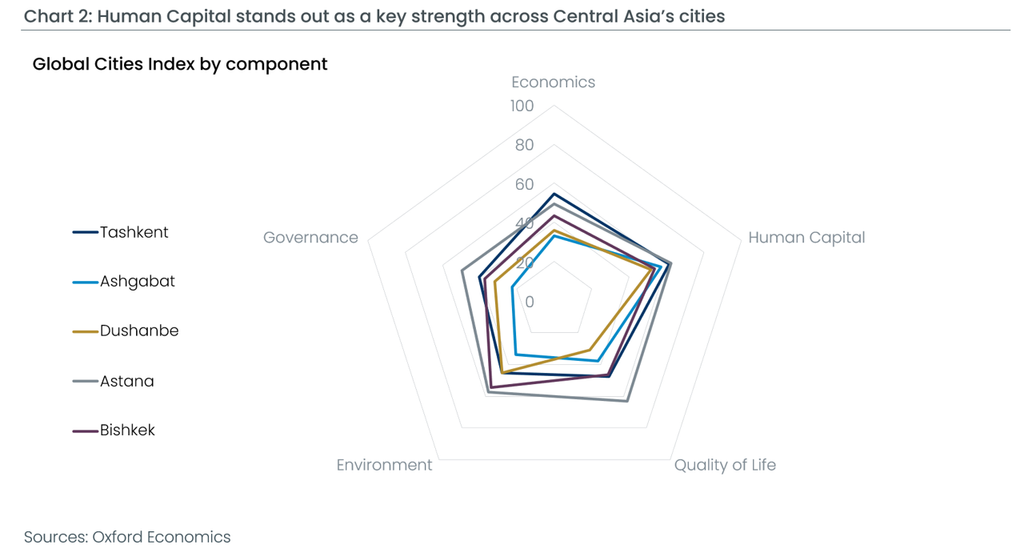
The strongest-performing category for the region’s cities is Human Capital, ranking highest of all five components for eight of the 10 cities we cover. In fact, four of these cities hold places among the top 150 cities for Human Capital globally, including Almaty and Astana in Kazakhstan at 66th and 98th, respectively, Tashkent (Uzbekistan) in 108th, and Ashgabat (Turkmenistan) at 146th.
For many of these cities, this strength rests on a solid educational foundation. Baku’s universities rank 57th globally, closely followed by Almaty’s at 67th, with the Kazakh city home to almost a third of the country’s university students. Kazakhstan has also moved to deepen its talent pool by attracting leading international institutions, with more than 30 foreign university branches now in operation, including Cardiff University’s Astana campus, the only Russell Group campus in Central Asia. Educational attainment is high across the region too, most notably in Tbilisi, which ranks 36th in the world for the mean years of schooling among its adult residents.
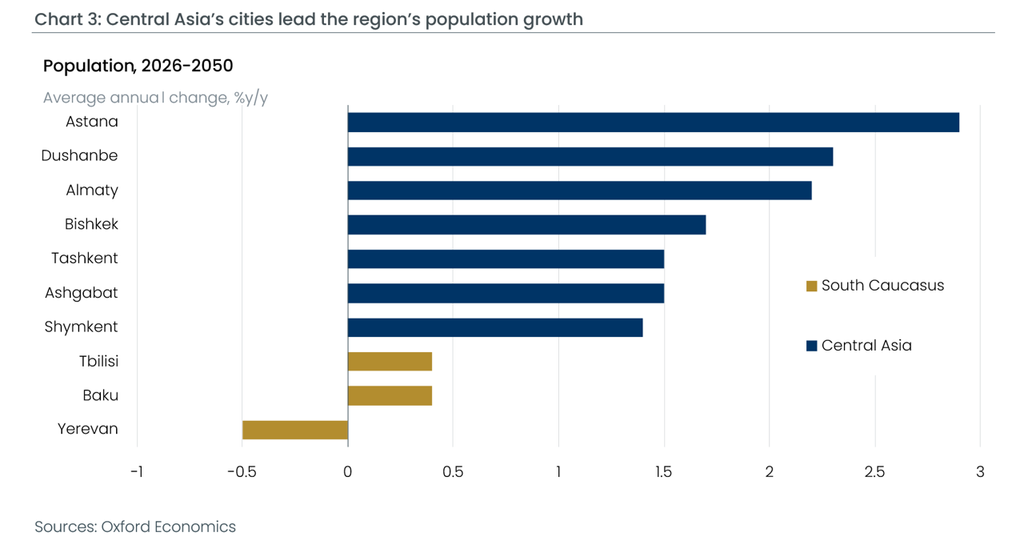
Crucially, the region’s highly educated labour force is also growing quickly. Unlike many advanced economies grappling with ageing populations and rapidly declining fertility rates, these cities are home to some of the fastest-growing populations in the world. Astana, Almaty, Dushanbe, and Bishkek all rank among the top 10% of cities globally for population growth, led by Astana in 16th, whose population is set to double by 2050. Over the next 25 years, we project that the region’s major cities will add more than 8 million residents. The pace of growth, however, is stronger in Central Asian cities than it is for those in the South Caucasus: Yerevan (Armenia), for example, is forecast to see its population decline, reflecting its more mature demographic profile.
This growing population is translating into rapidly expanding levels of employment. Employment growth across much of the region ranks among the fastest in the world, with Dushanbe (23rd) and Astana (25th) both in the global top 25. Combined with rising productivity, this trend is set to power the region’s rapid economic growth, increasing income level, and consumer appetite in the decades ahead.
Tashkent: Central Asia’s rising star and one of the world’s Cities to Watch
Tashkent offers one of the clearest examples of the region’s best strengths and overall potential, and features in the new Cities to Watch section of our 2026 report. While the Uzbek capital ranks 343rd overall, it posts the region’s highest Economics score (188th), underpinned by its fast economic growth forecast and favourable score for economic stability. We expect its economy to grow on average by 6.2% a year over the next 25 years, the seventh-fastest of any city globally, putting it on course to overtake Almaty as the region’s largest city economy within the next few years, and even to outgrow established European capitals such as Rome and Vienna by 2050.
Much of this momentum stems from Uzbekistan’s programme of economic liberalisation and opening to international markets, with construction- and investment-led expansions taking place across a range of sectors. The city is emerging as a regional leader in technology and finance, anchored by the Tashkent IT Park, while ‘New Tashkent’, a large-scale megaproject to build a modern city district, is fuelling construction activity. Its position along the Middle Corridor trade route connecting Europe and Asia is further cementing its role as a key regional logistics hub.
Tashkent’s skills base is another key attraction, with its universities among the best in the region and a growing pool of skilled labour drawing in businesses. As GDP per capita is still relatively low, the city has considerable room for catch-up growth, with productivity forecast to almost triple by 2050. However, this income gap also raises the risk of talent leaving for wealthier countries. Environmental pressures, particularly water stress (with Uzbekistan relying on external sources for 80% of its water) and high housing costs also weigh on its overall standing. How effectively these challenges are managed will shape whether Tashkent can sustain its momentum and growing regional leadership.
Challenges remain, but the region’s potential is clear
Indeed, sustaining the region’s urban growth momentum and ascent up our overall rankings will depend on addressing several key weaknesses. For most Central Asia and South Caucasus cities, Governance and Environment rank among their weakest categories. All 10 place outside the global top 500 for civil liberties and the global top 600 for temperature anomalies. High emissions intensities and poor air quality also weigh on Environment scores, particularly in Tashkent, Ashgabat, and Dushanbe. Strengthening institutions and addressing these environmental pressures will be key to ensuring the region’s growth translates into lasting prosperity and quality of life for residents.
Overall, the major cities of Central Asia and the South Caucasus are quietly emerging as a new frontier for growth, from the region’s highest-ranked cities Almaty and Astana to the rapid ascent of Tashkent. With a large, growing, and increasingly skilled population, the region is one that business decision makers would do well to watch closely in the years ahead.
Top 10 Central Asia and the South Caucasus cities in 2026 Global Cities Index
- Almaty
- Astana
- Tbilisi
- Baku
- Tashkent
- Bishkek
- Yerevan
- Shymkent
- Ashgabat
- Dushanbe
To explore the full rankings and see how other cities perform, visit the 2026 Global Cities Index site.
You might also be interested in
Explore the 2026 Global Cities Index
REQUEST A TRIAL
Access detailed city analysis and forecasts with a free trial of our cities and regions services.
