
Cameroon election: Change, but when?

Cameroon’s President Paul Biya is expected to secure another term in the upcoming presidential election, largely due to the formidable electoral machinery of his party, the Cameroon People’s Democratic Movement (CPDM). This blog will delve into the factors contributing to Biya’s anticipated victory, the fractured opposition, and the broader political landscape in Cameroon to inform readers not only about the election, but what is likely to happen in Biya’s next term and when he passes away. Internal conflicts within the ruling CPDM and a generational shift in political aspirations are marking the current political scene. Younger politicians are eager to bring fresh ideas and reforms, challenging the old guard’s dominance. This dynamic is likely to lead to a period of intense political manoeuvring and disputes, particularly as new leaders emerge from upcoming legislative elections.
Cameroon’s Political Landscape Under Biya
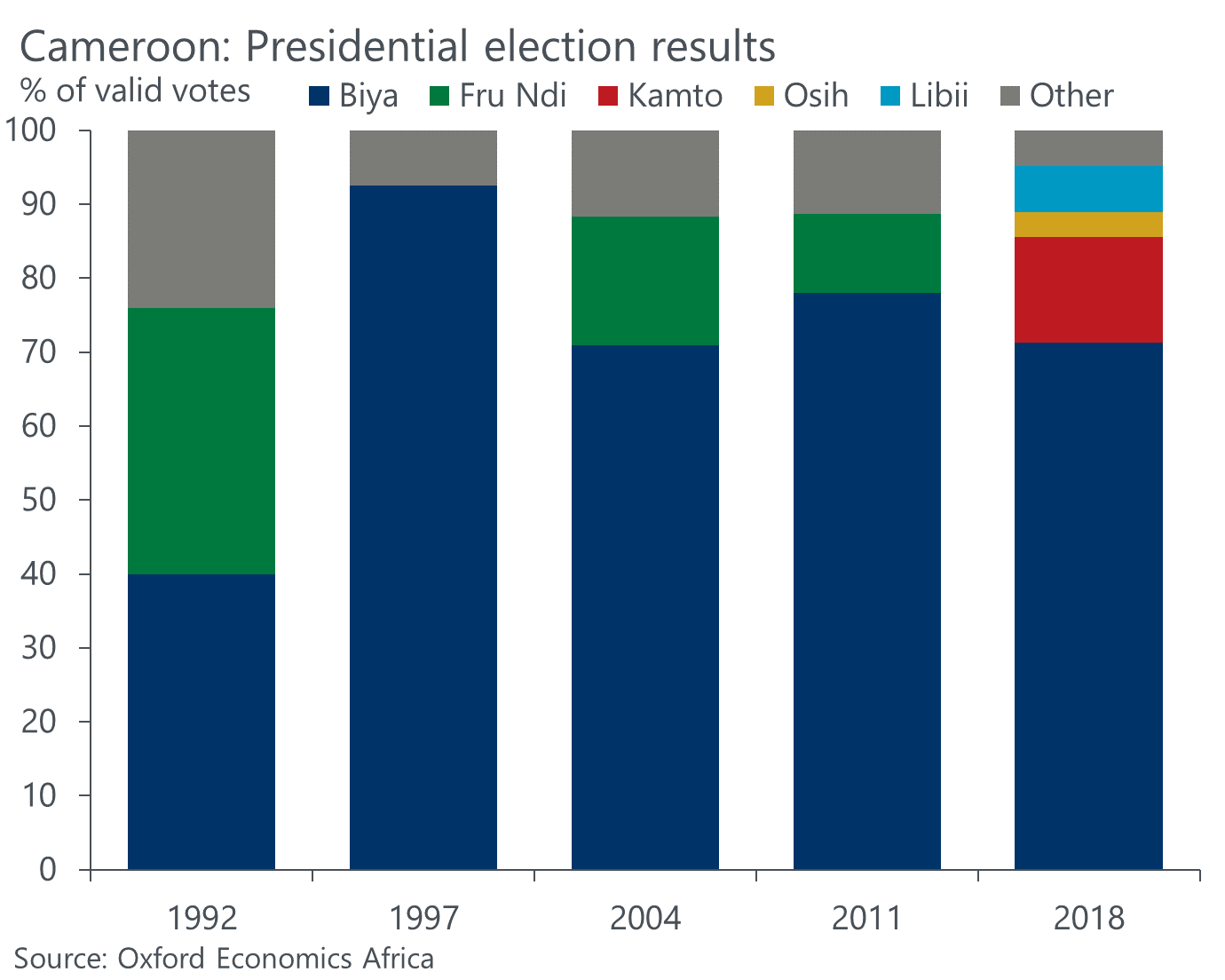
Since its first presidential election victory in 1984, Paul Biya’s CPDM has established itself as a powerful electoral force, effectively mobilizing financial and positional resources to reward supporters and secure block votes. Despite internal factional battles, the party has unified temporarily to ensure Biya’s re-election. In contrast, the fragmented opposition, with nine candidates, has failed to consolidate support around a single consensus candidate, significantly diminishing its chances of challenging Biya’s dominance.
The political environment in Cameroon is marked by Biya’s prolonged absence from public life, raising questions about his health and the actual exercise of power. His recent public appearances are carefully managed, amid widespread speculation of emergency medical treatment during frequent trips to Switzerland. This has led to a peculiar form of governance where Biya’s image is omnipresent, yet his physical presence is minimal. Power is exercised through decrees bearing his signature, but the actual decision-making process remains shrouded in mystery, with key figures like Ferdinand Ngoh Ngoh, the Secretary-General in the Presidency, playing a significant role behind the scenes.
CPDM’s Tactics and Opposition Challenges in Election Strategy
The CPDM’s election strategy focuses on leveraging traditional chiefs, minor party leaders, and government departments to mobilize votes. The party incentivizes loyalty by offering positions in regional councils and legislative seats. This approach has historically secured support from traditional chiefs, who direct state funds to their communities in return for electoral backing. The significance of the election has temporarily quelled internal disputes within the party, strengthening its position. The deployment of police to maintain order and prevent unrest highlights the government’s commitment to a smooth election process.
The opposition includes figures like Maurice Kamto, who was excluded from the election on technical grounds, showcasing the government’s control over the Electoral Commission and the Constitutional Council. Kamto’s exclusion was a potential turning point for regime change, but it did not occur. Other opposition candidates, such as Cabral Libii and Issa Tchiroma Bakary, have their own support bases but struggle to unify the opposition. Tchiroma has made notable progress by apologizing for past actions and gaining support from separatist leaders in the Anglophone regions, potentially enhancing his chances.
Impact of Military on Cameroon’s Political Future
The military’s influence on Cameroon’s political stability is significant. President Biya has historically maintained control by creating numerous military brigades to prevent any single officer from becoming a threat. As central control weakens, the risk of a military coup grows. Upon Biya’s death, the Senate President will temporarily take over, with an election required within 40 days. This transition period is critical, as the CPDM will likely try to sway the outcome, while the opposition will push for a fair election.
The most optimistic scenario post-Biya involves a brief eighth term followed by strong democratic reforms. Pressure from the public and international community could compel the CPDM to respect the constitution and conduct a fair election, possibly leading to an opposition politician like Maurice Kamto initiating generational renewal. This change could promote dialogue in the Anglophone region, granting some autonomy and easing conflicts. Expatriates might return, bringing skills and capital to support Cameroon’s development.
A less favourable scenario involves the CPDM maintaining power through election fraud and intimidation, resulting in political and social decline with high levels of conflict, crime, and protest. This would negatively impact sovereign risk and investor perceptions, hindering economic progress. The risk of a military coup remains, with rival officers potentially clashing and causing further instability. If a coup occurs, the best-case scenario would mirror Gabon’s quick transition, while the worst-case scenario could involve prolonged violence and repression.
International involvement will be crucial in Cameroon’s transition. France, the United States, and Russia have vested interests in the region, each with varying degrees of influence. The US has shown interest in prosecuting separatists, indicating a strategic focus on Cameroon’s stability. France’s historical ties and Russia’s arms sales further complicate the geopolitical landscape. These external actors will significantly impact the post-Biya transition.
As Biya’s health continues to decline, the future of Cameroon’s governance will likely involve increased power struggles and uncertainty, making the post-election period the most critical in decades for the country’s stability and development. The potential for significant political change is high, with various scenarios ranging from optimistic democratic reforms to continued CPDM dominance or military intervention. Despite the challenges, there is hope for a more representative democracy and improved stability, driven by the aspirations of a younger generation and the pressure for constitutional adherence.
Watch our webinar – Cameroon election: Change, but when?
Available on demandRelated content

Africa: A continent besieged along old fault lines
Africa has, once again, taken centre stage as countries vie for the top spot. The playing field has shifted slightly, and the rules of engagement have moved more toward the economic arena. In this Research Briefing, we explore the economic and political ties between Africa and China, the US, Europe and Russia as the continent navigates the new multi-polar world order.
Find Out More
The Green Leap: Using regulation to combat deforestation
We exploring the European Union's bold initiative to tackle deforestation through the European Union Deforestation Regulation (EUDR).
Find Out More
The economic impact of US funding for malaria
The report evaluates the direct and indirect economic benefits of US funding for malaria control through two major channels: the US President’s Malaria Initiative (PMI) and the Global Fund to Fight AIDS, Tuberculosis and Malaria (GF).
Find Out More
Mapping the uncertain demographic future
Demographic shifts are reshaping the global economy, with ageing populations and declining fertility slowing labour supply and growth. Some regions face fiscal pressures, while others, like sub-Saharan Africa, could drive future expansion. But as populations diverge, what does the uncertain demographic future mean for global economic stability?
Find Out MoreTags: