
Ungated Post | 13 Dec 2016
Trump and Technology
If the most iconic American job ever is riding the range as a cowboy, then rolling down the highway as a long-haul trucker is somewhere on the short list. Now, 159 years after a patent was issued for the technology (barbed wire) that would end mass employment for the cowpoke, technology in the form of self-driving vehicles is threatening to reduce the role of the truck driver—one of the most common occupations in the country.
This is something the Trump administration needs to take seriously if it means to honor the populist economic promises made during the campaign. So far, at least, the focus has been on jobs lost to other countries, a real phenomenon but one that is less powerful and far-reaching than the automation that has remade other industries and is now coming for truckers.
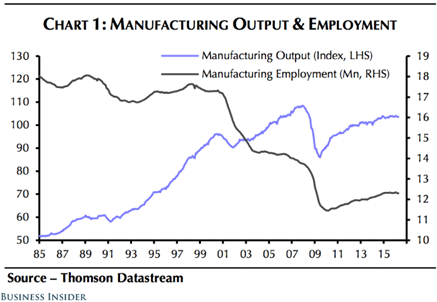
To frame the issue around the factory jobs Trump has vowed to restore, it’s not that America doesn’t make things any more, it’s that Americans make less and less of our manufacturing output.
And as robotics and machine learning continue to mature, and the Internet of Things and 3-D printing replace or remake many positions, the impact of technology on employment will only increase. Trump’s own designee as Secretary of Labor has spoken favorably about kiosks in the fast-food business, saying, “They’re always polite, they always upsell, they never take a vacation, they never show up late, there’s never a slip-and-fall, or an age, sex or race discrimination case.”
Good new jobs will be created as technology progresses, but human lives are not fungible goods and it’s unlikely that displaced truckers or factory workers will be filling enough of those roles to offset the damage to careers, families, and entire regions. Meanwhile, any relief to hard-hit communities by revisions in trade policy seem likely to be relatively small in scale and probably short-lived in the face of ongoing automation.
So what’s the plan? Maybe this week’s planned meeting with technology industry leaders will start that conversation. Are we going to talk about education, investment, maybe even something currently unthinkable like UBI? Because until we do, it will feel like the new administration is fighting the last war, or maybe the one before that, as the people who voted for change keep getting more of the same: jobs that once defined a nation, disappearing without reasonable replacements in sight.
Tags:
You may be interested in

Post
Oxford Economics announces a leadership transition for the next phase of growth
Oxford Economics, the world’s leading economic forecasting and advisory firm, announced today the appointment of Innes McFee as its new Chief Executive Officer, effective 4th December.
Find Out More
Post
Oxford Economics launches enhanced Real Estate Economics Service
Oxford Economics is pleased to unveil its enhanced Real Estate Economics Service, now covering 100 global cities.
Find Out More
Post
Oxford Economics Acquires Majority Stake in Alpine Macro
We're excited to share that Oxford Economics has acquired a majority stake in Alpine Macro, a prominent global investment research firm based in Montreal, Quebec, Canada.
Find Out More