
Ungated Post | 19 Dec 2018
The impact of the aluminium sector on the UAE economy
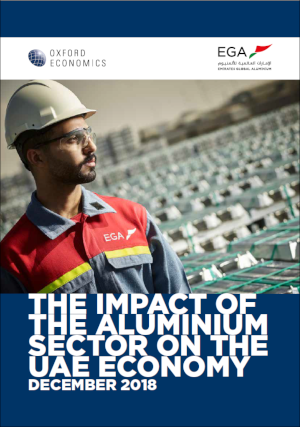
Production of aluminium and of semi-finished aluminium products supports just over 60,000 jobs in the UAE, once supply chain linkages and employee spending impacts are taken into account. This is associated with a US $5.47 billion contribution to UAE GDP.
The UAE’s aluminium sector, which comprises the major primary aluminium producer Emirates Global Aluminium (EGA), and its domestic business customers who make semi-finished aluminium products, contributed US $2.42 billion to UAE GDP in 2017. The sector’s high labour productivity, by global and local standards, meant that this required only 10,110 directly-employed workers. However, taking supply chain linkages (‘indirect impacts’), and staff spending effects (‘induced impacts’) into account, in total the sector supported 60,950 UAE-based jobs across the manufacturfing, construction, energy and utilities, and services sectors. That is equivalent to 1.0 percent of all UAE jobs, and means that for every job in the aluminium sector itself, a further five roles are supported elsewhere in the national economy. The total contribution to national GDP associated with that was US $5.47 billion, or 1.8 percent of total non-oil GDP.
Our economic consulting team are world leaders in quantitative economic analysis, working with clients around the globe and across sectors to build models, forecast markets and evaluate interventions using state-of-the art techniques. Lead consultants on this project were:
Oxford Economics’ team is expert at applying advanced economic tools that provide valuable insights into today’s most pressing business, financial and policy issues.
To find out more about our capabilities, contact:
EMEA
Sam Moore
+44 (0)207 803 1415
Email
Americas
Hamilton Galloway
+1 (646) 503 3068
Email
Asia
Christie Tang
+852 3974 8841
Email
Related Services

Post
KPMG M&A Outlook 2026: Between Uncertainty, Resilience, and Seizing Opportunities
Discover how Germany’s M&A landscape is evolving – with a focus on growth, AI and post-merger value creation.
Find Out More
Post
Silver, the next generation metal
This report highlights the critical role silver plays in data centres and artificial intelligence (AI), automotive and electric vehicles (EVs), and solar energy photovoltaics (PVs). With these sectors expected to expand significantly over the coming years, we expect future silver demand to be strong.
Find Out More
Post
Powering the UK Data Boom: The Nuclear Solution to the UK’s Data Centre Energy Crunch
The UK’s data centre sector is expanding rapidly as digitalisation, cloud computing, and artificial intelligence (AI) drive surging demand for high-performance computing infrastructure.
Find Out More