
Ungated Post | 10 Nov 2017
The Future Flow of Goods
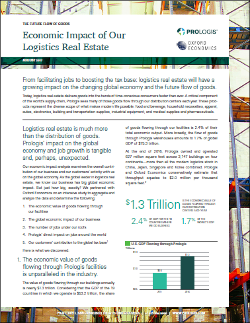
Warehouses and distribution centers facilitate the commercial flow of goods across the world. Nearly every product purchased by consumers and businesses will have passed through a warehouse or distribution facility. Oxford Economics undertook a custom, data-driven assessment of Prologis warehouse and distribution facilities to better quantify and describe the economic value of goods that flow through their facilities, the number of jobs under Prologis roofs, as well as jobs supported through the economic activities of Prologis tenants and the tax implications of all economic activity associated with Prologis’ warehouses and distribution centers.
In 2016, Prologis, the world’s largest owner of warehouses and distribution centers, owned or operated 627 million square feet of warehouse space across 3,147 buildings in 19 countries. Approximately $1.3 trillion worth of goods flow through these facilities annually—which accounts for 1.7% of global GDP. About 816,000 people work under Prologis roofs, specifically for Prologis tenants who lease warehouse and distribution center space. The economic activities of Prologis’ tenants and employees support an additional 1.55 million jobs globally. In context, if the employment supported by Prologis and their tenants were a US city, they would be the fourth largest—ahead of Houston, Philadelphia and Phoenix.
Within the US, the economic activity supported through Prologis warehouses and distribution centers generates about $16.7 billion in federal, state and local taxes.
Oxford Economics’ team is expert at applying advanced economic tools that provide valuable insights into today’s most pressing business, financial, and policy issues.
To find out more about our capabilities, contact:
Americas
Diantha Redd
+1 (646) 503 3052
Email
Asia Pacific
Peter Suomi
+65 6850 0110
Email
EMEA
Aoife Pearson
+44 (0)203 910 8054
Email
Related Services

Post
KPMG M&A Outlook 2026: Between Uncertainty, Resilience, and Seizing Opportunities
Discover how Germany’s M&A landscape is evolving – with a focus on growth, AI and post-merger value creation.
Find Out More
Post
Silver, the next generation metal
This report highlights the critical role silver plays in data centres and artificial intelligence (AI), automotive and electric vehicles (EVs), and solar energy photovoltaics (PVs). With these sectors expected to expand significantly over the coming years, we expect future silver demand to be strong.
Find Out More
Post
Powering the UK Data Boom: The Nuclear Solution to the UK’s Data Centre Energy Crunch
The UK’s data centre sector is expanding rapidly as digitalisation, cloud computing, and artificial intelligence (AI) drive surging demand for high-performance computing infrastructure.
Find Out More