
Economic Impact | 13 Sep 2021
The Economic Importance of Motorcycles to Europe

Economic Consulting Team
Oxford Economics
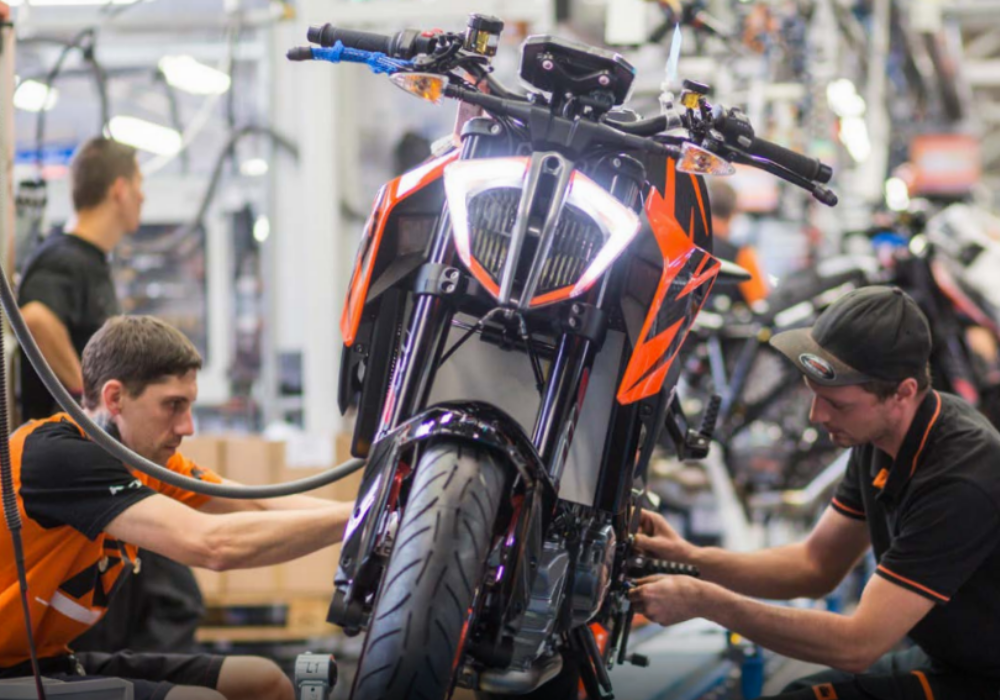
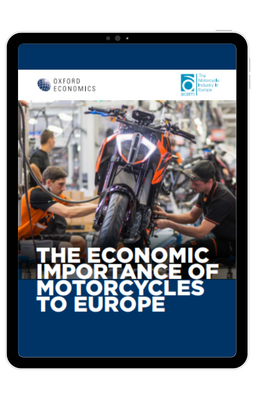
Motorcycle-related activity supports €21.4 billion of output (GDP) across Europe a year, sustains 389,000 jobs, and generates €16.6 billion of tax revenues, according to research by Oxford Economics. This means that in 2019 economic activities associated with motorcycling generated more GDP, and employed more people, than the metropolitan area economies centred on Venice, Malaga, and Palma de Mallorca. The total tax impact would have been sufficient to cover the pay of 380,000 teachers, or some 6.5% of all European teachers.
Four-fifths of the total was accounted for by six countries, namely Italy (23%), Germany (20%), France (13%), the UK (11%), Spain (7%), and Austria (7%).
This report, commissioned by ACEM, the motorcycle industry in Europe, also investigates the international trade in motorcycles and parts. In 2019, manufacturers in the EU-27 and the UK sold €2.1 billion of these goods to non-European customers—so that exports accounted for 39% of their total sales by value. Even so, European countries had a trade deficit in these products, with imports totalling €4.5 billion. Large quantities are imported from Asian countries where European manufacturers face high import tariffs. These high custom duties protect their domestic markets by making European vehicles relatively more expensive.
This report, commissioned by ACEM, the motorcycle industry in Europe, also investigates the international trade in motorcycles and parts. In 2019, manufacturers in the EU-27 and the UK sold €2.1 billion of these goods to non-European customers—so that exports accounted for 39% of their total sales by value. Even so, European countries had a trade deficit in these products, with imports totalling €4.5 billion. Large quantities are imported from Asian countries where European manufacturers face high import tariffs. These high custom duties protect their domestic markets by making European vehicles relatively more expensive.
About the team
Our economic consulting team are world leaders in quantitative economic analysis, working with clients around the globe and across sectors to build models, forecast markets and evaluate interventions using state-of-the art techniques. The lead consultant on this project was:

Doug Godden
Lead Economist, Economic Footprint & Sustainability
Doug Godden
Lead Economist, Economic Footprint & Sustainability
London, United Kingdom
Since first joining Oxford Economics in 2009, Doug has delivered a large number of economic impact studies concerned with companies, sectors, and investment projects. Recent studies that he has made a major contribution to include those for the Independent Schools Council (ISC), the head teachers’ professional association (HMC), the Railway Industry Association (RIA), ASOS, Reckitt, and Motability, as well as the European Broadcasting Union (EBU), European Steel Association (Eurofer), European motorcycle manufacturers’ association (ACEM), World Brewing Alliance (WBA), and several businesses and institutions across the Middle East.
He previously spent 20 years at the Confederation of British Industry (CBI), culminating in positions as Head of Economic Analysis and Head of Economic and Fiscal Policy. He holds two degrees in economics—BSc(Econ) and MPhil—having studied at University College London and Brasenose College, Oxford.

James Bedford
Lead Economist, Economic Footprint & Sustainability
James Bedford
Lead Economist, Economic Footprint & Sustainability
London, United Kingdom
James is a Lead Economist working within the Economic Footprint and Sustainability team of Oxford Economics. He holds a BSc (Hons) in Economics from Newcastle University. For his dissertation, James was awarded the European Award for Aviation Economics by the German Aviation Research Society. Since joining the team in 2016, James has worked on a range of high-profile economic impact studies for clients including the World Brewing Alliance, Airbus, and Sky.
You might be interested in
Post
Industry key themes 2026: Industry will grow if you know where to look
Prospects appear solid for global industry in 2026, but activity is set to remain regionally and sectorally divergent.
Find Out More
Post
Commodity Key Themes 2026: Softer oil prices and firmer metals
In this report, we outline five key themes that will shape the global commodity landscape in 2026.
Find Out More
Post
Silver, the next generation metal
This report highlights the critical role silver plays in data centres and artificial intelligence (AI), automotive and electric vehicles (EVs), and solar energy photovoltaics (PVs). With these sectors expected to expand significantly over the coming years, we expect future silver demand to be strong.
Find Out More
Post
Europe automotive sector industry outlook: 2026 and beyond
We expect that the number of cars produced in Europe will grow over the next years. However, the future is much bleaker than the past.
Find Out More
Post
India’s GST reform benefits durables, but far from a game changer
Research Briefing The Economic Importance of Motorcycles to Europe
Find Out More