
Recent Release | 11 Oct 2022
The Economic Impact of Buy Now Pay Later in Australia

Economic Consulting Team
Oxford Economics

Oxford Economics was commissioned to measure the economic impact of Buy Now, Pay Later (BNPL) in Australia by the Australian Finance Industry Association.
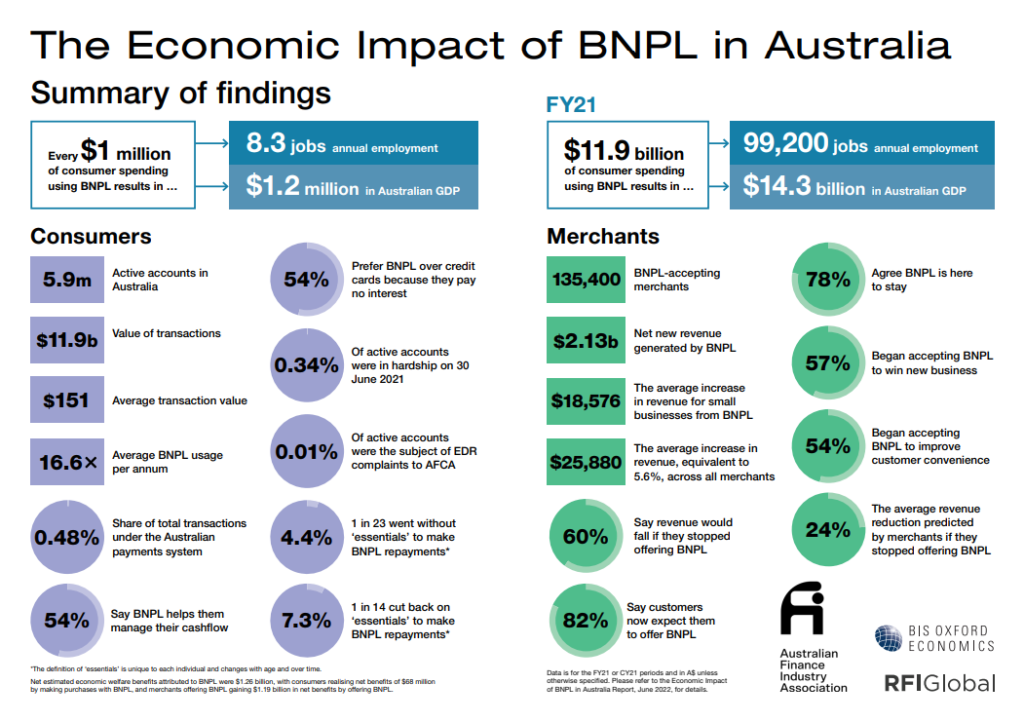
Relying on economic contribution and welfare economics approaches, we find that for Financial Year (FY) 2021, the BNPL industry helped create or retain some 99,200 jobs throughout Australia and contributed $14.3 billion in Gross Domestic Product (GDP) to the Australian economy.
Furthermore, we measure the combined consumer and merchant surplus benefits, or ‘net social surplus’, revealing merchants and consumers have continued to adopt BNPL because it provides advantages to other payment alternatives such as interest and fee savings, and growth in revenue and associated profits for merchants.
About the team
Our Economic Consulting team are world leaders in quantitative economic analysis, working with clients around the globe and across sectors to build models, forecast markets and evaluate interventions using state-of-the art techniques. Lead consultants on this project included:

Andrew Tessler
Head of Economic Impact Consulting, Australasia, OE Australia

Raúl Arias
Senior Economist, OE Australia
You might be interested in

Inside the UK’s Data Centre Boom: Why London Still Dominates—and what comes next
As AI accelerates and global tech companies commit billions to new cloud and data-centre projects in the UK, the country is cementing its role as a leading AI hub.
Find Out More
Student housing makes the grade in Australia
Rising student demand and limited housing availability are pushing rents higher and reinforcing investor confidence in Australia’s student accommodation market.
Find Out More
Australia’s Infrastructure Outlook: Big Shifts, Bigger Challenges
Australia’s infrastructure landscape is shifting fast, driven by new investment trends, emerging asset classes and growing capacity constraints. This outlook explores the major changes ahead and what industry and government must do to navigate the decade effectively.
Find Out More
Powering the UK Data Boom: The Nuclear Solution to the UK’s Data Centre Energy Crunch
The UK’s data centre sector is expanding rapidly as digitalisation, cloud computing, and artificial intelligence (AI) drive surging demand for high-performance computing infrastructure.
Find Out More