
Ungated Post | 15 May 2015
London 2030: How will the capital’s economy change?
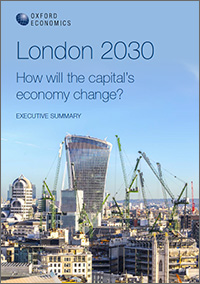
London’s economy is growing strongly, easily outpacing both the UK and its nearest European rivals such as Paris and Frankfurt. Significant investments in public infrastructure, office buildings, retailing, and homes all point to widespread optimism that the growth will continue, not just for the next year or two but for many years to come. But how confident should we be about London’s growth trajectory?
London 2030 analyses the trajectory and magnitude of change that is likely to confront London’s economy in the decade and a half from 2015 up to 2030. The study is the result of analysis by our specialist cities forecasting team, and provides unrivalled forecast data sets and in-depth analysis of what trends imply for the scale and structure of the capital’s economy over the next fifteen years, as well as assessment of other factors that might influence growth.
The full research programme is now available for purchase, and is comprised of five research papers:
- Our baseline forecasts for London’s economy, population growth and employment to 2030
- A forecast comparison between our data and The London Plan
- Analysis of housing trends: will a shortage of housing constrain London’s growth?
- Assessment of the impact of alternate scenarios, such as a Eurozone crisis, or a stronger performance -Possible drivers of change such as the impact of new technology, or the UK leaving the EU
Oxford Economics’ team is expert at applying advanced economic tools that provide valuable insights into today’s most pressing business, financial, and policy issues.
To find out more about our capabilities, contact:
Americas
Diantha Redd
+1 (646) 503 3052
Email
Asia Pacific
Peter Suomi
+65 6850 0110
Email
EMEA
Aoife Pearson
+44 (0)203 910 8054
Email
Related Services

Post
KPMG M&A Outlook 2026: Between Uncertainty, Resilience, and Seizing Opportunities
Discover how Germany’s M&A landscape is evolving – with a focus on growth, AI and post-merger value creation.
Find Out More
Post
Silver, the next generation metal
This report highlights the critical role silver plays in data centres and artificial intelligence (AI), automotive and electric vehicles (EVs), and solar energy photovoltaics (PVs). With these sectors expected to expand significantly over the coming years, we expect future silver demand to be strong.
Find Out More
Post
Powering the UK Data Boom: The Nuclear Solution to the UK’s Data Centre Energy Crunch
The UK’s data centre sector is expanding rapidly as digitalisation, cloud computing, and artificial intelligence (AI) drive surging demand for high-performance computing infrastructure.
Find Out More