
Consulting | 04 Sep 2017
Global Infrastructure Outlook

Macro Consulting Team
Oxford Economics

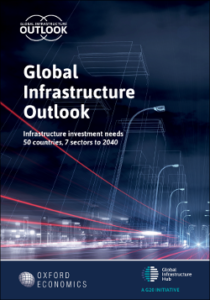
A well-functioning, modern infrastructure is central to economic development and to quality of life. From the roads and railways needed to transport people and goods, to the power plants and communications networks that underpin economic and household activity, to the basic human need for clean water and sanitation, infrastructure matters to people and businesses everywhere.
However, there have been relatively few attempts to track and monitor infrastructure investment across countries and sectors. This has made it difficult to predict how, where and when investment is most needed.
Over the last year or so we have been working with the Global Infrastructure Hub to address this knowledge gap. Our study seeks to estimate how much the world needs to spend on infrastructure in the years to 2040, and in which countries and sectors this investment will be required. The granularity the study provides is unique: it collates data and creates forecasts for seven sectors in 50 countries, over a period of 25 years.
We estimate global infrastructure investment needs to be $94 trillion between 2016 and 2040. This is 19 percent higher than would be delivered under current trends, and is an average of $3.7 trillion per year. To meet this investment need, the world will need to increase the proportion of GDP it dedicates to infrastructure to 3.5 percent, compared to the 3.0 percent expected under current trends.
About the team
Our macro consulting team are world leaders in quantitative economic analysis, working with clients around the globe and across sectors to build models, forecast markets and evaluate interventions using state-of-the art techniques. Lead consultants on this project were:
Related Services

Post
KPMG M&A Outlook 2026: Between Uncertainty, Resilience, and Seizing Opportunities
Discover how Germany’s M&A landscape is evolving – with a focus on growth, AI and post-merger value creation.
Find Out More
Post
Silver, the next generation metal
This report highlights the critical role silver plays in data centres and artificial intelligence (AI), automotive and electric vehicles (EVs), and solar energy photovoltaics (PVs). With these sectors expected to expand significantly over the coming years, we expect future silver demand to be strong.
Find Out More
Post
Powering the UK Data Boom: The Nuclear Solution to the UK’s Data Centre Energy Crunch
The UK’s data centre sector is expanding rapidly as digitalisation, cloud computing, and artificial intelligence (AI) drive surging demand for high-performance computing infrastructure.
Find Out More