
Ungated Post | 31 Jan 2017
Fast start in cognitive innovation
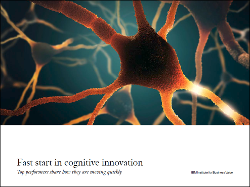
How will cognitive computing transform lives, both personally and professionally? What can enterprises do to tap into cognitive computing’s full potential? What steps can leaders take today to accelerate cognitive computing benefits? In this survey of 6,050 C-suite executives worldwide, we explore these and many other questions. A small group of cognitive innovators show what can be done: Their most successful strategies combine cognitive and analytic capabilities – including machine and deep learning, natural language processing, descriptive and predictive analytics – as well as robotics and automation.
Oxford Economics worked with IBM’s Institute for Business Value in the second half of 2016 to field a survey among 6,050 global executives to investigate the effects of cognitive computing on various functions across the enterprise.
Oxford Economics’ team is expert at applying advanced economic tools that provide valuable insights into today’s most pressing business, financial, and policy issues.
Related Services

Post
KPMG M&A Outlook 2026: Between Uncertainty, Resilience, and Seizing Opportunities
Discover how Germany’s M&A landscape is evolving – with a focus on growth, AI and post-merger value creation.
Find Out More
Post
Silver, the next generation metal
This report highlights the critical role silver plays in data centres and artificial intelligence (AI), automotive and electric vehicles (EVs), and solar energy photovoltaics (PVs). With these sectors expected to expand significantly over the coming years, we expect future silver demand to be strong.
Find Out More
Post
Powering the UK Data Boom: The Nuclear Solution to the UK’s Data Centre Energy Crunch
The UK’s data centre sector is expanding rapidly as digitalisation, cloud computing, and artificial intelligence (AI) drive surging demand for high-performance computing infrastructure.
Find Out More