OE Logo

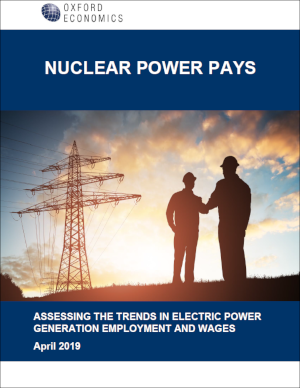
Our analysis of the US electric power generation sector finds that nuclear power sector provides 20 percent of the electricity needs in the US, and it supports tens of thousands of high-skill jobs throughout the country. In 2017, the nuclear power generation industry employed nearly 48,400 workers in the US that were paid an average salary of $136,600.

The Future of Work initiative is a combination of research and events celebrating 100 years of the International Labour Organization (ILO). This research project, commissioned jointly by the ILO and the International Organisation of Employers (IOE), focused on the impact of major workforce trends on companies around the world, including many developing countries. It has been produced to understand the strategic choices they were making in response to these trends and the support from government policy, or employer and business organizations, that could help them prosper.

Thales commissioned Oxford Economics to undertake a comprehensive assessment of its contribution to the UK economy. In this report, we demonstrate how Thales directly contributes economic value to the country in terms of annual GDP generated, employment supported, and tax revenues raised.

To celebrate National Fragrance week (18-24 March), this report provides the first comprehensive assessment of the contribution of the fragrance industry to the UK economy. It finds the fragrance industry has a large positive economic footprint in the UK. The industry must therefore be recognised as a valuable asset for the UK economy.

Our global analysis finds that the chemical industry, its supply chain and payroll-induced impacts, made an estimated $5.7 trillion contribution to world GDP in 2017, and supported 120 million jobs.

Approaching 2019, SMEs are confident they can continue to prosper, despite economic uncertainty, disruptive technologies, and threats to global trade. This year highlights a notable shift in attitudes toward technology, as SMEs deploy it to increase both top and bottom lines.

How retailers are putting AI-powered technologies to use. A new era is dawning across the retail sector, powered by artificial intelligence. Technologies like predictive analytics, chatbots, and robotic process automation – all enabled by AI – are creating fresh opportunities for growth, efficiency, and customer engagement.

While women may be in fewer leadership positions worldwide, those organizations with more females at the top outperform their peers.

Innovation is a must for companies to survive today and into the future. Still, very few businesses have understood how to innovate successfully and turn innovation into tangible financial result. Successful innovators not only outperform others financially over the last 5 years – they also have higher expectations about future results. We call them Innovation Champions.

The UK downstream oil sector supported 300,000 jobs and a £21.2 billion contribution to UK GDP in 2016. In this report we explore the vital role that the downstream oil sector plays within the UK economy.

Today’s consumers reveal the future of healthcare

The rapid rise of the Internet of Things (IoT) demands a new look at security. With network vulnerabilities and the potential for industrial process interruption, companies need to develop new strategies to mitigate and manage cyber-risks.

We set out our view of US economic prospects for 2019 and some of the key issues for businesses as they seek to navigate current uncertainties and meet the year’s challenges

Oxford Economics’ custom research was recently featured in the fourth edition of the World’s Most Competitive Cities (published by Conway). The report examines the economic fundamentals supporting direct foreign investment projects in the world’s most competitive cities.

Oxford Economics surveyed 90 technology executives in the financial services sector, including meaningful samples from the retail banking, insurance, and capital markets subsectors. The study found 68% of respondents expect that in five years, customers will do most of their saving, investing, and borrowing through non-finance platform companies. In the face of this and other looming challenges, 90% have long-term plans for digital transformation. Further analysis and interviews with executives show how these industries are preparing for the future of digital innovation.

Companies are waking up to an untapped source of business growth: vast amounts of new data on work and the workforce that can unlock the potential of their people. This data – now available through a range of digital innovations – is both a goldmine and a minefield.

Production of aluminium and of semi-finished aluminium products supports just over 60,000 jobs in the UAE, once supply chain linkages and employee spending impacts are taken into account. This is associated with a US $5.47 billion contribution to UAE GDP.

New analysis from Oxford Economics show that incidence of illicit tobacco across four GCC markets (Saudi Arabia, UAE, Kuwait and Oman) has increased in recent years – having been just 1.2% of Total Consumption in 2016, the Illicit Incidence rose to 1.6% of Total Consumption in 2017 and to 5.3% in the first half of 2018.

Oxford Economics surveyed 150 C-suite executives from 11 industries across the UAE and Saudi Arabia in mid-2018. The objective was to learn how large companies are prepared to respond to disruptive change.

The National Fluid Power Assocition (NFPA) commissioned Oxford Economics to develop state-level fluid power demand estimates (e.g. industry sectors who purchase fluid power products as part of their supply chain) as well as other key sector characteristics. NFPA integrated the output from this research into a members’ access only tool to shed new light on the size of fluid power product demand. Additional info can be found