
OE Logo

While the US economy is now in its longest expansion on record, clouds are forming on the horizon. Trade tensions between the world’s largest economic powers, heightened geopolitical risks and growing policy uncertainty threaten the health of the US economy.

Business-to-business (B2B) customer engagement presents unique challenges for chemicals and petroleum companies. Empowered customers expect more and want to buy at the time and through the channel of their choosing. Chemicals and petroleum companies face large effectiveness gaps with their customer engagement objectives.

AI capabilities are rapidly maturing. And so, too, is enterprise adoption. More executives than ever before are actively conceiving where and how to leverage AI. But executives are also more discriminating about their organizational priorities for AI and how these leading-edge technologies are rolled out.

It’s no secret that innovative technologies, empowered consumers, and digital disruptors are inexorably changing the business landscape, including instigating the proliferation of cloud-based services. Whether it’s accessing streaming entertainment or collaboration tools, consumers and businesses alike have been quick to adopt cloud-enabled services, enjoying lower costs, added convenience and enhanced experiences.

Oxford Economics’ analysis demonstrates the importance of the EU steel industry, which supports an extensive supply chain across the continent, and facilitates highly-valued work in key customer sectors – including metal product, machinery and motor vehicle manufacturing, as well as construction.

The robotics revolution is rapidly accelerating, as fast-paced technological advances in automation, engineering, energy storage, artificial intelligence and machine learning converge. The far-reaching results will transform the capabilities of robots and their ability to take over tasks once carried out by humans.

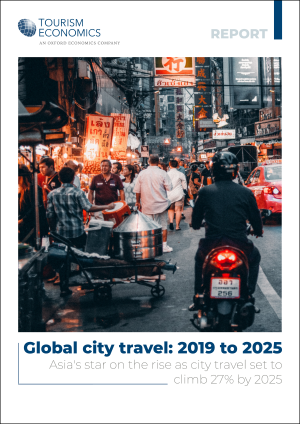
Cities are a dynamic driver of global travel. To understand the value and potential of our cities today and in the future, here’s our forecast for global travel in 2025.

Services providers account for nearly one-fifth of total workforce spending and are increasingly critical to business performance–but this vital piece of the workforce is often overlooked and under-managed.

Oxford Economics and SAP Concur surveyed 500 finance and IT executives at growing companies to find out how the most successful organizations manage the growing pains that come with business expansion. We found that cost-consciousness—prioritizing spending and cash flow in expansion decision-making—can greatly affect an expansion’s success. We produced two research reports—one focusing on SMBs with less than 1,000 employees and the other focusing on larger companies. Regardless of company size, paying close attention to spend can increase the chances of successful business growth.

Measuring the Effects of Supply-Chain Loss Due to Expansion of Foreign State-Owned Enterprises in the U.S.

For millions of Americans, a career in the travel industry is not just a first job, but the first step toward the American dream of a stable, prosperous and rewarding life with a competitive salary for employees and their families. Travel jobs are accessible, often providing the first foothold on the career ladder, the flexibility to pursue education or raise a family and opportunities to reenter the workforce.

The family business sector is vital to the UK economy. Throughout every region and industrial sector, family-owned businesses are a driving force, employing millions of people, generating more than a quarter of the UK’s annual GDP, and contributing over 20 percent of its total tax revenues each year.

Corporate board directors are working harder than ever before. New regulations, changing business models, rising shareholder activism, and other emerging risks require rapid responses. At the same time, technological innovation offers many companies a chance at digital transformation, adding urgency to the board’s strategic mandate. What risks are top of mind for directors? How do successful boards stay on top of these risks while remaining agile? And what can all boards do to adopt best–in–class governance practices?

The Cisco UK Productivity Index – Examining Local Performance Disparities Within The UK

Huawei is a global leader in information and communications technology solutions. Since opening its first UK office in 2001, Huawei has played an important part in helping its UK carrier partners to develop and roll out both fixed and mobile networks throughout the UK, by its provision of network architecture, sites, and stations. More recently, it has offered its range of smart devices to personal customers in the UK and elsewhere.

The overwhelming majority of firms in industrialised countries are small and medium-sized enterprises (SMEs). Together, they are responsible for 60 percent of all jobs, and almost the same proportion of the billions in GDP that these countries generate.

Ungated Post|26 April 2019

Sizing up the US-China showdown as trade talks reach crunch point

Sizing up the US-China showdown as trade talks reach crunch point

Louis Kuijs, chief Asia economist, discusses the implications in a podcast for the San Francisco Fed.

With US-China talks to agree a truce in the economic superpowers’ trade war reaching an imminent crunch point, Louis Kuijs, our chief Asia economist recently talked to the Pacific Exchanges podcast from the Federal Reserve Bank of San Francisco.
Read more

The 2019 Allianz GI Institutional Investor Survey shows that investors want strategies to help manage emerging risks, knowing that, thanks to quantitative easing, market conditions since the global financial crisis have been unusual. They foresee alternative investment strategies playing a growing role in their portfolios in the future. And they are eager to incorporate ESG principles into their investment objectives.

Despite being a part of the world’s most dynamic digital economy, U.S. consumers have the least amount of trust in businesses and a greater propensity to protect their data. Read our global study to understand how consumers have taken back control, and how brands can connect with them in a more meaningful way.

Assigning a measurable value to something as intangible and fluid as organizational culture – defined here as the often-unspoken rules that guide the behaviour of leaders and employees alike – is a challenge for even the best-managed companies.