
Ungated Post | 13 Jun 2017
The Economic and Social Impact of the University of Liverpool on the Liverpool City Region 2015/16
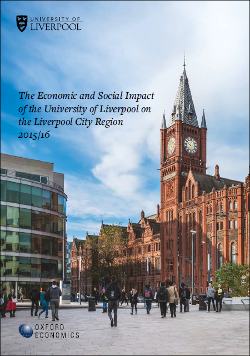
Oxford Economics was commissioned by the University of Liverpool to investigate its economic and social impact on the Liverpool City Region.
Together with its students and their visitors, the University of Liverpool generated a £652 million gross value added contribution to the Liverpool City Region in 2015-16. One in every 57 jobs in the Liverpool City Region (some 10,790 in total) was supported by the University, its students and their visitors in 2015-16. The University is a driver of growth in the City Region; University-supported employment has increased 17 percent since 2011-12.
The report examined the wider impact of the University, on the City Region and beyond. We explore the University’s role as a supplier of graduate talent for the local economy, with 25 percent of 2014-15 graduates working in the Liverpool City Region six months after graduating. The impact of the University’s research is assessed, and the benefit to local businesses of being able to access facilities and experts. The University has a significant social impact; it is committed to widening participation, and many of its staff and students regularly devote time to volunteering.
Oxford Economics’ team is expert at applying advanced economic tools that provide valuable insights into today’s most pressing business, financial, and policy issues.
To find out more about our capabilities, contact:
Americas
Diantha Redd
+1 (646) 503 3052
Email
Asia Pacific
Peter Suomi
+65 6850 0110
Email
EMEA
Aoife Pearson
+44 (0)203 910 8054
Email
Related Services

Post
KPMG M&A Outlook 2026: Between Uncertainty, Resilience, and Seizing Opportunities
Discover how Germany’s M&A landscape is evolving – with a focus on growth, AI and post-merger value creation.
Find Out More
Post
Silver, the next generation metal
This report highlights the critical role silver plays in data centres and artificial intelligence (AI), automotive and electric vehicles (EVs), and solar energy photovoltaics (PVs). With these sectors expected to expand significantly over the coming years, we expect future silver demand to be strong.
Find Out More
Post
Powering the UK Data Boom: The Nuclear Solution to the UK’s Data Centre Energy Crunch
The UK’s data centre sector is expanding rapidly as digitalisation, cloud computing, and artificial intelligence (AI) drive surging demand for high-performance computing infrastructure.
Find Out More