
Blog | 27 Feb 2023
Forecasting the impacts of climate change is essential to meet the net zero agenda

Abby Samp
Director, Industry Subscription Services

With extreme weather events becoming more common across the globe, climate and sustainability have been climbing up the agenda of policymakers and business leaders in recent years. Governments worldwide are intent on pursuing aggressive climate mitigation and adaptation policies—even under its most conservative scenario, the IEA’s Stated Policies Scenario (STEPS) sees fossil fuel demand peaking by 2030. Against such a backdrop, it is critically important for business to understand the risks and opportunities—both now and in the future.
Winners and losers from a Net Zero transition
With our newly launched Global Industry Climate Service, we quantify the macroeconomic impacts of five climate scenarios against a stated policies baseline for over 100 sectors. These scenarios include Net Zero Transformation, Net Zero, Delayed Transition, Sustainable Development and Climate Catastrophe.
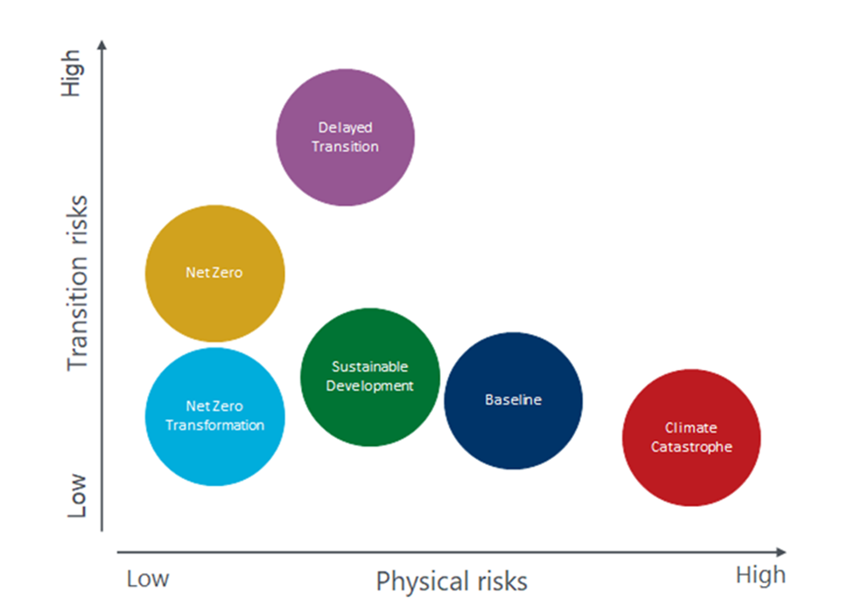
Our scenarios can help businesses understand the trade-offs and implications of climate mitigation policies across different sectors in the economy. For example, in our Net Zero scenario, governments implement stringent policies to reach Net Zero CO2 emissions in 2050. Globally coordinated carbon pricing, investment, and innovation support a move towards cleaner and more efficient energy consumption.
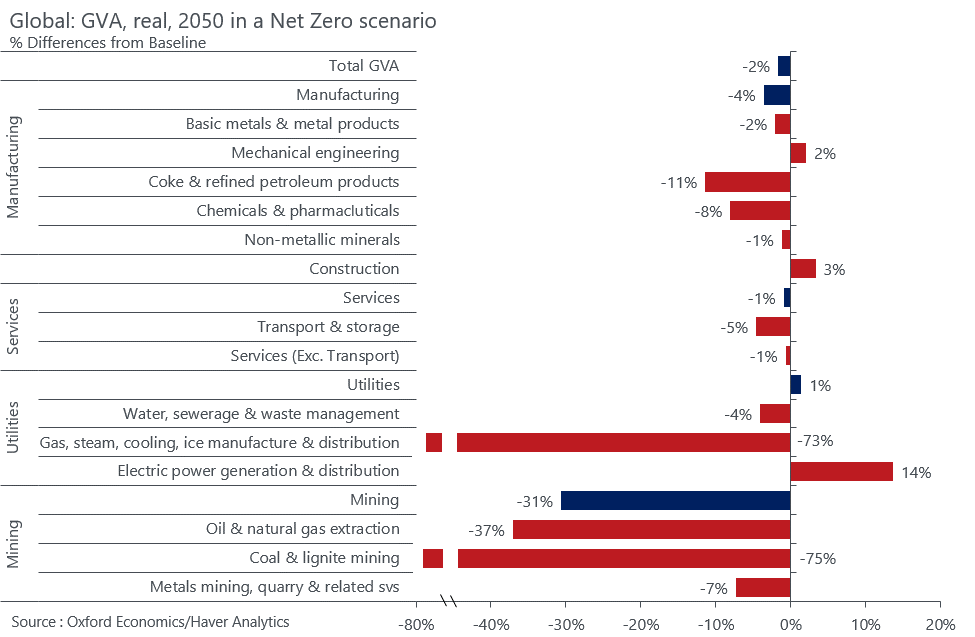
The impact of these policies will not be felt uniformly throughout the economy. The transition away from fossil fuel use sees a steep decline in energy mining and gas distribution. But this will be somewhat offset by a rise in electricity generation as economies electrify. Fuel costs rise significantly in energy-intensive industrial sectors—particularly those reliant on oil and coal.
Moreover, relative movements in sectoral energy prices—vis-à-vis both the economy-wide average and relative to the same sectors in other countries—are important drivers of output performance. As an example, we can compare the relative performance of French and German chemicals output in the Net Zero scenario. In Germany, the oil and gas price responses are slightly larger than in France. In addition, costs facing chemical firms in Germany rise more than in France relative to an economy-wide cost basket in both countries. Taken together, the result is that the output of German chemical producers declines more than for French producers relative to our baseline forecast by 2050.
While some sectors will face challenges, others will face opportunities. Demand for capital goods will benefit from the large-scale investments required for countries to achieve Net Zero. Globally, output rises relative to our baseline forecast in the machinery and construction sectors. There are further boosts within these sectors’ supply chains, even in energy-intensive sectors. Metals and building-materials, for example, are both energy-intensive sectors that initially see a large price shock in the Net Zero scenario. But throughout the scenario, they transition away from coal and towards greener sources of energy. Strong demand for these goods from transport, machinery, and construction brings them back towards the baseline forecast by 2050.
Author
Abby Samp
Director, Industry Subscription Services
Abby Samp
Director, Industry Subscription Services
London, United Kingdom
Abby is the Director of Global Industry Subscription Services, where she oversees service developments, helps shape the global industry overview and monitors and updates the forecast for the high-tech sector. Abby manages developments to Oxford Economics’ Global Industry Model (GIM), has extensive experience in modelling and scenario-based project work.
Abby has a BASc in Economics from McGill University in Montreal, where she graduated with great distinction and received the Hubert Marleau prize for top marks in economics. She also holds an MSc in Econometrics and Mathematical Economics from the London School of Economics and Political Science, where she graduated with distinction.”
Tags:
You may be interested in

Post
Key take-aways from COP30
COP 30’s agenda had placed a strong emphasis on countries’ implementation of their emissions reduction target and, for the first time, several workstreams included discussions on unilateral trade policies.
Find Out More
Post
COP 30 in focus: How to stay the course on the path to Net Zero
EMDEs are projected to account for 70% of global CO₂ emissions by 2050, making accelerated emissions reductions in these economies essential. Yet gaps in AE leadership—such as US policy rollbacks and insufficient climate finance—risk slowing the global transition.
Find Out More
Post
COP30 in focus: The economic cost of a warmer world
As COP30 approaches, we explore the economic cost of a warmer world and why adaptation and resilience must be at the heart of climate action.
Find Out More