


Research Briefing
| Jul 22, 2022
Italian policy vacuum in an unfavourable economic context
 The resignation of Prime Minister Mario Draghi is going to leave a policy vacuum in Italy. Snap elections are now very likely and will probably be held in October, around six months earlier than planned, leaving the country without a fully functioning government for the next few months, in an unfavourable economic context.
Research Briefing
| Jul 22, 2022
Italian policy vacuum in an unfavourable economic context
The resignation of Prime Minister Mario Draghi is going to leave a policy vacuum in Italy. Snap elections are now very likely and will probably be held in October, around six months earlier than planned, leaving the country without a fully functioning government for the next few months, in an unfavourable economic context.

 The ECB’s decision to hike rates, abandon forward guidance and introduce an anti-fragmentation tool appear to reflect a balancing act between the more hawkish and dovish council members as well as between the upside risks to inflation and the increasingly clouded growth outlook. On balance, we think the outcome of the meeting is a net positive and marginally dovish.

 Despite a better start to 2022 than previously estimated, we have kept our forecast for this year unchanged due to downward revisions in H2 2022. Downside risks to activity are mounting, with high inflation increasingly passing through to core prices, squeezing real incomes and denting confidence. Meanwhile, energy prices remain elevated, and gas rationing in Europe this winter is increasingly likely.


 2022 is proving to be a very disappointing year for global GDP growth, with risks that the outlook could worsen. But many cities are out-performing their national economies. Some are seeing strong rebounds in tourism and hospitality; a few are helped, not hurt, by higher global commodity prices, whereas others face manufacturing challenges. For Chinese cities the pandemic is still a big problem, but fortunately inflation is not the issue that it is elsewhere.
 We have cut our 2022 GDP growth forecast for Denmark by 0.7ppts to 3.1% to reflect the prospect of energy shortages in Europe. As a net importer of natural gas via Germany, who is seeing reduced supply from Russia, Denmark is highly likely to see some degree of industrial gas rationing over the winter months.

 Global economic uncertainty remains elevated, despite an easing in concerns about the fallout from war. Evidence suggests risks to growth are significantly greater than prior to the pandemic.

 Increased borrowing costs are raising corporate default fears in the US, but we believe higher interest rates alone won’t be sufficient to spur a significant jump in defaults. We think businesses are well-positioned to stand the heat due to a high degree of liquid assets and long debt maturity profiles, plus healthier interest coverage and lower leverage ratios than pre-pandemic.

 Supply chain dynamics improved for the third straight month in June, according to our tracker. Pressures eased most on the inflation front, though prices were still very high. Logistics faced less challenges as logjams declined and shipping prices retreated. Stress declined on the inventories front and there was a healthier balance between labor demand and supply.

 We expect eurozone services prices to continue to rise sharply over the summer as the sector’s recovery progresses. The ECB will see this as validation for the series of rate hikes it has signalled – we expect a cumulative 150bps of hikes by end-2022. Any upside surprises from core and especially services inflation will just add pressure to tighten faster.

 We now see gas rationing this winter in European economies most reliant on Russia as very likely. Our modelling finds that cutting final gas demand in Q4 by 10% via rationing with governments shielding households would mean severe contractions in industry and a direct loss of annual gross value-added from 1.5% to 4%. GVA losses would roughly double if gas rationing extends to Q1 2023.

 Surging inflation across Europe has led us to lower the outlook for real growth in consumer spending this year, although some cities such as Budapest, Lisbon, and Munich are still likely to see increases above 5%. Certain cities are also being affected by supply chain disruptions. Lisbon, Budapest, and Amsterdam top our forecasts for 2022 GDP growth, while central and eastern European cities lead over the medium term.

 Asian cities are facing several challenges to economic growth, including the slowdown of the Chinese economy, supply chain problems, and commodity price inflation. We have reduced our average GDP growth forecast from our March release for the 33 leading Asian cities to 2.9% in 2022. But post-Covid-19 recovery momentum and the return of tourism will lessen the pain for many cities.

 The short-term outlook for China’s major cities has deteriorated further since our last release in March. While the global surge in inflation is not being felt to any significant extent in China, the Omicron variant has led to more widespread and longer lockdowns—hammering consumer spending and the activity of the most vulnerable, consumer-reliant, sectors.

 The eurozone’s labour market has outperformed expectations since the start of the pandemic, but current headwinds to economic growth are mounting and will adversely impact employment into 2023. A mix of domestic reopening tailwinds and looser travel restrictions will support employment growth in the first half of 2022 and helps underpin our GDP forecast for this year.

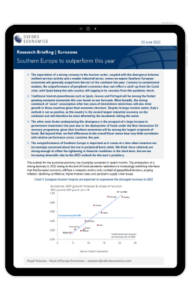 The expectation of a strong recovery in the tourism sector, coupled with the divergence between resilient services activity and a weaker industrial sector, means we expect Southern European economies will generally outperform the rest of the continent this year. Contrary to conventional wisdom, the outperformance of peripheral economies does not reflect a catch-up from the Covid crisis, with Spain being the only country still lagging in its recovery from the pandemic shock.
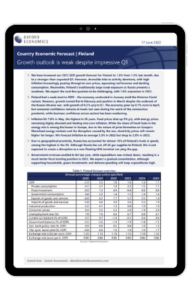 We have increased our 2022 GDP growth forecast for Finland to 1.8% from 1.5% last month, due to a stronger-than-expected Q1. However, downside risks to activity dominate, with high inflation increasingly passing through to core prices, squeezing real incomes and denting consumption.

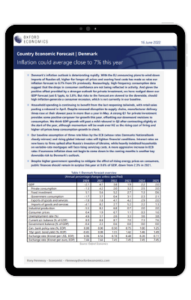 Denmark’s inflation outlook is deteriorating rapidly. With the EU announcing plans to wind down imports of Russian oil, higher-for-longer oil prices and soaring food costs has made us raise our inflation forecast to 6.7% from 5% previously. Reassuringly, high-frequency consumption data suggest that the drops in consumer confidence are not being reflected in activity.
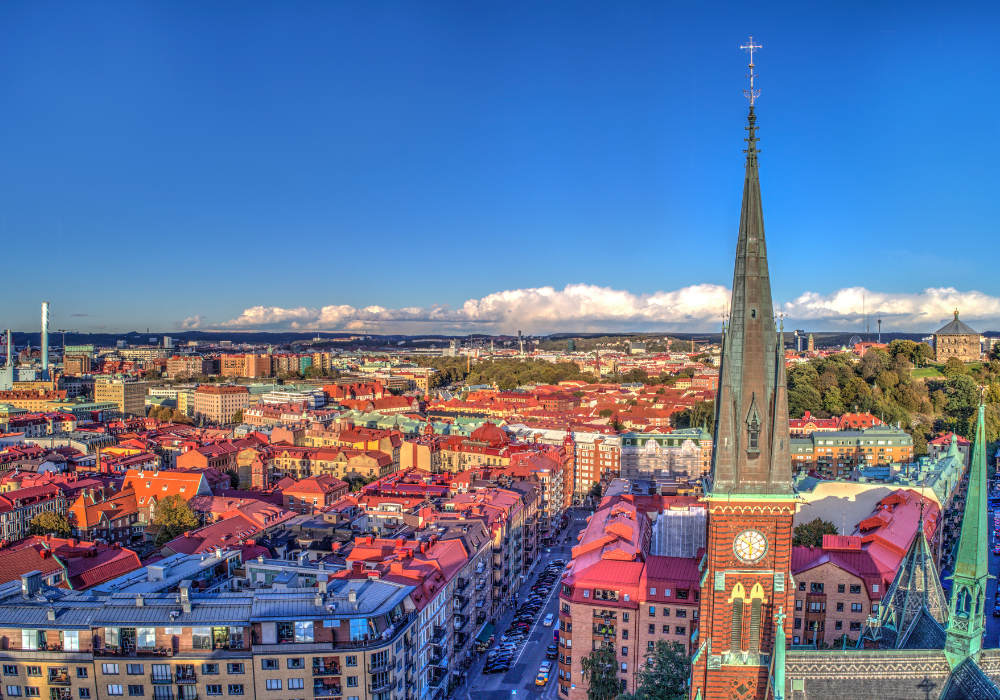
 We have lowered Sweden’s growth outlook for this year to 2.1% from 2.6% last month, a move largely driven by revisions to the past few quarters. The overall picture, though, is little changed, with inflation eroding real incomes and private consumption, while prompting accelerated monetary policy tightening.
