

The Model Assistant in action: What would an escalating Iran war mean for bond yields?
In Part 1 of this series, we introduced the AskOEAI Model Assistant, the world’s first AI assistant for scenario modelling, and explained why we built it. In this post, we put it to work on a question many of our clients are asking right now: what would a renewed escalation of the war in Iran mean for the global economy, and for government bond yields in particular?
The question: what if the war in Iran escalates again?
The war in Iran has already pushed up energy prices and unsettled financial markets. Renewed attacks on shipping and energy infrastructure in the Gulf have lifted oil prices, and global bond markets have sold off sharply. The US 10-year Treasury yield has climbed above 5% for the first time since 2007, and the Federal Reserve raised interest rates in September for the first time since 2023, as we discuss in our latest analysis of the bond sell-off.
Our baseline forecast already reflects the conflict and the market moves seen so far. What many clients want to know is what happens if the war escalates again: how far could energy prices rise, how would inflation and central banks respond, and how much higher could bond yields go? So we asked the Model Assistant, walking through four simple steps:
- Describe your scenario in your own words, as broadly or as specifically as you like.
- Research the scenario with the assistant, drawing on Oxford Economics’ analysis to propose shocks, their timing and the reasoning behind each.
- Review and adjust inputs as required, then run the scenario through the GEM with a single click or message.
- Analyse the results through charts and explanations, then refine your assumptions and re-solve as often as you need.
Describe the scenario in your own words
We started with a single prompt: “Model a scenario of new and sustained escalations in the war in Iran”
We didn’t specify any indicators, shock sizes or timings. In its first response, the assistant pulled in the most relevant Oxford Economics research and set out a complete first draft of the scenario.
The assistant based its calibration on the downside case from our research on a prolonged Iran war, which points to sustained energy disruption, higher inflation risk premia and increased long-term borrowing costs. It translated these channels into four shocks, starting in Q4 2026 (Table 1).
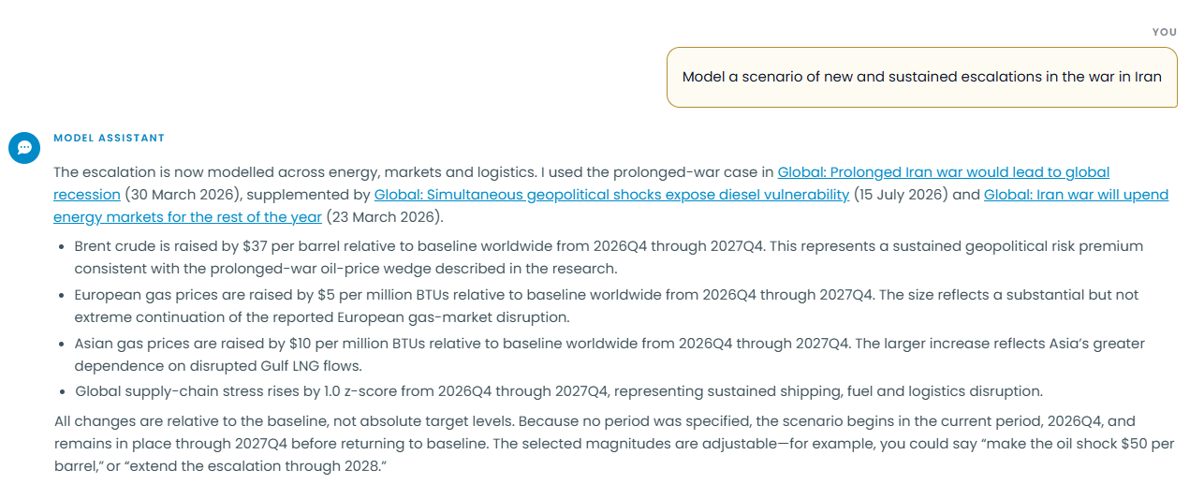
Table 1: Scenario inputs proposed by the Model Assistant
| Input | Assumption | Rationale |
| Brent crude oil price | +$37 from 2026Q4-2027Q4 | The elevated oil price path supported by prolonged-war downside case |
| European gas price | +$5 from 2026Q4-2027Q4 | Sustained LNG disruption and tighter European supply |
| Asian gas price | +$10 from 2026Q4-2027Q4 | Asian LNG markets’ greater exposure to prolonged disruption |
| Supply chain stress | +1.0 from 2026Q4-2027Q4 | Sustained disruption to shipping, logistics and refined-fuel movements |
Source: Oxford Economics AI Model Assistant
Each input comes with a short rationale and a preview chart showing how the scenario path compares with our baseline.
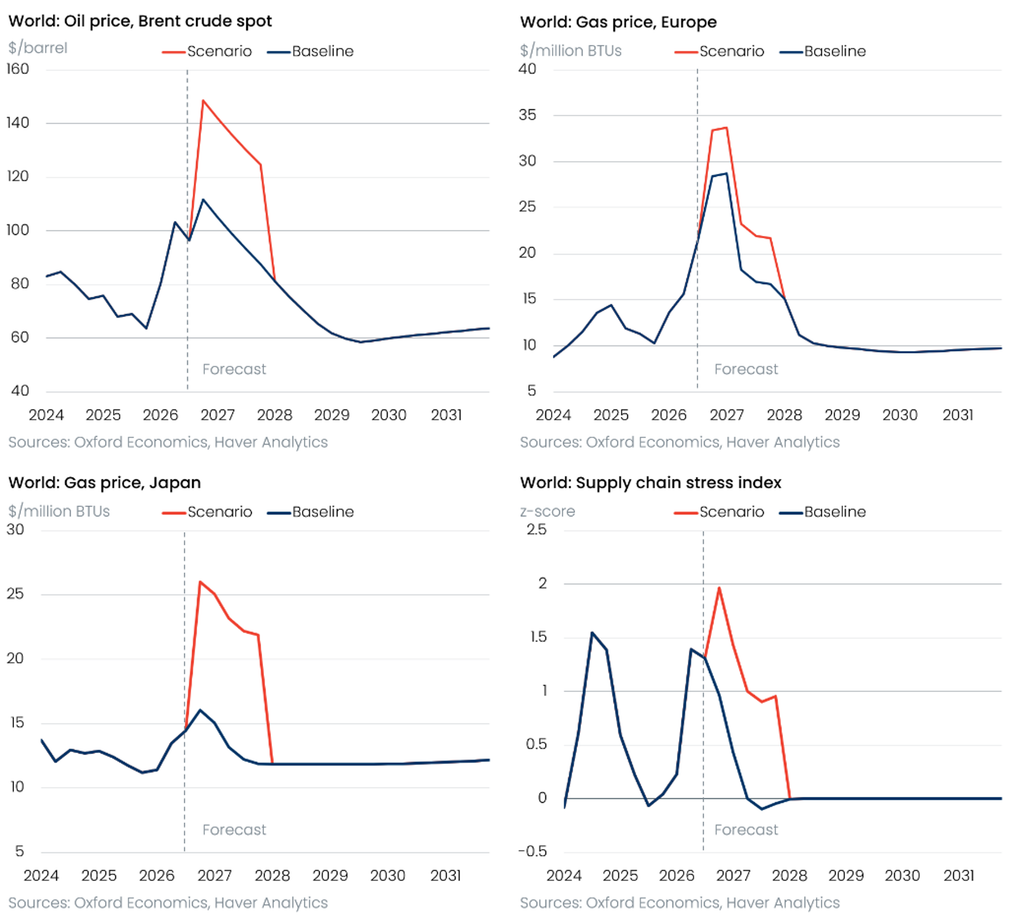
Run the scenario and review the results
Once we’re happy with the inputs, a single click on Solve runs the scenario through the GEM. The shocks feed through trade, prices, financial markets and policy responses across economies, and the results are automatically benchmarked against our latest baseline.
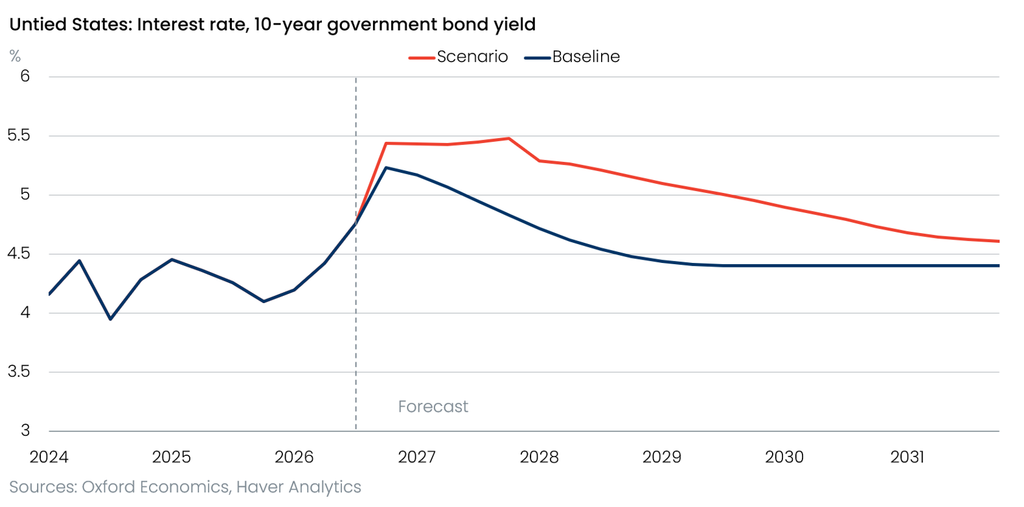
Once the scenario had solved, we asked for the impact on US yields, and the assistant returned a chart and a short summary. In our scenario, US 10-year government bond yields are 0.78 percentage points above baseline at their widest gap, in 2028Q2. Higher energy prices and supply-chain stress create inflation pressure and prompt a tighter monetary policy stance, keeping risk premia elevated, lifting yields and tightening financial conditions.
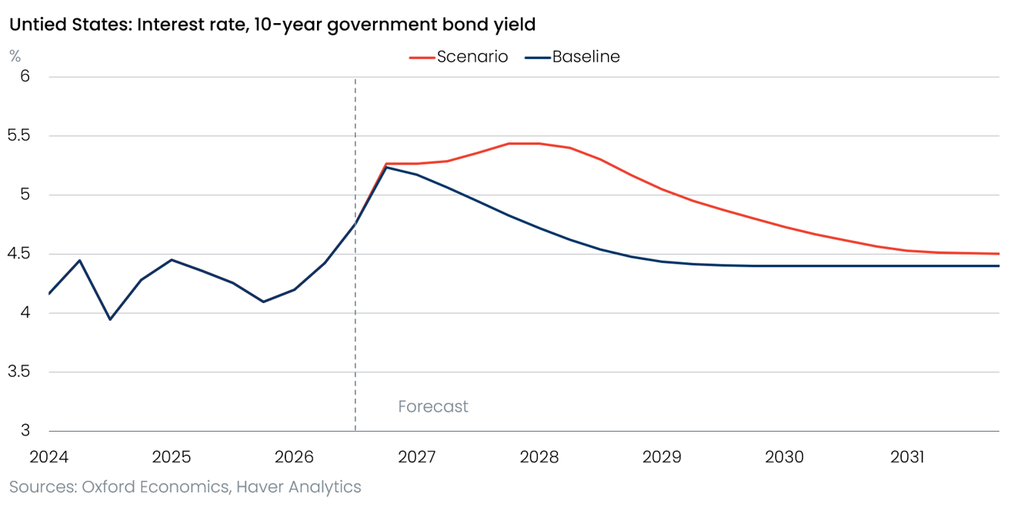
Understand what is driving the results
The assistant’s analysis pointed to a tighter monetary policy stance as a key factor behind the initial rise in yields. To understand this better, we asked the Model Agent: “How does the Fed react?”
Based on our initial assumptions, the assistant gave a concise description of the Fed’s “stagflationary trade-off”, along with further research to review. Higher inflation creates pressure to raise rates, while weaker growth and a softer labour market subsequently lead to rate cuts. This Taylor-rule mechanism drives policy-rate dynamics in the GEM, but users can take their own view and add a new assumption.
Refine the scenario through conversation
A scenario is rarely complete in one go. Having reviewed the results, we assumed a more hawkish Fed reaction: “Assume the Fed is more hawkish, raising rates by 50bps above the baseline until the energy shock subsides.”
The assistant added a fifth shock, raising the US policy rate by 0.5 percentage points above baseline from 2026Q4 to 2027Q4, until the energy shocks fade.
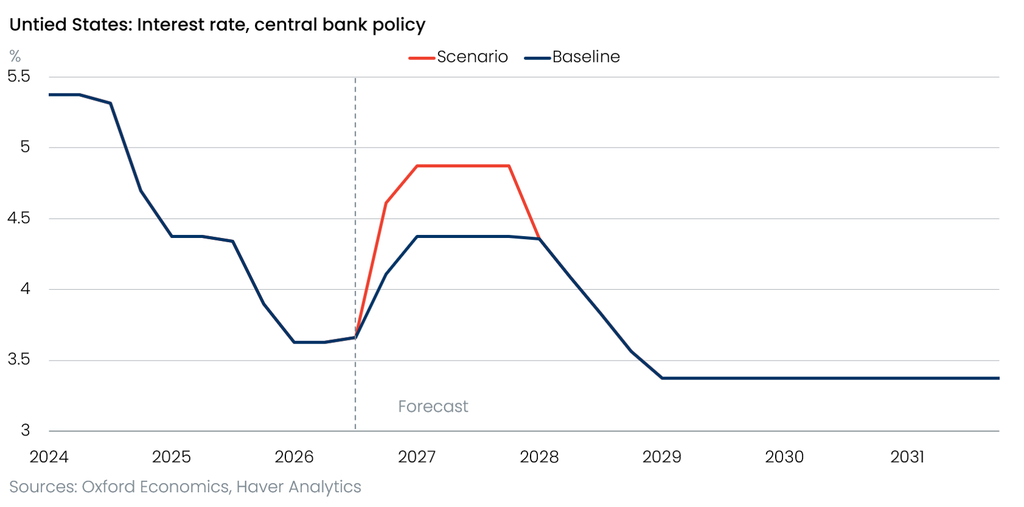
Adding the assumption means solving the scenario again, which takes a single click, and each version is traceable in the chat.
With a more hawkish Fed, US bond yields rise more quickly and stay higher for longer than in our first run. Comparing the two gives a range of ‘what-if’ outcomes under different assumptions, all built through conversation with the Model Assistant.
From economic question to modelled insight
In four steps, we went from a topical question to a fully modelled scenario grounded in our research, complete with charts and an explanation of the results. We didn’t need to know which variables to shock, by how much, or how to set up the model inputs. Every assumption was transparent and open to change, so we could question the results, adjust the shocks and re-solve within the same conversation.
The Model Assistant is designed to make scenario analysis quicker and open to more people, with economic judgement staying firmly with the user. To find out more about the problem it solves and what sets it apart from general-purpose AI tools, read part 1 of the series.
The Model Assistant is available as an add-on to the Global Economic Model. To see it in action, click here to request a demo.
