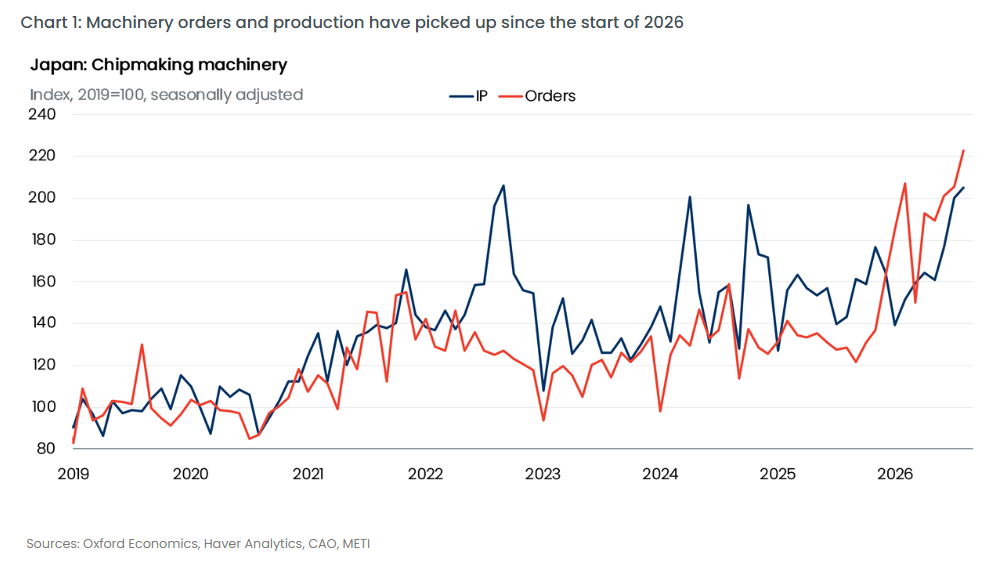
Japan’s AI Boom Benefits Chipmaking Machinery
We expect the benefits of the ongoing AI boom to Japan to mainly take the form of boosted demand for its chipmaking machinery, rather than for chips themselves. Surging demand for AI data centre chips over the past few years and intensive investment by chipmakers are starting to bolster chipmaking machinery production, an area where Japan has a material presence in the global market.
Unlike its neighbouring tech economies Taiwan and South Korea, Japan’s chip production lacks a focus on high-end logic and memory chips, leaving it less exposed to AI demand. Indeed, although Japan’s chip production has been rising since 2024, the increase has been modest relative to its peers.
Still, demand for Japan’s chipmaking machinery has started to pick up, as chipmakers have expanded their production capacity to meet the unprecedented global surge in AI spending. History suggests that orders for chipmaking machinery tend to precede chip production, as chipmakers invest based on their best guess of future demand. However, the unexpected strength of AI demand has caught chipmakers off guard, and the delayed increase in investment will sustain demand for chipmaking machinery for the next few years.
We think the benefits to Japan are unlikely to extend across the whole economy. Compared with Taiwan (43.1%), South Korea (32.6%), and Singapore (19.9%), the chip sector represents only 3.6% of manufacturing, even after accounting for chipmaking machinery. Moreover, production spillovers to other sectors are small compared with those of other major sectors, such as automotive, partly because of import leakage.