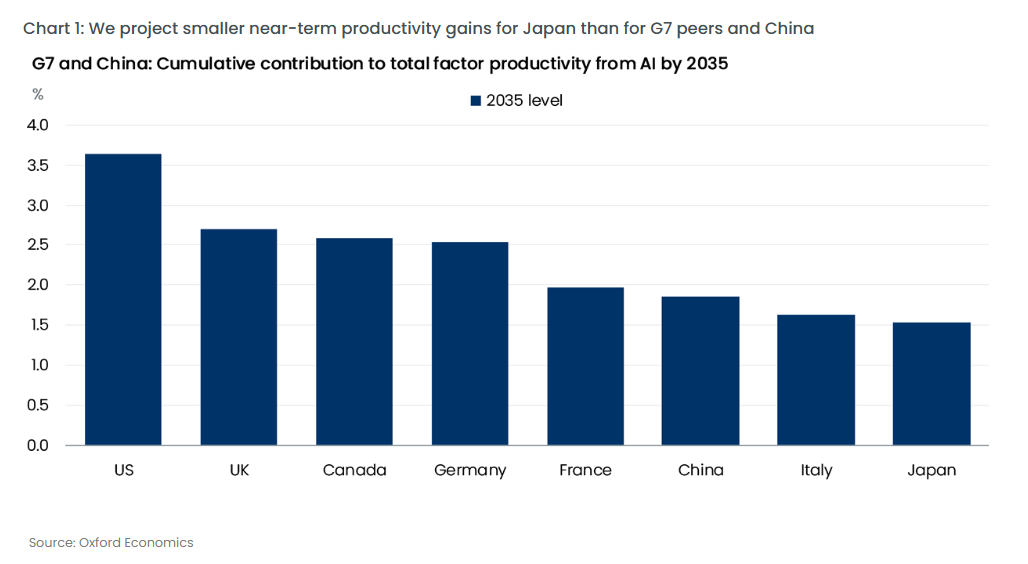
Japan sees limited AI-driven productivity gains in the near term
Generative AI should offer some support to Japan’s potential growth by boosting its total factor productivity, but less than in most other advanced economies in the near term. Slow adoption is likely to limit the gains.
We think Japan has significant potential to benefit from generative AI, given its relatively high exposure to and preparedness for AI technology. The recent acceleration in corporates’ software investment in response to Japan’s severe labour shortages appears to have laid some of the groundwork for AI utilisation, while the country’s ICT capital stock still lags far behind that of the US.
However, in practice, adoption of new tech is likely to be slow. Japan has lagged behind on digitalisation for many years. The shortage of IT personnel is a key bottleneck, particularly in small and medium-sized enterprises. Its adoption rate is beginning to fall behind those of other advanced economies and China.
There’s high uncertainty around AI’s impact on productivity. Our optimistic ‘AI breakthrough’ scenario features faster adoption and stronger productivity gains than in our baseline, pushing GDP 7ppts above our forecast by 2035. But this still wouldn’t fully offset the drag from the labour supply’s decline on potential growth.
On the downside, there’s considerable risk that the AI boost to workplace efficiency won’t translate into higher productivity at the macro level, given Japan’s rigid corporate structures and labour market practices, particularly among permanent employees. In a scenario of lower pass-through of efficiency gains from workers to the economy, together with slower adoption of the tech, Japan’s potential growth rate would turn negative by the mid-2030s.