
Blog | 15 Apr 2021
In emerging markets, the world is even less flat

In his recent blog post, Richard Holt explored whether Covid-19 will lead to a permanent flight from the cities as people and their employers make permanent their favourable pandemic experiences—thus taking a job once located in a major city to a quieter area with lower housing costs and a more relaxed lifestyle. While he could imagine that people in their 30s and 40s will move out of large cities like London to an even greater degree than before (and advertises Bordeaux!), Richard does not expect the pandemic to lead to a major reorganization of work and living patterns, as the pull of big city life will remain.
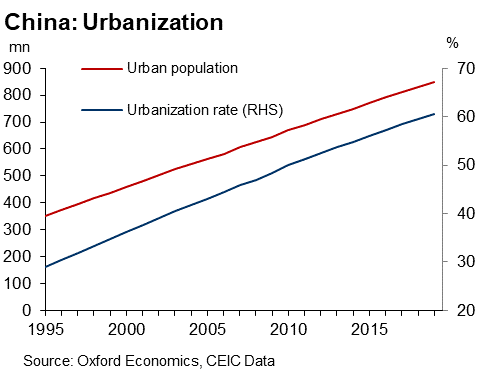
In most emerging market (EM) economies, it is even less likely for people to leave urban areas on a large scale, as the quality of life tends to be so much better there than in the rural areas where they come from. Take China, where hundreds of millions of people have migrated to cities in recent decades, drawn by higher incomes and better infrastructure and public services such as health and education. While infrastructure and services in the countryside have improved over time, the gap with cities remains vast. Indeed, since the outbreak of Covid-19 in February 2020, the number of people that have moved out of the large cities has remained small.
 Of course in several ways China is not representative of what is happening in EMs. For one, in various EMs, the economic damage caused by the pandemic and government lockdowns has been significantly larger than in either advanced countries or China. India is a case in point: many millions of people tried to return home to their place of origin when the government imposed a lockdown of urban economies in end-March 2020, and many of them have not returned to the cities—yet. But as the Indian post-pandemic recovery matures, most of those people will likely be keen to return to metropolitan areas, if they have the choice.
It is hard to generalize. Significant numbers of Indian white-collar workers enjoy remote working and some may end up living outside the largest cities because of their experience during Covid-19, similar to their British peers. But, generally speaking, in most EMs the charm of living in the countryside, or even in smaller cities, is less convincing than in advanced economies, making it less likely that large numbers of people will be keen to leave the big cities permanently.
Tags:
You may be interested in

Post
Asia’s cities are reshaping the world
From Seoul to Delhi and Shanghai, Asia’s urban centres are rapidly overtaking global rivals as living standards soar. What will this mean for the balance of global economic power?
Find Out More
Post
The rise of Southern India’s business service hubs
Over the next five years, India is set to be one of the fastest-growing major economies across Asia Pacific, lead by the performance of its IT and business services. The Southern states of Karnataka and Telangana are at the forefront of this success as they are home to two of India’s most rapidly growing cities and productive cities—Bengaluru and Hyderabad.
Find Out More
Post
The Green Leap: More promises but little innovation at COP30
The COP30 in November made some ambitious commitments to scaling up climate finance. Until those materialise, initiatives to leverage natural endowments for financing may be more attractive to African countries, especially those with high forest cover.
Find Out More