
Recent Release | 10 Jan 2023
The Global Green Economy: Understanding and capturing the opportunity

Economic Consulting Team
Oxford Economics

As each year passes, the climate emergency facing the planet becomes ever more alarming. But this trajectory is increasingly being met by the rapid emergence of new technologies and expertise that are focused on tackling it. As a result, we can now discern the emergence of a future green economy; one that harnesses human ingenuity to protect the planet’s future.
But what is the green economy? How large is it? How will it grow? And how can it be developed in a way that drives prosperity and inclusiveness, as well as environmental sustainability?
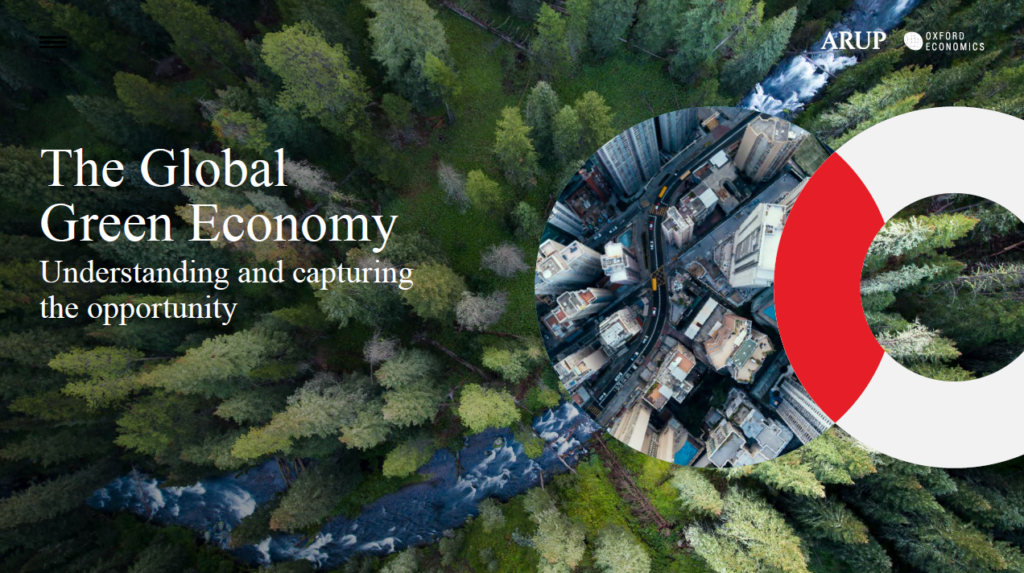
These are the questions that a team of climate specialists, industry experts and economists from Arup and Oxford Economics spent the last 12 months addressing. Our goal is to help governments, investors and communities better understand the opportunities a green economy represents. In this study, we provide a new resource to support the strategic economic decision making required to seize those opportunities, and to place the global economy on an environmentally sustainable track. We estimate that the transition to a net zero emissions environment by 2050 will create new industries worth $10.3 trillion to the global economy by that same year.
The study addresses three key questions:
• What is the green economy, and what economic activities represent it?
• What is the size of the green economy? And what opportunities does the world’s transition to a net zero emissions environment present?
• How can countries and companies identify and capture the right green economy opportunities?
Download the report
About the team
Our Economic Consulting team are world leaders in quantitative economic analysis, working with clients around the globe and across sectors to build models, forecast markets and evaluate interventions using state-of-the art techniques. Lead consultants on this project were:

James Lambert
Director of Economic Consulting, Asia
+65 6850 0118
James Lambert
Director of Economic Consulting, Asia
Singapore
James is the Director of Oxford Economics’ economic consulting services in Asia.
James moved to this role from Oxford Economics’ London office, where he headed up a team dedicated to exploring the economic impact of technology. He delivered high profile studies on the growth of the digital economy, the impact of automation and the implications for the labour market.
Prior to joining Oxford Economics, James spent over six years in the Government Economics Service. He worked in economics teams of the Cabinet Office, the Foreign and Commonwealth Office and the Department for Transport. There, he gained experience in microeconomic analysis and impact assessment as well as international macroeconomics, economic risk analysis and energy security. In the FCO, James spent three years working on economic issues in East and South East Asia. He also previously worked for the International Labour Organization.

Matthew Tinsley
Lead Economist, Economics & Sustainability
+44 (0) 203 910 8000
Matthew Tinsley
Lead Economist, Economics & Sustainability
London, United Kingdom
Matt joined Oxford Economics’ Economic Impact team in 2014. In his time with the company, he has worked on a diverse range of Economic Impact studies, including in the creative industries, tourism and retail sectors.
Between 2019 and 2022, Matt was based in our Singapore office, supporting the development of a specialist Economic Impact team there, before relocating back to London to work in the Economics and Sustainability team. Matt holds both a BSc (Hons) and an MSc (Hons) in Economics, from the University of Bristol.

Tom Rogers
Associate Director, Capital Projects and Assets Consulting
+44 (0) 203 910 8047
Private: Tom Rogers
Associate Director, Capital Projects and Assets Consulting
London, United Kingdom
You might be interested in

Policymakers must be honest about the winners and losers of clean energy transition and building a green economy
Achieving a net zero and carbon neutral world by 2050 is the defining challenge of our age. It relies on many partners working together to shoulder great costs, and to do so as equitably and efficiently as possible. It is important for policymakers to be honest about the challenges businesses, investors, and consumers will have to face if we are to halt global warming on the sort of timescales scientists are telling us is necessary.
Find Out More
Competing on climate: Rewards are there for those who prioritise transition towards a green economy
Is a poor understanding of the advantages of going green the reason less than a third of companies have actually taken action to attain their sustainability goals? Competitive opportunities in industry disruption, new green markets and productivity gains from mitigation all await those with the necessary green ambitions and associated strategy to take advantage of the green opportunities.
Find Out More
$10.3 trillion: the value of the green economy opportunity
Greening the global economy – an Arup / Oxford Economics advisory perspective series The scientific consensus is clear: the impact of a failure to tackle climate change will be devastating. Higher concentrations of pollutants such as CO2 will push average temperatures up across the world, causing rising sea levels and extreme weather events that will…
Find Out More
Cresting the wave: businesses must navigate a course towards sustainability
Amid intensifying pressure from consumers, employees, regulators, and investors, businesses are steadily progressing from the early stages of sustainability target-setting to the complex and expensive work of implementation.
Find Out More