
Republic of Moldova: Bracing for domestic and external Covid-19 shocks
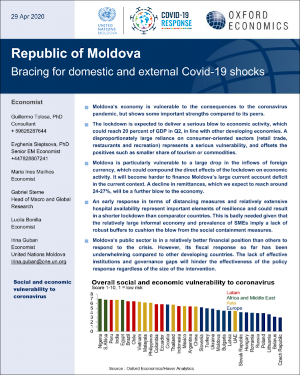
In a report commissioned by the UN, we highlight that Moldova’s economic structure – highly reliant on consumption and remittances – makes it particularly vulnerable to the effects of social distancing measures, both at home and abroad.
The report highlights:
- Moldova’s economy is vulnerable to the consequences to the coronavirus pandemic, but shows some important strengths compared to its peers.
- The lockdown is expected to deliver a serious blow to economic activity, which could reach 20 percent of GDP in Q2, in line with other developing economies. A disproportionately large reliance on consumer-oriented sectors (retail trade, restaurants and recreation) represents a serious vulnerability, and offsets the positives such as smaller share of tourism or commodities.
- Moldova is particularly vulnerable to a large drop in the inflows of foreign currency, which could compound the direct effects of the lockdown on economic activity. It will become harder to finance Moldova’s large current account deficit in the current context. A decline in remittances, which we expect to reach around 24-27%, will be a further blow to the economy.
- An early response in terms of distancing measures and relatively extensive hospital availability represent important elements of resilience and could result in a shorter lockdown than comparator countries. This is badly needed given that the relatively large informal economy and prevalence of SMEs imply a lack of robust buffers to cushion the blow from the social containment measures.
- Moldova’s public sector is in a relatively better financial position than others to respond to the crisis. However, its fiscal response so far has been underwhelming compared to other developing countries. The lack of effective institutions and governance gaps will hinder the effectiveness of the policy response regardless of the size of the intervention.
Lead consultants on this project were:
Oxford Economics’ team is expert at applying advanced economic tools that provide valuable insights into today’s most pressing business, financial, and policy issues.
To find out more about our capabilities, contact:
EMEA
Corinna Hoyer
+49 (0)69 96 758 658
Email
Americas
Leondardo Loffler
+1 (646) 503 3059
Email
Asia
Rhianne Clark
+65 6850 0112
Email