Recent Release | 11 Jul 2022
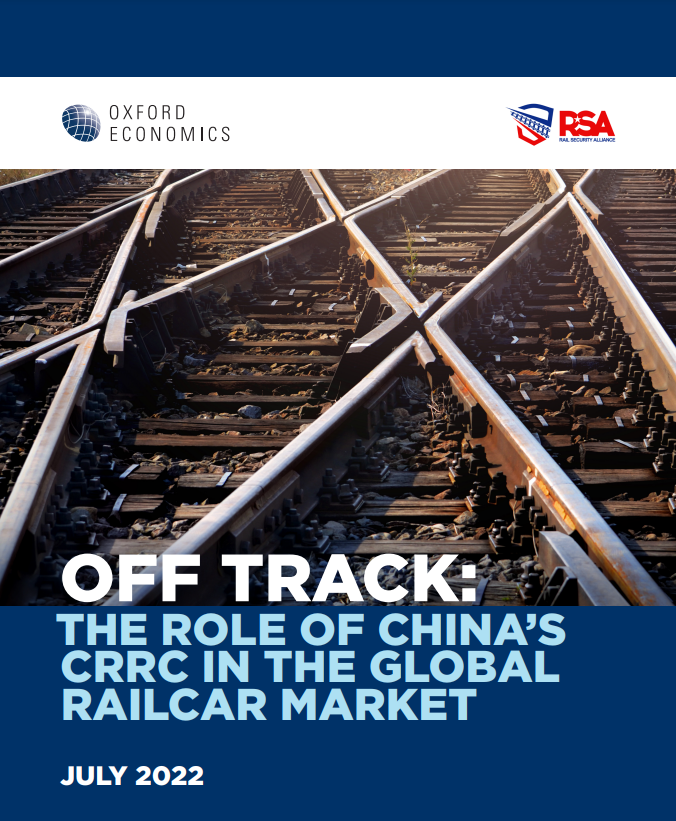
Off Track – The role of China’s CRRC in the Global Railcar Market

Economic Consulting Team
Oxford Economics
This report for the Rail Security Alliance explores the role of Chinese state-owned enterprise (SOE) CRRC in the global railroad rolling stock market. It quantifies explicit Chinese government subsidies to CRRC; considers likely additional implicit subsidies; explores the history of Chinese SOE reform and recent policy towards national champion SOEs, and how these apply to CRRC; and considers the Chinese government’s strategic interest in the global rail industry. Finally, the report explores the available data relating to CRRC’s rolling stock sales outside of mainland China, particularly in the North American market.

With $35 billion in total revenue in 2021, CRRC, the Chinese state-owned railroad rolling stock manufacturer, is the largest player in the $71 billion global railroad rolling stock industry. According to its annual reports, CRRC received $271 million in explicit Chinese government subsidies in 2020, and nearly $1.3 billion total between 2015 and 2020. Estimates by other researchers show that implicit Chinese government subsidies to state-owned enterprises (SOEs) are on average about three times as large as explicit subsidies.
Under the management of the State-owned Assets Supervision and Administration Commission (SASAC) since 2003, Chinese SOEs have been encouraged to “go big and go global” through domestic consolidation and expansion, and through foreign mergers and acquisitions. The effect of this mercantilist policy has been for national champion SOEs like CRRC to capture their domestic markets, using the economic rents so generated to finance global expansion. As reflected in planning documents, the selection of industries for national champions reflects the strategic interests of the Chinese government. In the case of rail, the government’s strategic interest is transparent and is laid out in the Belt and Road Initiative (BRI)—China seeks to dominate an integrated global rail transportation network based on Chinese technical standards.
Between 2015 and 2020, CRRC won seven passenger rail projects in North America worth over $4.3 billion. It undercut the next lowest bidder on these projects by an average of 21%. However, despite the goals of the BRI, there is not clear evidence of a clear upward trend in CRRC’s penetration of rolling stock markets outside mainland China. The reason for CRRC’s failure, thus far, to significantly expand its share of these foreign markets is not certain, but likely reflects the long lead time of rail projects, as well as the success of investment restrictions by other countries against Chinese rail imports.
About the team
Our Economic Consulting team are world leaders in quantitative economic analysis, working with clients around the globe and across sectors to build models, forecast markets and evaluate interventions using state-of-the art techniques. Lead consultants on this project included:
Hamilton Galloway
Head of Consultancy, Americas
Hamilton Galloway
Head of Consultancy, Americas
New York, United States
Hamilton Galloway joined Oxford Economics in 2014 as Head of US Consultancy – a team focused heavily on developing quality, customized research, analysis and impact modeling services for a range of private and public organizations. Prior to joining Oxford Economics, Mr. Galloway worked nearly seven years as an economist, senior consultant and manager at Economic Modeling Specialists Int (EMSI), a data and analytic company based in the US.
Mr. Galloway’s work included building a consultancy presence in the US, conducting bespoke economic and labour market research and engaging public and private sector clients. In 2013/14 he lived and worked in the UK as a senior consultant, focusing on developing data-driven, decision-making analytics and reports for use across public entities and education. He has authored numerous reports, publications, as well as economic development user guides and even a textbook chapter.
You might be interested in
Post
How Leading CPG Companies Understand Their Economic Footprint
Blog Off Track – The role of China’s CRRC in the Global Railcar Market Understanding the broader economic role of a business is becoming increasingly important for companies in the consumer goods and services sector. Decisions around new product launches, facility expansions and supply chain investments ripple far beyond the balance sheet—shaping communities, supporting suppliers…

Find Out More
Post
From Farm to Table: The Philippine Agri-Food Economy in 2025 and the Road to Competitiveness
This report assesses the Philippines’ agri-food system, from agricultural production and food and beverage (F&B) manufacturing, to the wholesale, retail, and hospitality distribution networks that bring F&B to market. We quantify the economic contribution of the local agri-food sector, document the challenges faced by Philippine agri-businesses due to the tightening operating environment and shifting trade patterns, and outline a practical path to navigate these headwinds.
Find Out More
Post
Economic Impact of The Pitt Season One in California
The production of The Pitt, Season One resulted in nearly $87 million in total spending across California in 2024. The production spent $62.2 million (72% of the total spend) on wages and salaries for local production cast and crew, and $24.8 million (28%) on goods and services supplied by local businesses.
Find Out More
Post
Powering Growth: How Data Centres Are Reshaping APAC Economies
At Oxford Economics, we help you surface and quantify those contributions, turning anecdotes into evidence. Our Economic Impact Consulting team builds defensible models that capture direct, indirect, and induced impacts, plus catalytic effects that are often missed, such as supplier development, skills formation, productivity gains, and infrastructure upgrades. We translate your operational data into board and regulator ready insights on jobs, GVA, incomes, and tax across construction and operations, at city, provincial, and national levels. We also run forward looking scenarios, including AI driven load growth, power and carbon forecast, and policy shifts, so you can credibly articulate both today’s impact and tomorrow’s trajectory. The result is a clear country level value story that strengthens stakeholder trust, supports siting and incentives, and helps you scale with confidence.
Find Out More