OE Logo
Research Briefing | Jul 13, 2021

APAC | Limited vaccination holds back recoveries
image of the research briefing

A string of new Covid-19 outbreaks is weighing on the APAC region’s economic recovery. Among Asia’s developed economies, the case load is low compared to other nations. But, amid low tolerance for the coronavirus, upsurges in Japan in April, Taiwan in May, and South Korea and Australia more recently have led to renewed anxiety and government restrictions. Among Asian emerging market (EM) economies, following the crisis in India, there have recently been serious flare-ups in Thailand, Indonesia and,
especially, Malaysia. 

What you will learn:

  • ONew outbreaks of Covid-19 are weighing on APAC’s economic recovery. The
    economic impact of outbreaks is relatively large because of generally low vaccination rates, combined with low tolerance to the virus in several places.
  • China and Singapore have seen large increases in vaccinations. But in China’s case, given low tolerance to the virus, even small Covid-19 flare ups have led to stringent local restrictions and dampened confidence.
  • In many other APAC economies, where less than 20% of the population has been fully vaccinated, recent Covid-19 outbreaks are having a significant impact on behaviour and policy. Many governments in the region have recently tightened restrictions, leading to delays in recoveries. Indeed, we expect growth
    in APAC ex-China to be relatively subdued in 2021.
  • Fortunately, APAC economies will eventually be able to vaccinate enough people to raise the level of immunity and thus become less vulnerable to Covid- 19 outbreaks. Also, Covid-19 challenges and vulnerabilities notwithstanding, we remain relatively optimistic about Asia’s medium-term outlook.

Read more

Research Briefing | Jul 13, 2021

APAC | Limited vaccination holds back recoveries

image of the research briefing

A string of new Covid-19 outbreaks is weighing on the APAC region’s economic recovery. Among Asia’s developed economies, the case load is low compared to other nations. But, amid low tolerance for the coronavirus, upsurges in Japan in April, Taiwan in May, and South Korea and Australia more recently have led to renewed anxiety and government restrictions. Among Asian emerging market (EM) economies, following the crisis in India, there have recently been serious flare-ups in Thailand, Indonesia and,
especially, Malaysia. 

What you will learn:

  • ONew outbreaks of Covid-19 are weighing on APAC’s economic recovery. The
    economic impact of outbreaks is relatively large because of generally low vaccination rates, combined with low tolerance to the virus in several places.
  • China and Singapore have seen large increases in vaccinations. But in China’s case, given low tolerance to the virus, even small Covid-19 flare ups have led to stringent local restrictions and dampened confidence.
  • In many other APAC economies, where less than 20% of the population has been fully vaccinated, recent Covid-19 outbreaks are having a significant impact on behaviour and policy. Many governments in the region have recently tightened restrictions, leading to delays in recoveries. Indeed, we expect growth
    in APAC ex-China to be relatively subdued in 2021.
  • Fortunately, APAC economies will eventually be able to vaccinate enough people to raise the level of immunity and thus become less vulnerable to Covid- 19 outbreaks. Also, Covid-19 challenges and vulnerabilities notwithstanding, we remain relatively optimistic about Asia’s medium-term outlook.

Read more

Research Briefing | Jul 13, 2021

Global | The slowdown in global liquidity is no cause for alarm

Although none of the big four central banks have started tapering their QE programmes yet, monetary aggregates are being pinched from different sides, bringing global liquidity dynamics slowly back to pre-crisis levels. Liquidity may still be abundant, but it’s no longer growing and in some major economies is even beginning to retreat.

Read more

Research Briefing | Jul 12, 2021

Finland | We expect a strong rebound in Q2

Finland | We expect a strong rebound in Q2

Following a mild contraction in Q1, the Finnish economy is now in the early
stages of a broad-based recovery. Most national restrictions have been eased, reflecting a fall in Covid cases, and 75% of the adult population having received at least one vaccine dose, among the highest in the EU. Our forecast for growth this year is unchanged at 2.5%, before a slowdown to 2.1% in 2022.

Read more

Oxford Economics in collaboration with the EPRA have launched two reports analysing the impact of the COVID-19 crisis on European listed real estate.

James Lambert participated and spoke virtually at the 2021 World Artificial Intelligence Conference (WAIC) in Shanghai on 8th July 2021 on What does AI mean for the accountancy sector? The event was also attended by other tech giants across the globe such as Microsoft, Alibaba Group and many more.

Research Briefing | Jul 8, 2021

MENA | OPEC+ talks break down, Saudi tariffs, PMIs

MENA | OPEC+ talks break down, Saudi tariffs, PMIs

OPEC+ negotiations to raise oil production in the coming months are in
deadlock as the UAE opposed an extension of the deal beyond the current end date of April 2022. Talks were abandoned with no date set for the next meeting and oil prices jumped to a three-year high of almost US$78pb, before retreating.

Read more

Research Briefing | Jul 7, 2021

London Monitor | The economy is moving forward despite a rise in Covid cases

London Monitor | The economy is moving forward despite a rise in Covid cases

There has been a rise in Covid 19 cases , exacerbated by the more transmissible Delta variant. As a result, the Oxford Economics Normality Tracker shows London’s return to normality slowed in May and the start of June. London now lags other major European cities.

Read more

Research Briefing | Jul 6, 2021

UK | Freedom day to bolster recovery, but Covid rates a worry

UK | Freedom day to bolster recovery, but Covid rates a worry

The government’s announcement that most of the remaining Covid restrictions are likely to be removed on July 19 has bolstered our confidence in the strength of the UK’s recovery. We expect UK GDP to grow nearly 8% this year.

The link between Covid cases and hospitalisations appears to have weakened significantly. But with case numbers rising sharply and new variants still a potential threat, the UK cannot be complacent.

Read more

Research Briefing | Jul 6, 2021

Indonesia | Delayed fiscal consolidation unlikely to raise debt risks

Ipad Frame (55)

Due to ongoing pandemic-related spending needs, we now expect Indonesia’s fiscal deficit will narrow to 3% of GDP only by 2024, a year later than we anticipated last year. Our latest forecast assumes a slight fiscal expansion in 2021 and a gradual reduction in deficits from 2022 onwards.

Read more

Research Briefing | Jul 5, 2021

Canada | Acceleration in vaccines will boost economy in the remainder of 2021

With a second surge of COVID in April, Canada sustained a longer lockdown than the US. GDP climbed 1.4% in the first quarter while employment increased 0.2%. Vaccinations accelerated in the quarter, pushing the rate to just under 20% of the population fully vaccinated. Rates are expected to be on par with the US by September, which should boost GDP to its 2019 peak in Q3 2021.

Read more

Research Briefing

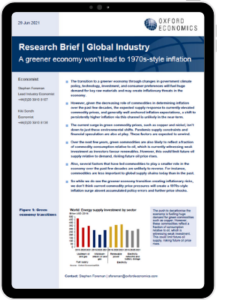
A greener economy won’t lead to 1970s-style inflation

Global | A greener economy won’t lead to 1970s-style inflation

The transition to a greener economy through changes in government climate policy, technology, investment, and consumer preferences will fuel huge demand for key raw materials and may create inflationary threats in the economy.
However, given the decreasing role of commodities in determining inflation over the past few decades, the expected supply response to currently elevated commodity prices, and generally well anchored inflation expectations, a shift to persistently higher inflation via this channel is unlikely in the near-term.

Read more

Research Briefing | Jul 1, 2021

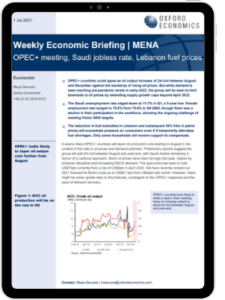
MENA | OPEC+ meeting, Saudi jobless rate, Lebanon fuel prices

 OPEC+ meeting, Saudi jobless rate, Lebanon fuel prices

OPEC+ countries could agree an oil output increase of 2m b/d between August and December against the backdrop of rising oil prices. But while demand is seen reaching pre-pandemic levels in early-2022, the group will be keen to limit downside to oil prices by extending supply growth caps beyond April 2022.

Read more

An examination of historic shifts and changes in passenger demand and airport CAPEX to calculate airport infrastructure needed to support short-, medium-, and long-run growth of air passengers to 2040.

Blog|1 July 2021

Does a greener economy mean longer-lasting inflation? Not necessarily

Stephen Foreman
Stephen Foreman
Associate Director, Economic Footprint & Sustainability
Does a greener economy mean longer-lasting inflation? Not necessarily

Commodity price surges were associated with spikes in inflation in the 1970s, but have not been so in recent decades. During the period before the creation of the Organization of the Petroleum Exporting Countries (OPEC), for example, cheap oil encouraged households to purchase cars, while manufacturers benefitted from energy-intensive production techniques. Consequently, when oil prices quadrupled in 1973-74, that degree of energy dependence resulted in substantial inflation. Since the early 1990s, though, this relationship has evaporated as commodities’ role in the economy has declined and central banks have been more effective at keeping inflation expectations stable. None of the commodity price surges seen in the decades since has led to substantial rises in core inflation—in fact some have been associated with lower inflation.

Read more

Research Briefing | Jul 1, 2021

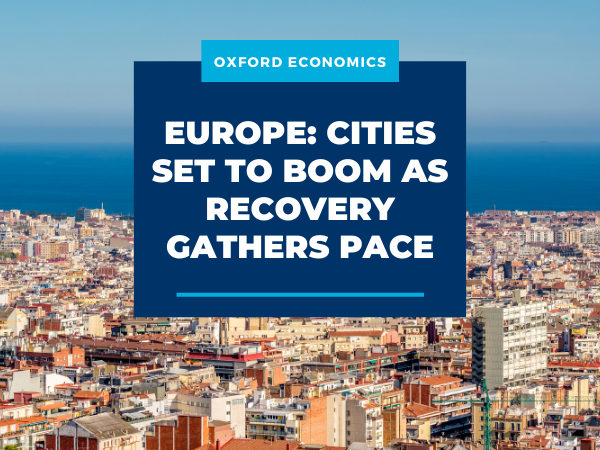
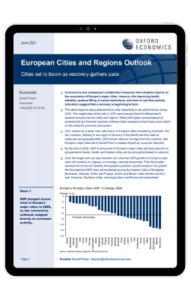
Europe | Cities set to boom as recovery gathers pace

Research Briefing - Cities set to boom as recovery gathers pace

Coronavirus and subsequent containment measures have weighed heavily on the economies of Europe’s major cities. However, the improving health situation, gradual lifting of social restrictions, and rises in real-time activity indicators suggest that a recovery is beginning to form.

Read more

The family business sector is vital to the UK economy. This report presents key insights into the UK family business sector and quantifies its economic importance.

Research Briefing | Jun 30, 2021

US | Enhanced benefits aren’t the labor market’s top problem

Ipad Frame (54)

Enhanced US unemployment benefits are discouraging only a small share of unemployed workers from finding jobs. The disincentive to work is greatest among lower-wage workers in states where the combination of emergency and regular unemployment benefits are the highest relative to prevailing wages.

Read more

Research Briefing | Jun 29, 2021

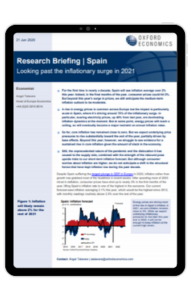
Spain | Looking past the inflationary surge in 2021

Ipad Frame_Spain-Looking-past-the-inflationary-surge-in-2021

For the first time in nearly a decade, Spain will see inflation average over 2% this year. Indeed, in the final months of the year, consumer prices could hit 3%. But beyond this year’s surge in prices, we still anticipate the medium-term inflation outlook to be moderate.

Read more

Research Briefing | Jun 29, 2021

Global | Coronavirus Watch: Case rates fall globally

New global cases of Covid-19 have fallen below the March lows and in many advanced economies, rapid vaccination programmes have allowed economies to begin to reopen without triggering a surge in Covid cases.

Read more

Research Briefing | Jun 29, 2021

UK | MPC predicts larger but still brief inflation burst

MPC predicts larger but still brief inflation burst

The MPC now thinks CPI inflation could exceed 3% this year, with the risk of an even bigger overshoot of the BoE’s 2% target. However, the majority on the committee maintained the view that higher inflation will be transitory.

Read more