
RESEARCH BRIEFING
25 Feb 2026
What the US tariff changes mean for growth
Based on our calculations of the new tariff rates, Brazil and China are the biggest winners.
The macro implications of replacing US IEEPA tariffs with a global 15% tariff are minor at best, according to our simulations. If the US leaves the global tariff rate at 10%, as applies now, rather than raising it to 15%, the macro impacts will be smaller still. Sectoral impacts, however, will be more significant.
What you will learn in this report:
- Based on our calculations of the new tariff rates, Brazil and China are the biggest winners, while several Asian economies will benefit from 5ppt falls in their average effective tariff rates.
- The biggest losers appear to be the UK and Australia. Other advanced economies, including the EU, face no change in their tariff rate, but suffer relative losses compared to the gainers.
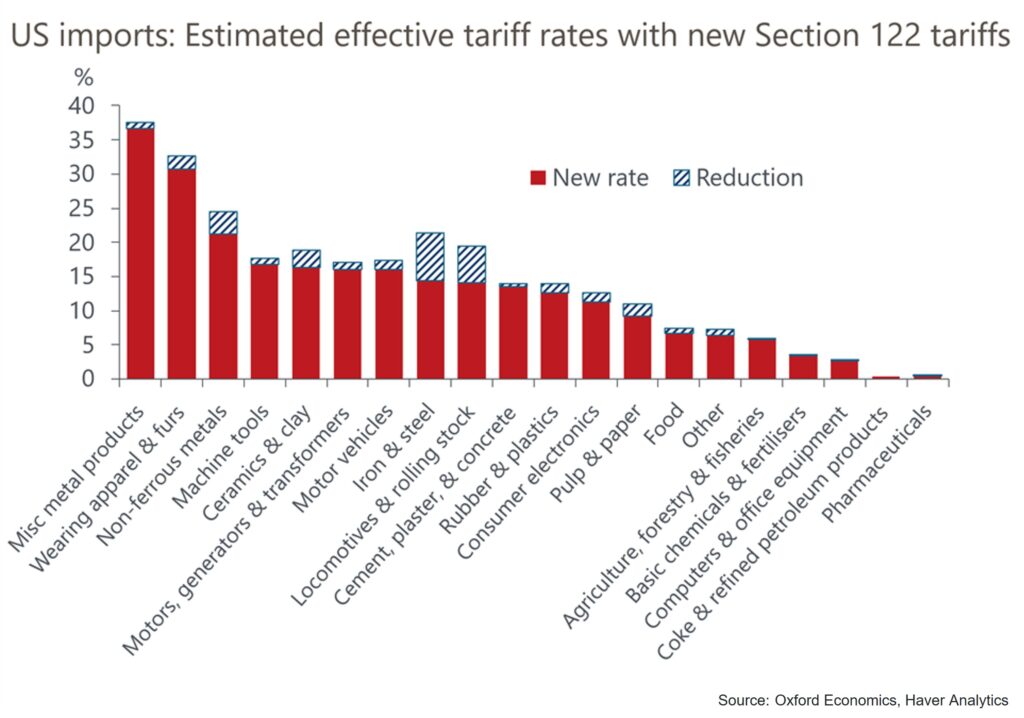
- We simulated the replacement of IEEPA tariffs with a global 15% tariff using our Global Economic Model (GEM) and the results suggest the implications for global GDP are minor. However, more notable deviations will show across and sectors.
- The largest tariff reductions will be in high-rate sectors: leather goods (-3.8 ppts to 25.5%), wearing apparel (-1.9 to 30.7%), and textiles (-2.0 to 20.9%).
You might also be interested in
Tags:
