

The world’s top 10 cities by economic strength in 2026
The Oxford Economics Global Cities Index ranks the world’s 1,000 largest cities across five categories: Economics, Human Capital, Quality of Life, Environment and Governance.
Economics sits at the heart of the Index, capturing not just the size of a city’s economy, but also its stability, growth path, and how broadly its gains are shared among residents. Rather than relying on a single indicator, we combine multiple measures that together capture the scale and resilience of an urban economy, namely: GDP size, GDP growth, economic stability, GDP per capita, employment growth, and economic diversity.
This composite approach matters because no single number tells the full story. A city can be fast-growing but volatile, or enormous but stagnant. By considering all facets of the economy, our Global Cities Index identifies not just which cities are big today, but which are best placed to stay economically vital over the long term.
New York takes top spot as the world’s largest economy
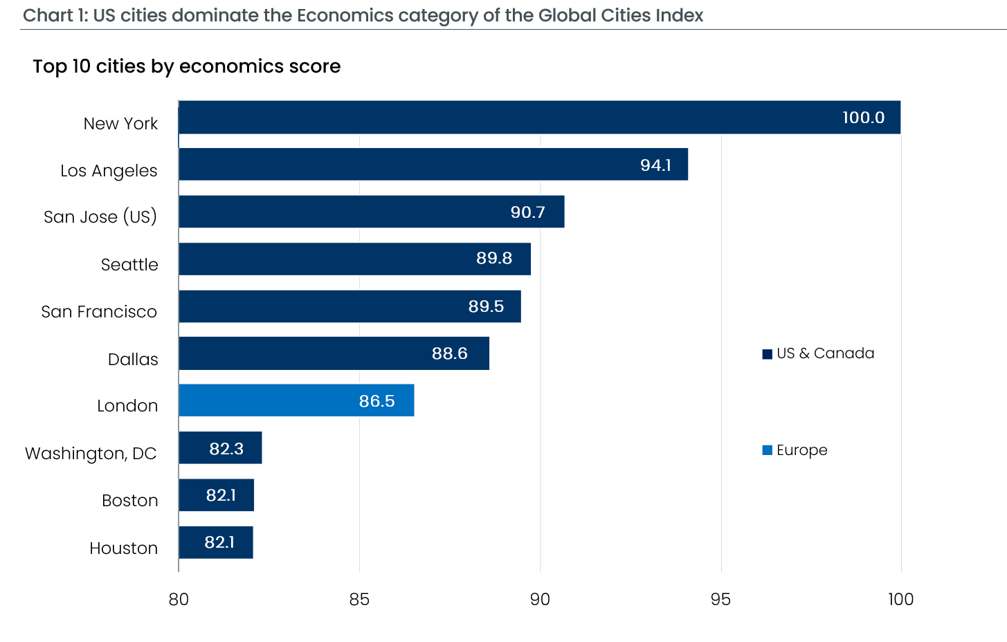
This year, New York once again claims the top position overall in the Global Cities Index, driven in large part by its first-place ranking in the Economics category. It has the biggest metro economy in the world—nearly double that of the next-largest cities, Tokyo and Los Angeles—and benefits from remarkably stable, long-term GDP dynamics. While New York’s economic diversity is lower compared with peers, reflecting the outsized role of its finance sector, we expect it to remain a top-scoring city for years to come.
And New York is far from alone at the top. Nine of our top 10 cities by Economics rankings are in the US, with London the sole non-US city to break into the group. Los Angeles (second place) draws on a broad economic base spanning entertainment, tech, and aerospace, which has driven high rates of GDP per person. Meanwhile, San Jose (third place) benefits from a high concentration of tech heavyweights—with firms like Apple headquartered there—and the city sees the highest GDP per person of our 1,000 cities.
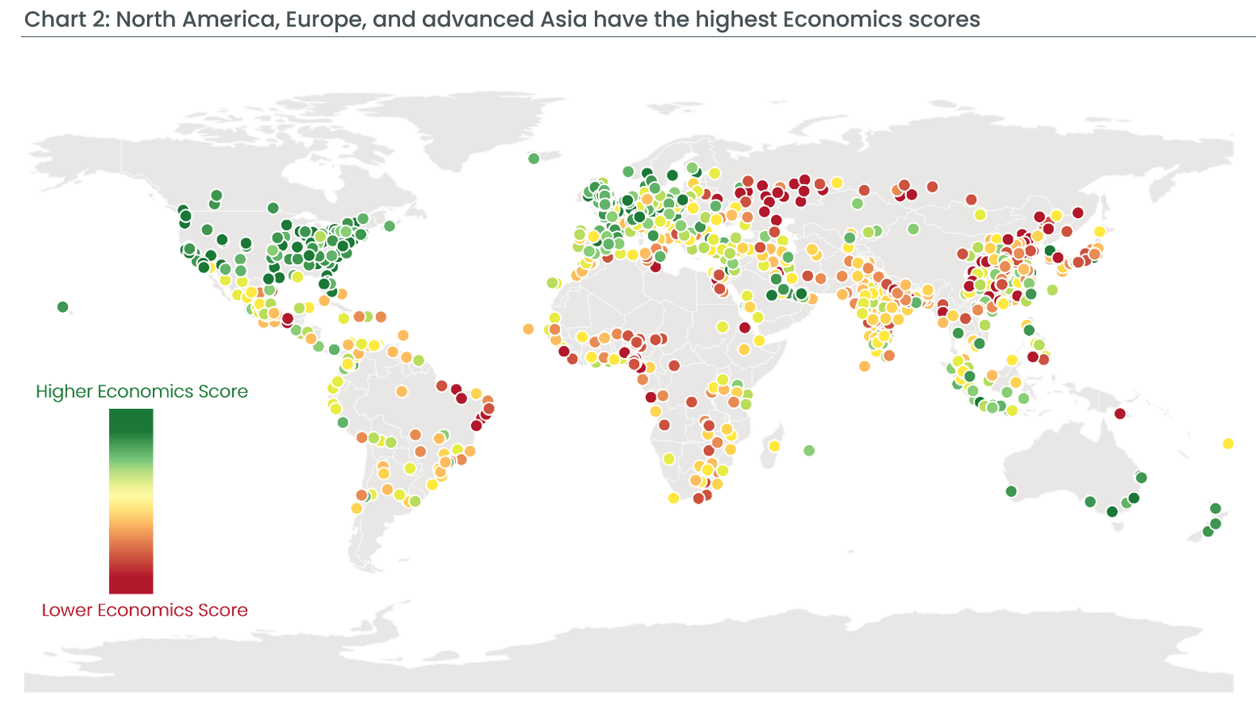
As is immediately visible, cities across North America and Europe dominate the top echelons of the index, with the US alone accounting for 30 of the top 100 cities (Chart 2). Yet the drivers of this dominance differ between the two regions. In the US, it is strong scores across the Economics and Human Capital categories that drive their elevated position. In Europe, however, it is outperformance across the Quality of Life, Environmental, and Governance categories. These differences are reflective of current trends and policy priorities, as the US continues to post strong economic gains, while Europe retains its advantage in resident amenities and liveability.
Over in Europe, London remains the continent’s premier economic powerhouse. As the fourth-biggest city economy in the world by GDP, its status as a truly global city is backed by a long track record of stable growth. And there are two other European capitals just outside the top 10: Dublin (12th place) and Paris (13th place). In Paris’ case, the French capital has long benefitted from its reputation as a cultural mecca, and its service-orientated economy has propelled it to have the fifth-biggest economy by GDP in the world.
Dublin’s position needs to be interpreted with some caution. Although it boasts the third-highest GDP per capita in the world, this figure is being inflated by the presence of large multinationals whose operations are located there. Looking past that, the underlying indicators remain strong. The city’s robust employment growth, with a broad base across tech, finance, and pharmaceutical sectors, is translating into real economic prosperity.
While these cities differ in their specific strengths, several commonalities explain their dominance: productive sectors that generate high incomes per person, which in turn attract productive workers, who contribute to the economy, creating a virtuous cycle. Their GDP growth rates may be more modest compared with smaller, emerging cities, but their sheer scale means even small percentage gains translate into large absolute increases, explaining why these same cities tend to dominate the top of our rankings year after year.
Fast-growing, mid-sized markets are rapidly ascending the rankings
Looking just a bit further down the rankings from these established behemoths, however, and a cohort of smaller and fast-growing cities appear. Chief among them are the emerging cities across Asia, which are reshaping the global urban hierarchy. Bengaluru in India, for instance, has been expanding at breakneck speed thanks to its IT sector, and is now poised to move into more advanced fields due to AI. Elsewhere, Ho Chi Minh City has leveraged rising trade activity, higher-value manufacturing, and an expanding private sector to generate substantial GDP growth, landing in the top 5% within our index for this metric.
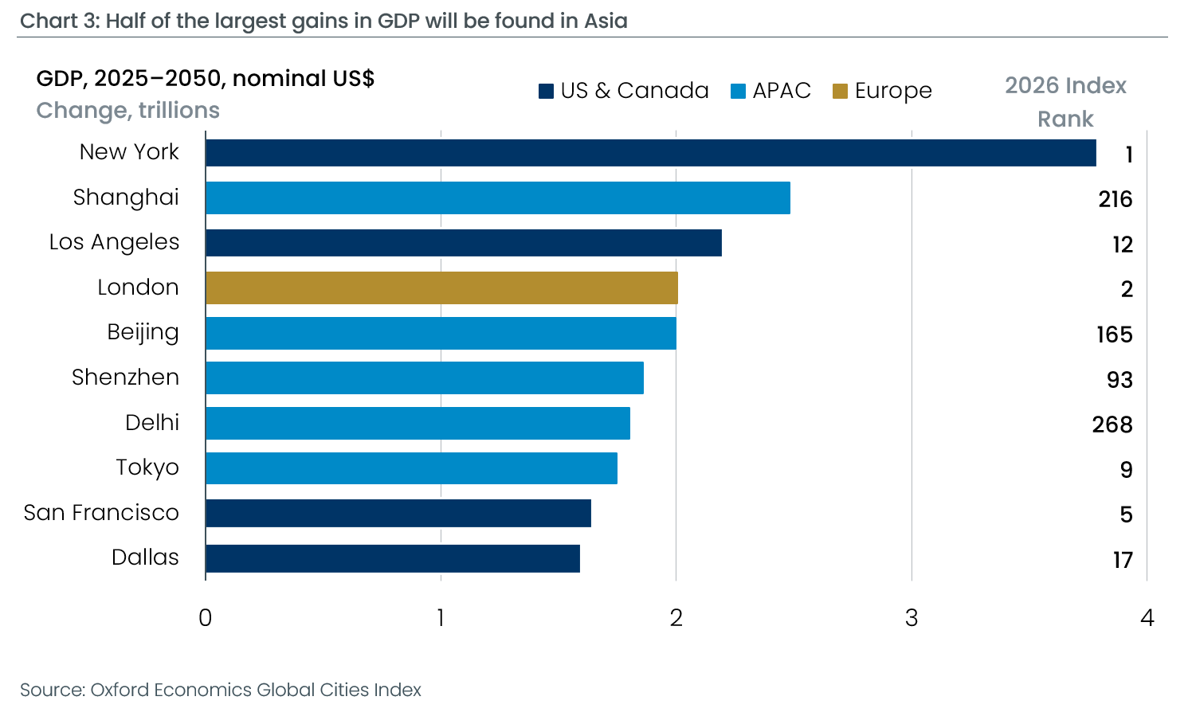
The global AI boom is playing a huge part in the region, with two of our ‘Cities to Watch’—Kuala Lumpur and Shenzhen—at its centre. Kuala Lumpur is closing in on a spot among the top 50 cities in our index as Malaysia’s leading digital hub. The capital is home to roughly half the country’s data centres and has drawn multibillion-dollar investments from Google and Amazon Web Services. Shenzhen, meanwhile, remains mainland China’s top-ranked city in our index, home to tech giants Huawei and Tencent and a dense cluster of robotics and AI businesses. But it is Hsinchu, 70 km southwest of Taipei, where the most significant AI-related growth has been; it is one of Asia’s fastest-growing cities in terms GDP, powered by rising demand for AI-linked chip exports (Chart 3).
Although the AI boom is relatively concentrated, economic growth is not only centred in Asia. In Africa, Egypt is home to Port Said and Suez, with both cities benefitting from their location along the Suez Canal corridor to record the second- and third-fastest GDP growth rates within our Global Cities Index, respectively. Still, Cairo remains the country’s main economic pillar, powered largely by its information and communications sector. Elsewhere, cities such as Dakar in Senegal and Nairobi in Kenya are in a unique position, with a wave of young workers entering the labour market at the same time as their economies increasingly diversify. If they can harness this demographic dividend, they will be well positioned to expand for years to come.
Latin America also has several strong performers. The continent’s mix of mature markets and emerging challengers presents a range of opportunities. Lima, the capital of Peru, is testament to this. It is the top-ranking South American city within our Economics category, placing 183rd. The city has seen rapid population growth over the past 20 years, and on the strength of a deepening skills base, is set to significantly outpace other regional peers on both GDP and income growth over the next decade.
Yet no list of emerging entrants would be complete without considering the rapid ascension of the Middle East. Indeed, Riyadh now ranks 18th within our Economics category, thanks in part to its large GDP size and fast employment growth. As the country continues to move away from oil, we expect it to become both a megacity and an urban economic powerhouse over the period to 2050. Over in the UAE, Abu Dhabi is following a similar path, recording rapid growth as its economy diversifies beyond oil into finance, culture, and advanced manufacturing. Meanwhile, Dubai’s expanding financial services sector is helping propel it towards becoming the world’s 60th-largest city economy by 2050. Rather than competing, the two emirates increasingly complement one another’s strengths.
Scale, speed, and staying power determines a city’s Economics score
Our index is built on the premise that no single metric determines a city’s economic staying power, and our rankings this year bear that out from two directions. On the one side, the largest metros defend their positions through scale and stability, benefitting from agglomeration effects that compound year after year. On the other side, however, smaller and faster-growing cities are closing the gap fast, riding demographic and sectoral tailwinds. In other words, opportunity isn’t confined to any one tier or type of city, but knowing how to capitalise on it is what will decide who’s still climbing next year.
The world’s top 10 cities by economic strength in 2026
- New York
- Los Angeles
- San Jose (US)
- Seattle
- San Francisco
- Dallas
- London
- Washington, DC
- Boston
- Houston
To explore the full rankings and see how other cities perform, visit the 2026 Global Cities Index site.
You might also be interested in
Explore the 2026 Global Cities Index
REQUEST A TRIAL
Access detailed city analysis and forecasts with a free trial of our cities and regions services.
