

The top European cities in 2026

Despite all the talk of European decline, the continent’s cities remain a dominant force on the global stage. Within the top 100 of our 2026 Global Cities Index, Europe represents almost half (44), ahead of North America with its 34 cities.
European cities dominate the top 100 of our Global Cities Index
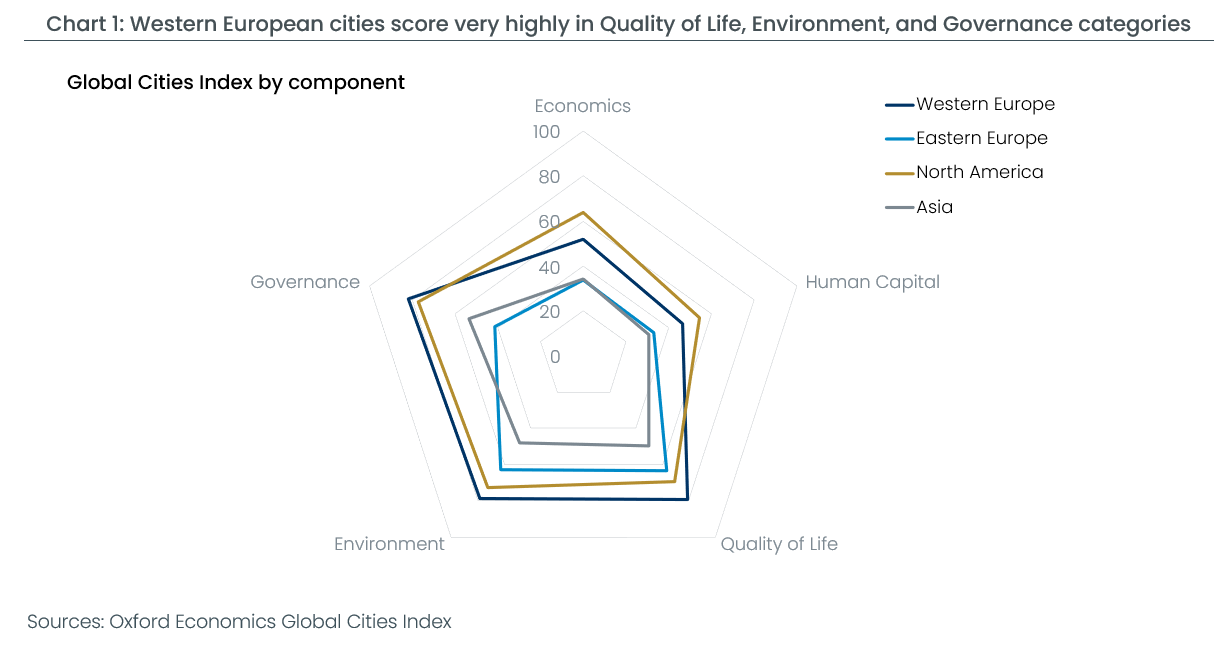
Europe itself is split into two halves under our classification: Western and Eastern Europe. Western Europe accounts for the vast majority of the wider region’s top 100 cities, and scores particularly highly in the Quality of Life, Environment, and Governance categories, while slightly lagging their North American peers for Economics and Human Capital. By contrast, the cities of Eastern Europe are usually less advanced but faster-growing, with their scores in our index often closer to those of Asian cities (Chart 1).
While New York leads the ranking in our Global Cities Index, London is just a fraction behind its transatlantic rival in second place, and Paris closes the top three. Both European heavyweights demonstrate a broad range of strengths. London tops the global Human Capital category, benefiting from its plethora of renowned universities, corporate headquarters, and an exceptionally highly qualified workforce, while also scoring seventh for Economics. Paris achieves a strong score for its Human Capital too and also excels in Quality of Life—boasting the longest life expectancy in the world, and also benefitting from many recreational and cultural sites dotted around the French capital.
Dublin and Zurich are the other two European cities in the global top 10 (Chart 2). The Irish capital in particular is one of Western Europe’s most dynamic cities in terms of both GDP and employment growth, while also scoring very highly in the Environment category. Zurich, meanwhile, is a strong all-rounder, ranking in the top 50 in four of the five categories, and enjoying particularly high GDP per capita due to its favourable mix of very productive industries.
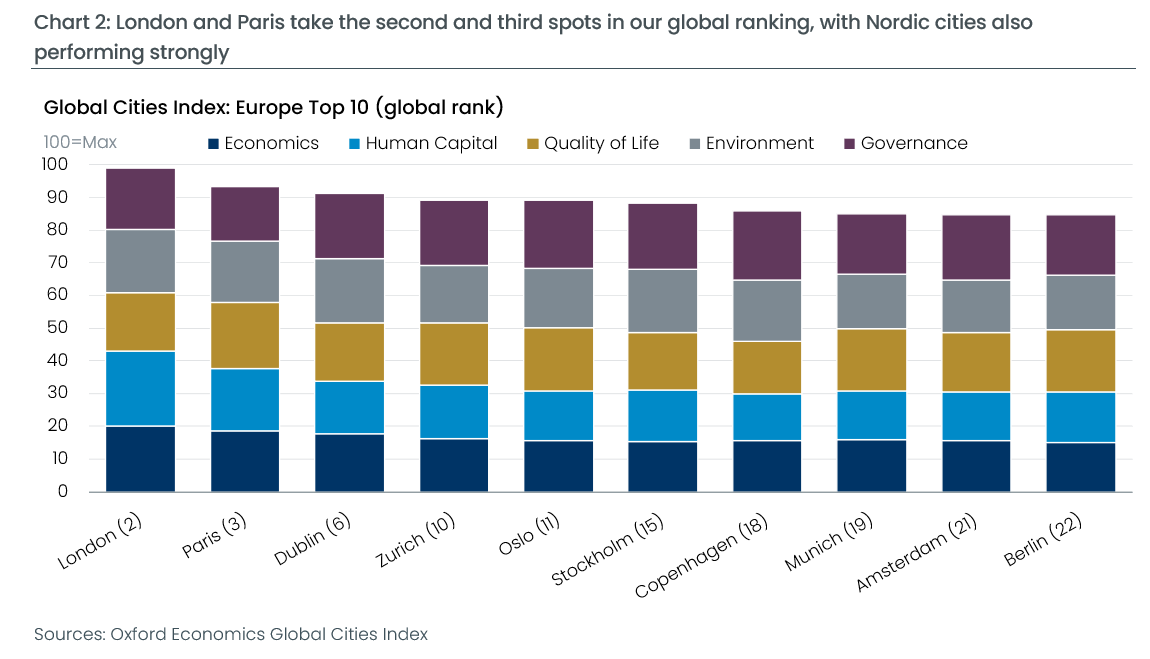
Nordic cities also perform well in our Global Cities Index, with Oslo, Stockholm and Copenhagen all ranking within the global top 20. Although smaller in size than some of their counterparts, these cities excel in the Environment and Governance categories. Boasting low emissions and high air quality thanks to the dominance of renewables in their energy mix, Nordic cities also benefit from strong institutions, and very favourable political and business environments.
In addition to established leaders, Europe also boasts some exciting challengers
In the 2026 update of our Global Cities Index we have included a new “Cities to Watch” section, where we highlight cities that aren’t necessarily top-ranking, but that are making significant strides and offer exciting opportunities. This year we’ve included Manchester, Toulouse, Eindhoven, Warsaw, and Tallinn as the cities to watch— united by their rapidly improving fundamentals.
Manchester has been at the forefront of the UK’s growth in recent years, using its rapidly expanding professional services base, rich cultural heritage, and more affordable housing to attract many skilled professionals. Meanwhile, Toulouse and Eindhoven have proved that European manufacturing is far from dead, and that specialising in high-tech production can lead to success. Warsaw and Tallinn are again different, representing the more dynamic Eastern European group that is benefitting from strong investment and productivity growth. Prague is another strong candidate here, with the Czech capital achieving the highest ranking in the region in our Global Cities Index, and 51st globally. In particular, Prague manages to combine high quality of life with robust forecast growth (Chart 3), as well as benefitting from a strong score in Governance.
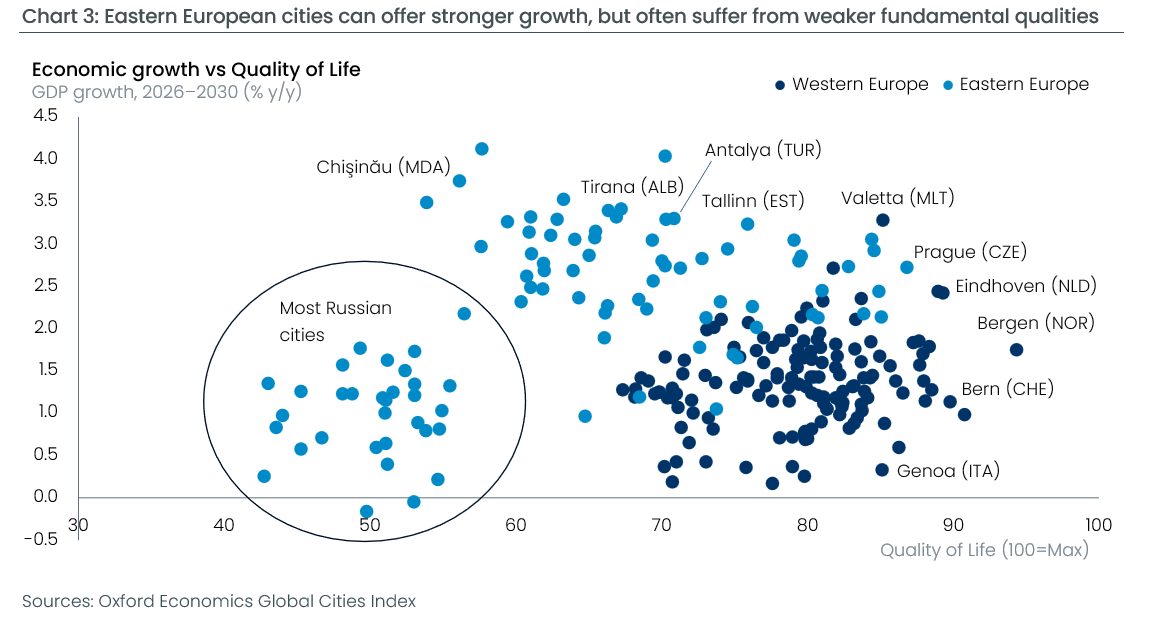
There are other cities in the Eastern Europe group that offer even stronger growth but often lag on their fundamental strengths. These include the capitals of Moldova and Albania, Chișinău and Tirana, as well as several Turkish cities. The latter benefit from their much younger demographics compared to the rest of Europe, and in addition to Istanbul, which ranks 64th overall in our index, it’s worth highlighting Antalya—one of the most dynamic Turkish cities. In contrast, most Russian cities do not fare well in either current fundamentals or future prospects, with Moscow and St Petersburg performing slightly better than the rest.
The overall message is that Europe offers plenty of different opportunities. These range from the large established markets of London and Paris, to the smaller more dynamic likes of Eindhoven and Tallinn, to the lesser-known but fast-growing cities of Tirana and Antalya. Our Global Cities Index helps to understand each city’s strengths and weaknesses, aiding location selection and informing the strategy required for businesses to succeed in each market.
Top 10 European cities in 2026 Global Cities Index
- London
- Paris
- Dublin
- Zurich
- Oslo
- Stockholm
- Copenhagen
- Munich
- Amsterdam
- Berlin
To explore the full rankings and see how other cities perform, visit the 2026 Global Cities Index site.
You might also be interested in
Explore the 2026 Global Cities Index
REQUEST A TRIAL
Access detailed city analysis and forecasts with a free trial of our cities and regions services.