
The top Latin American cities in 2026

Discussion of the world’s major cities often overlooks the role and dynamics of Latin America. Yet, to ignore the region would be to ignore around a quarter of the world’s land mass and almost a 10th of its population.
In the 2026 edition of the Global Cities Index, Latin American cities are at the forefront of our analysis. Not only has the region seen some the largest increases in their ranking relative to last year, but we have also introduced a new ‘Cities to Watch’ section for the region allowing our analysts to highlight the top five city-economies they are most excited about and think investors should take notice of. The five we covered—Brasília, Lima, Medellín, Monterrey, and Santiago—are a group of cities with diverse drivers, united by their productivity-led expansion as they progress up the value chain.
In terms of the overall rankings for the region, Buenos Aires, the capital of Argentina, takes top spot in the region and 138th overall (Chart 1). The city has the region’s second largest economy and has a deep skills base centred around strong universities and the many corporate headquarters. Second up is Chile’s Santiago, boasting similar credentials but higher housing costs and weaker Environmental scores cost it the top spot. Rounding off the top three is rapidly developing Lima as a combination of rural-urban migration, infrastructure investment, and rising trade volumes positions Peru’s capital as a key regional leader.
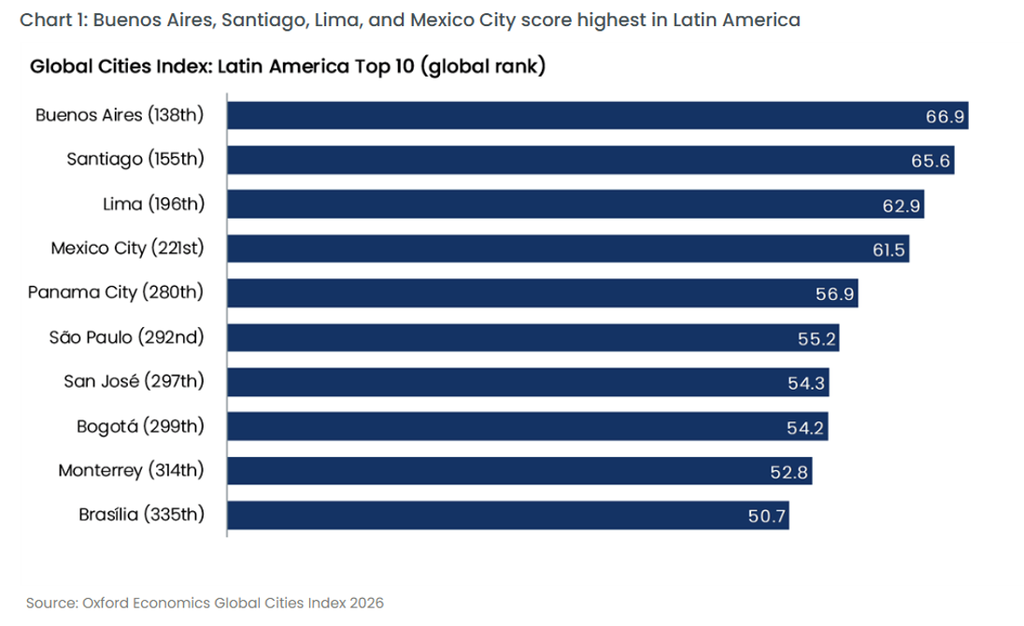
Major capital cities lead the index in Latin America
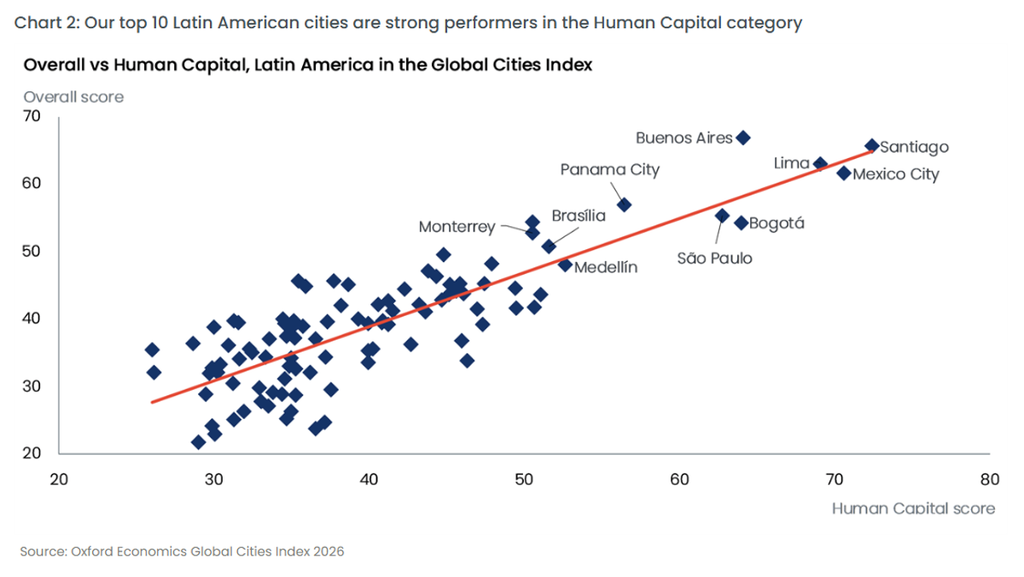
The megacities of São Paulo and Mexico City also rank highly, supported by their large GDP size and elevated scores in the Human Capital category. In fact, the Human Capital category is an area of relative outperformance across the region, with cities benefitting from good universities and high levels of educational attainment. The strength of Human Capital in driving Latin American cities’ performance in the index is perhaps best illustrated by the fact that nine of the 10 cities topping the overall rank for the region also top the Human Capital score, with only Medellín breaking into the top, as Costa Rica’s San José falls out.
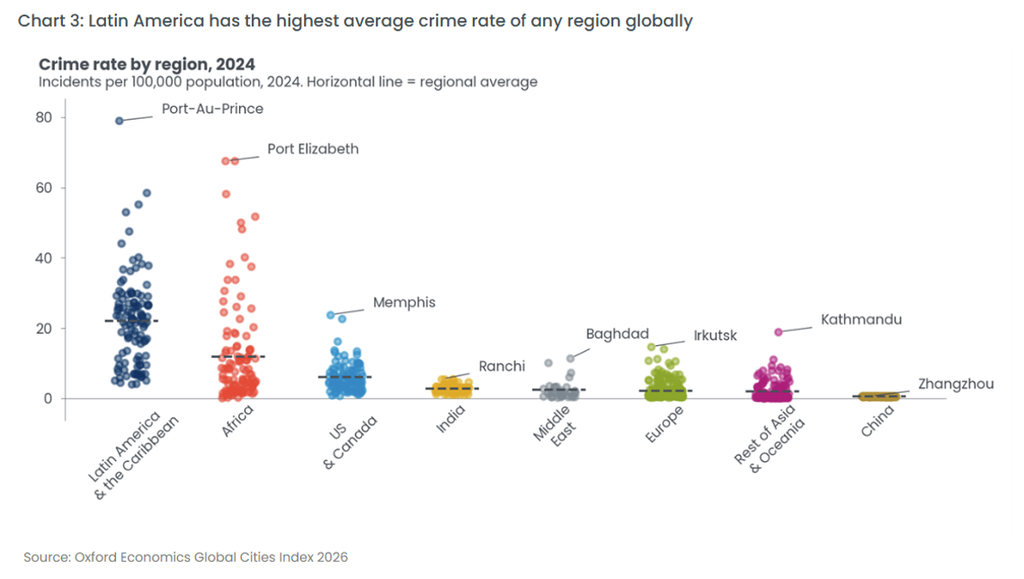
The region’s poorest-performing category is Quality of Life, which may sound odd when one thinks of the golden beaches of Rio de Janeiro or the cosmopolitan streets of Santiago and Buenos Aires. However, the region has high levels of inequality, severe poverty, and some of the highest crime rates in the world (Chart 3). Cities as far afield as Port-au-Prince in Haiti, Guatemala City, and Fortaleza in Brazil are emblematic of this reality.
While it would be easy to say that reducing crime will shoot Latin American cities up the rankings, it is much more nuanced than that. This is because of the strong link crime has with other socioeconomic factors, like poverty and inequality, explaining the poor performance of Latin American cities across each of these metrics. Instead, the region needs broad-based interventions to stem to the drivers of crime, which in turn means stronger economic performance as much as it does stronger law enforcement.
Peru’s major cities will continue their strong momentum
Looking ahead, the region is set to see several of its cities climb the rankings and become more prominent in the index. Chief among them is Lima. GDP growth in the city will significantly outpace all other major Latin American cities and, over the next decade, will average 3.2% per annum, more than double the rate of São Paulo and rivalling the growth expected in some of Europe’s and the Middle East’s most dynamic cities. Moreover, this will open up substantial consumer market opportunities—having already surpassed Rio de Janeiro in 2021, Lima is projected to have higher average disposable income than both São Paulo and Bogotá by 2050—despite having a level just 82% and 93%, respectively, of the two today.
Slightly further south, Arequipa, Peru’s second-largest city and one of the world’s leading copper producers, is also set to rise in the rankings. Industry accounts for close to two-fifths of the city’s output, and this specialisation has supported one of the fastest rates of economic expansion among Latin American cities over the past two decades, averaging 5.1% per year. Supported by a strong investment pipeline and sustained demand for copper as electrification advances, we expect Arequipa’s largest gains to come in its Economic score, lifting it into the top 10 Latin American cities in our index over the next decade.
Panama City and Georgetown (Guyana) are also set to climb the rankings, reflecting their roles as both capital city economies and centres of national economic activity. Panama City will remain among Latin America’s top-performing cities, supported by deep human capital, high income per person, and its strategic location at the Pacific mouth of the Panama Canal. Georgetown, by contrast, stands out more for its vast natural resources. It is already Latin America’s fastest-growing city economy, with average annual growth of 12.6% over the past two decades. Offshore oil discoveries and rising infrastructure spending are at the centre of this, driving strong employment growth and higher incomes. These dynamics should support further progress over the coming decade, even if income disparities remain among the highest in our Global Cities Index.
Weaker momentum across some of the region’s more established urban centres will see them lose ground in our index over the coming decade. Rio de Janeiro is one such example, with growth set to remain subpar and substantially weaker than in other vital cultural epicentres, such as Buenos Aires and Santiago. A mature urban economy, softer demographic trends, and limited productivity gains are likely to constrain its performance. A similarly weak outlook applies to Cancún, where the same tourism reliance that drives its global appeal also leaves the city with a less stable economic footing than its more diversified city peers.
Top 10 Latin America cities in 2026 Global Cities Index
- Buenos Aires
- Santiago
- Lima
- Mexico City
- Panama City
- São Paulo
- San José (Costa Rica)
- Bogotá
- Monterrey
- Brasília
To explore the full rankings and see how other cities perform, visit the 2026 Global Cities Index site.
You might also be interested in
Explore the 2026 Global Cities Index
REQUEST A TRIAL
Access detailed city analysis and forecasts with a free trial of our cities and regions services.
