

The top US cities in 2026

US cities dominate the upper reaches of our 2026 Global Cities Index (GCI), accounting for half of the top 10 cities and nearly a third (30) of the leading 100 cities. Strong Economics scores are what set US cities apart from the rest of the global economy.
US cities lead the top 100 of our Global Cities Index
Of the 1,000 cities analysed within the GCI, the 90 US cities (or 9% of the total) account for a third of the total GDP of the composite 1,000, with an average GDP per capita of $101,000—close to four times the GCI weighted city average. This economic strength is matched by US cities’ Human Capital scores, which rank highly due to their strong showing in corporate headquarters, with 21% of the GCI total, as well as their revered universities and high educational attainment.
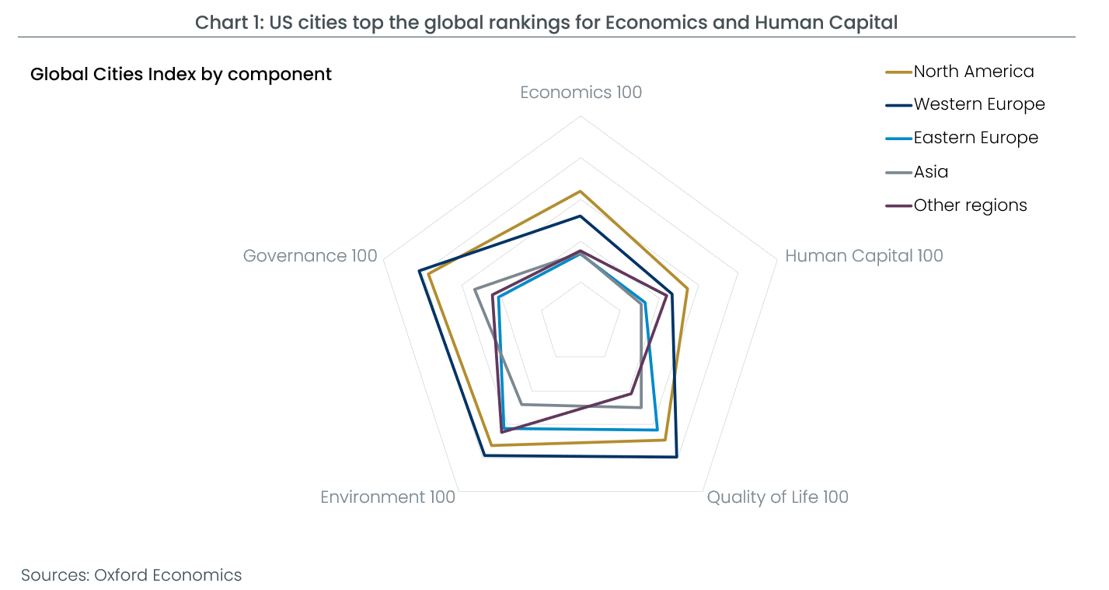
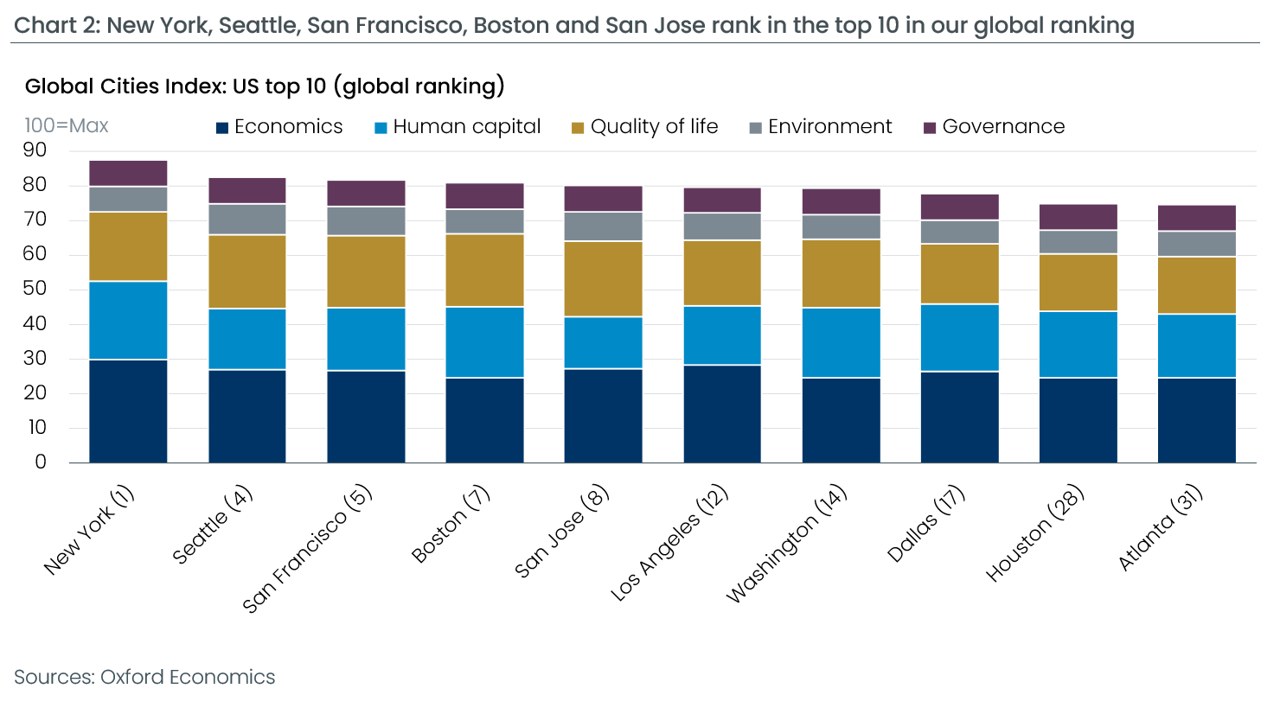
Foremost in the Global City Index rankings once again is New York, securing the top spot overall and in the Economics category, led by its significant GDP score, which is 20% above that of the next-highest city (Tokyo). New York’s strong Human Capital is underpinned by its numerous corporate headquarters and renowned universities. Its Quality of Life is similarly compelling, highlighted by its healthy income per capita and recreational and cultural offerings. Seattle, San Francisco, Boston, and San Jose also rank in the global top 10, with very high Economics and Human Capital rankings (Chart 2).
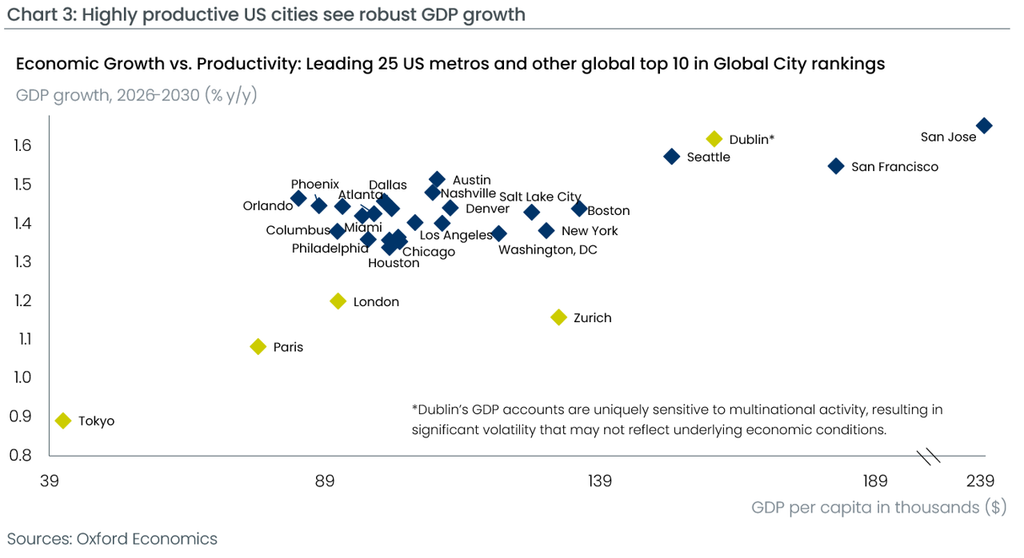
More than just their robust GDP scores, these cities also rank among the top tier in GDP per person, fuelled by their relatively large tech sectors. Leading US cities generate high GDP per person, which in turn spurs consistently strong GDP growth. (Chart 3). The three tech-heavy metros—San Jose, San Francisco, and Seattle—stand out from the others. Boston’s prominent showing is buoyed by its life sciences, pharmaceuticals, and finance sectors. Out of the top 20 city rankings in GDP per person, US cities account for 16, or 80%, with only much smaller and more specialised cities like Dublin, Basel, Luxembourg, and Zurich reaching this elite metric ranking.
Several US cities are emerging as growth leaders
Our 2026 updated Global Cities Index includes a new ‘Cities to Watch’ section that highlights cities that are smaller than the top-ranking ones yet are seeing significant strides. The US Cities to Watch are Boise, Durham, Jacksonville, and San Antonio. Each of these cities has posted steady job, GDP, and population growth over the last few years. A specific boon has been their ability to attract tremendous in-migration, especially in the post-Covid-19 years, as young and old alike sought out their many outdoor amenities. Indeed, these four cities score favourably on the Environment metrics, outperforming their larger peers.
Boise and Durham have especially drawn many young people to their large universities, which foster a robust entrepreneurial ethos, as demonstrated by their respective tech-related GDP and job growth numbers. Durham has also enjoyed strong life sciences and pharmaceutical growth concentrated near its Research Triangle Park, which it shares with its sister city, Raleigh. Boise, the state capital, is home to Boise State University, and it too has seen tremendous tech-related growth helped by one of its biggest employers, Micron, which is undergoing a $50 billion expansion. Jacksonville too has thrived on recent tech-related growth, particularly in fintech, but also has strong finance, federal government, and tourism-related sectors. San Antonio’s growth is also diverse with its large military base, defence contractors, auto manufacturing, finance, and tourism sectors all recording steady gains.
Meanwhile, other US cities climbed in their GCI rankings by a considerable margin, largely due to steady economic growth and/or improvements in several metrics in the Human Capital category, such as corporate headquarters and educational attainment. Those with the biggest jump in GCI rankings include Greenville (SC), Charleston, Provo, Fresno, and Indianapolis. Those with the biggest drop in rankings include New Orleans, Rochester (NY), Albany (NY), Hartford, and Pittsburgh.
Smaller cities that rank lower on the Economics score due to their size tend to perform better in Human Capital metrics due to several factors, including the number of universities, educational attainment, and age profiles. Provo, Durham, Worcester, Madison, and Des Moines have some of the highest Human Capital scores and most see healthy GDP growth (Chart 4).
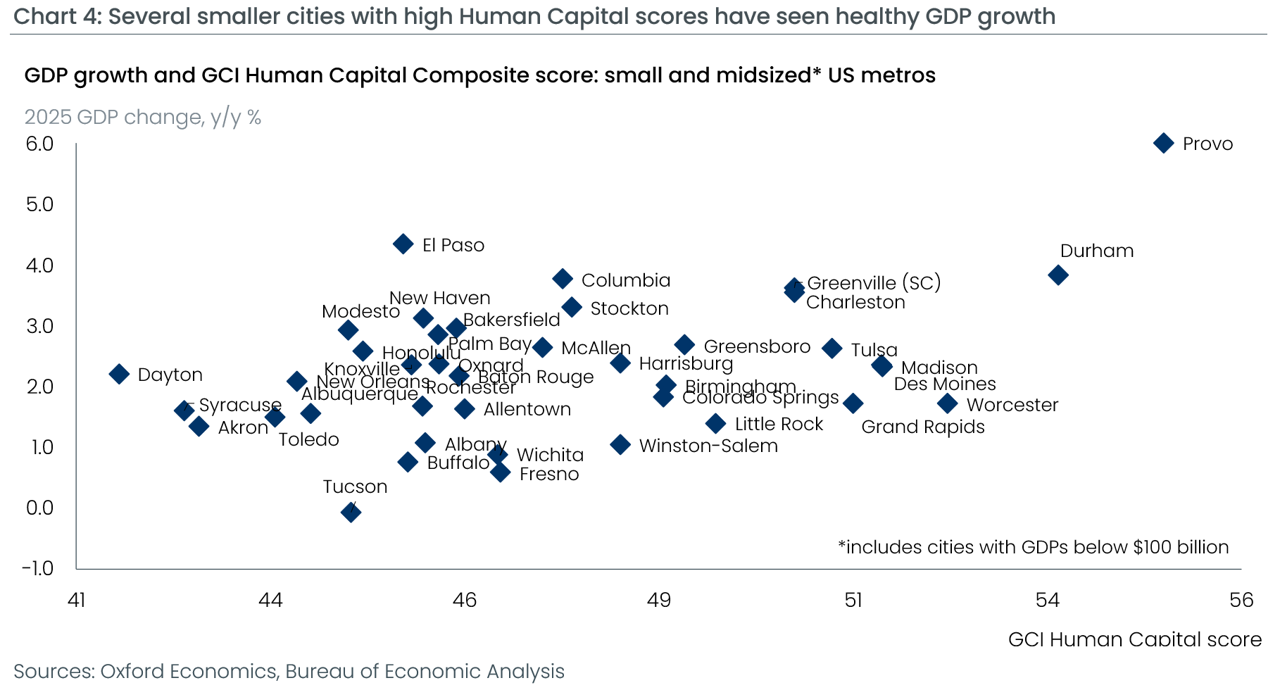
Other smaller cities, such as El Paso, Columbia (SC), Stockton, and New Haven, have weaker Human Capital scores but have nonetheless posted healthy GDP growth, with moderate Economic scores. These cities generally get good grades in their economic diversity measures, despite having a few large employers like the federal government in El Paso, state government in Columbia, Amazon in Stockton, and Yale University in New Haven. These large employers boost the economic stability scores in these cities.
The findings show that every US city has a unique profile, yet most rank among the global leaders. Indeed, relatively high labour mobility in the US, which often forces cities to compete for migrants and jobs, sets it apart from its cross-continental peers. This mobility is but one element in the dynamics of US cities, which are poised to continue generating stellar productivity and GDP growth over time, keeping them at the top of the economic pyramid.
Top 10 US cities in 2026 Global Cities Index
- New York
- Seattle
- San Francisco
- Boston
- San Jose
- Los Angeles
- Washington, DC
- Dallas
- Houston
- Atlanta
To explore the full rankings and see how other cities perform, visit the 2026 Global Cities Index site.
You might also be interested in
Explore the 2026 Global Cities Index
REQUEST A TRIAL
Access detailed city analysis and forecasts with a free trial of our cities and regions services.