

The world’s best value cities in 2026
If there is one factor that almost all the world’s leading cities have in common, it is that they are relatively expensive places to live and work. The high inflationary environment of recent years has only exacerbated this problem, pushing the cost of living firmly back to the top of the agenda for both residents and policymakers alike.
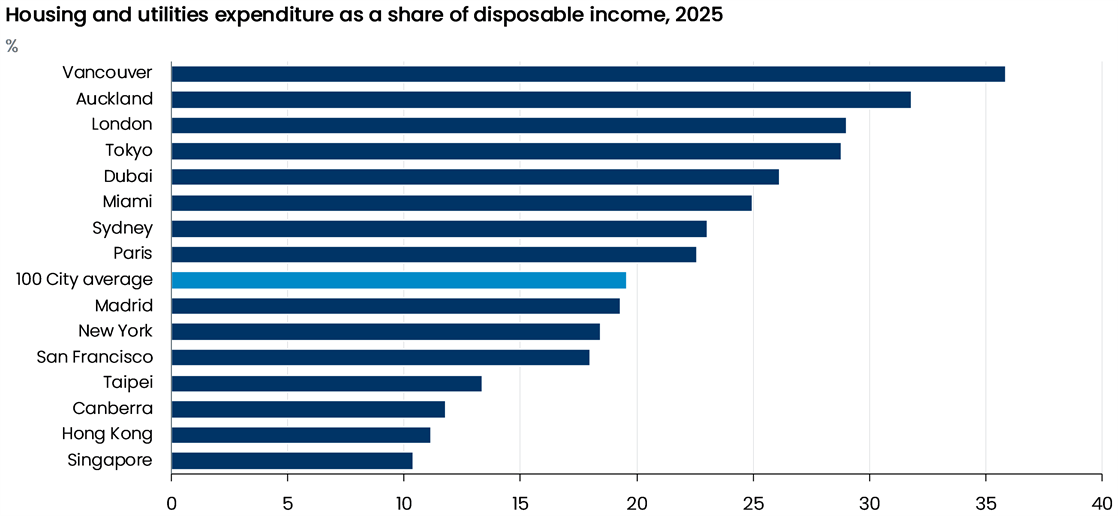
Within this, there is one area that is particularly important and increasingly burdensome, and that is the cost of housing. We estimate that residents in the top 100 cities in the 2026 Global Cities Index spend an average of 20% of their disposable income on housing and utilities, but this masks a significant amount of city-level variation, which has become increasingly pronounced over recent decades. This is because affordability in many markets has become stretched due to excess demand and undersupply, pushing up rents and house prices relative to real incomes.
Chart 1: City residents spend a significant portion of their disposable incomes on housing and utilities
Sources: Oxford Economics
At the upper end of the spending spectrum are cities such as Vancouver, Auckland, and London, which are notoriously expensive and have a very high housing cost burden of around 30% of disposable incomes (and much higher in central neighbourhoods). At the other end of the spectrum are cities that are more ‘affordable’ by comparison. This is through a combination of lower overall housing costs (Singapore) and higher disposable incomes (Canberra, San Jose), meaning that expensive living costs are more adequately offset.
Cities in Asia Pacific offer the best mix of quality of life and affordability
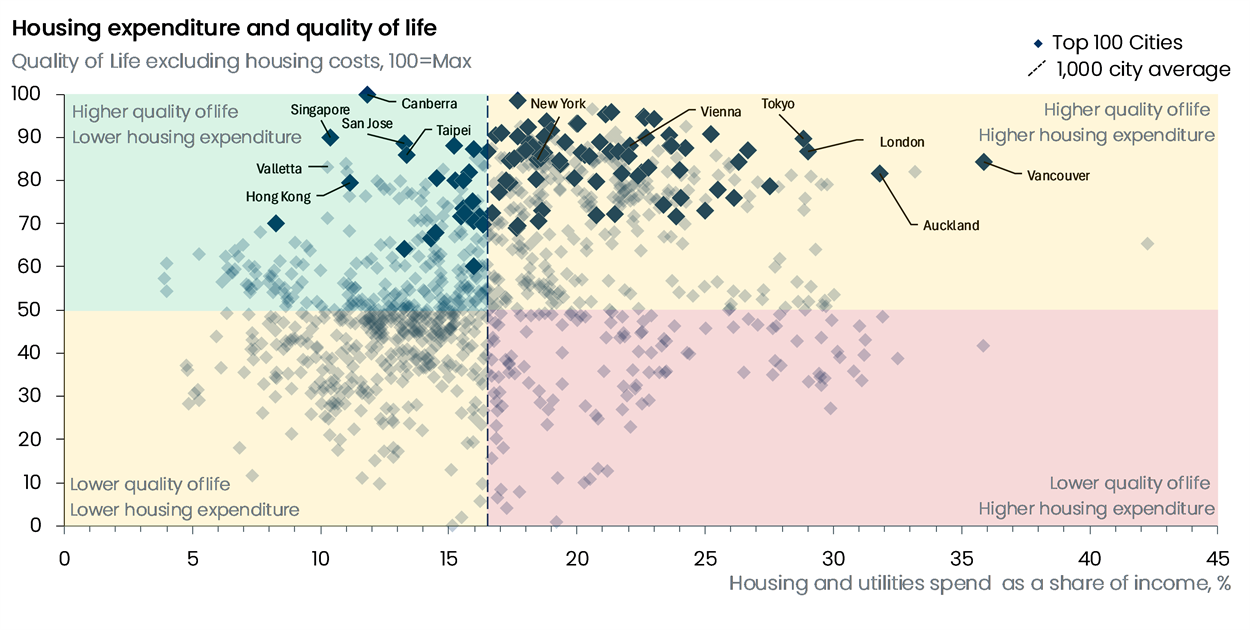
However, city living is not merely a financial decision. Yes, access to the typically higher paying jobs is a big draw for many and therefore the cost of living and housing will be an important consideration. But a high quality of life is equally important, which includes having access to numerous recreational and cultural facilities and feeling safe in your environment. This then begs the question—are there any cities that offer the best of both worlds, lower housing costs and a higher quality of life?
Chart 2: Singapore and Canberra offer a strong mix of quality of life and lower housing costs relative to incomes
Sources: Oxford Economics Global Cities Index
The best-performing cities when comparing both metrics (the definition of Quality of Life can be found at the annex) are largely in the Asia Pacific region. They are Canberra, Singapore, Taipei, and Hong Kong. This isn’t to say that they are ‘affordable’, but relative to many of their western peers, they appear to offer better value while maintaining a higher quality of life.
Canberra, in particular, tops our Quality of Life category overall, largely thanks to long life expectancy, lower income inequality, and higher average incomes, underpinned by an abundance of stable, well-paid government jobs. The latter certainly helps maintain affordability by boosting incomes, while the city’s planned environment can make the land more readily available for development, especially compared with peers such as Sydney and Melbourne. This helps to support the supply side, keeping the balance with demand more in check than elsewhere.
For Singapore, a high life expectancy and a very low crime rate help the city perform well in our Quality of Life category, while housing remains relatively affordable due to the state-led model of supplying and subsidising housing. Large-scale housebuilding schemes and generous grants offered to residents have helped keep prices in check and significantly boosted home ownership rates in the city-state, making expensive rents much less common. Other Asian cities also perform relatively well for similar reasons, and this state-led model is something that peers in the west, such as London, may wish to emulate.
Vienna is another city with a similar public housing-focused model, helping to make the Austrian capital more affordable than similarly sized European peers, while also being a desirable place to live. Among smaller European peers, Valletta (Malta) and Ljubljana (Slovenia) also offer good value, although both capitals are becoming increasingly expensive. This is an unfortunate byproduct of strong demand, driven by fast-growing local economies, and, in the case of Valletta, limited space and a sharp rise in short-term holiday rentals linked to the booming tourism sector. Therefore, the time of these cities as ‘affordable’ locations may be coming to an end, even if the quality of life offered is high.
The world’s megacities have an enduring appeal that will remain despite offering weaker ‘value’
One notable feature of this type of analysis is that the world’s megacities—New York, London, and Tokyo—all appear to offer a much less desirable mix of quality of life and affordability, largely because housing costs are so expensive relative to incomes. Yet, they retain an enduring appeal that continues to draw people in from all over the world.
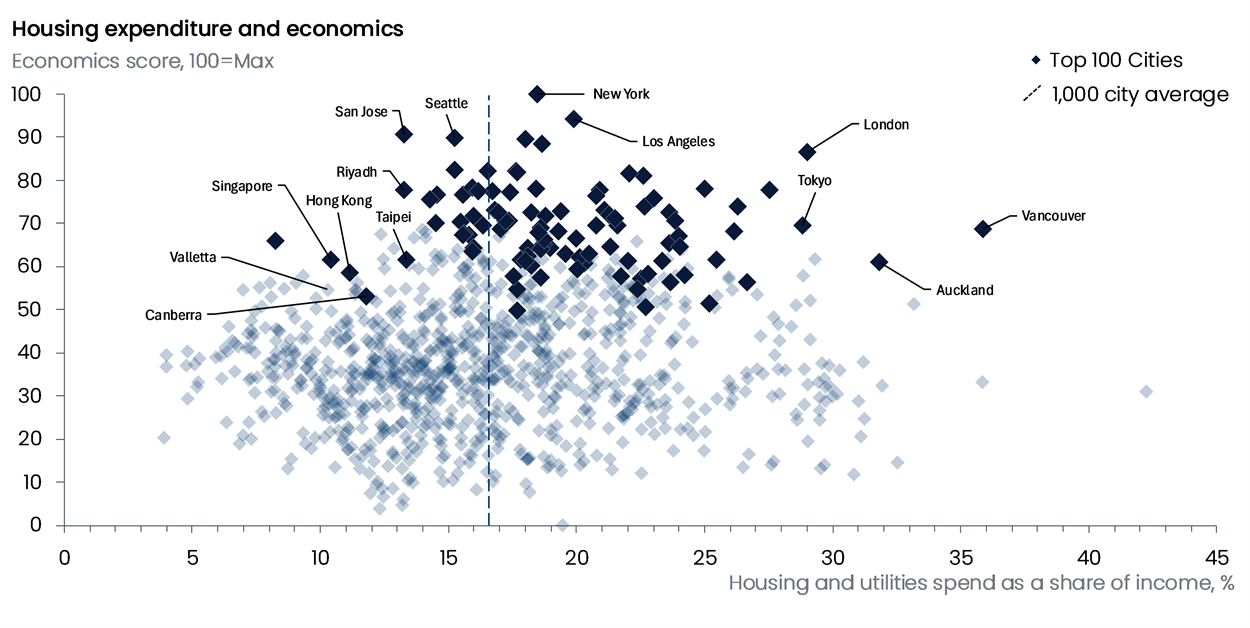
Why is this the case? Well, the sheer scale of labour market opportunities and access to world-leading cultural and recreational activities and events are unrivalled. Cities such as Canberra and Valletta can’t (and don’t aspire to) offer the sort of life that is available in these megacities. Therefore, the value judgement made by the millions of residents who choose to live there is that higher housing costs and a generally higher cost of living are a price worth paying for access to the job and amenity benefits offered.
Chart 3: The economic muscle of New York and London mean they will continue to attract and retain residents
Sources: Oxford Economics Global Cities Index
We don’t expect these fundamentals to change anytime soon, and so these superstar cities will continue to offer enough value to attract and retain residents. Their economic pull remains strong, especially when coupled with a good quality of life, even if that quality of life is not as high as elsewhere. This is particularly true for younger workers starting their career and requiring a vast and deep labour market to get them moving up the employment ladder. Smaller cities, no matter how high the quality of life, will always struggle to compete with likes of London, New York, Paris, Tokyo, and Los Angeles.
Ultimately, this shows how value is determined differently across the world. Cities such as Singapore illustrate how it is possible to combine a very high quality of life with relatively lower housing costs, offering a model that many more expensive cities are starting to look towards. But that doesn’t mean that the likes of London and New York are any less appealing, and higher spend on housing is just a fact of life that many will put up with in order to live there—not least given the benefits these cities can bring for long-term career development.
Annex—Quality of Life category
Our 2026 Global Cities Index assesses cities across five categories—Economics, Human Capital, Quality of Life, Environment, and Governance—providing a comprehensive measure of each city’s standing in the global landscape.
The Quality of Life category combines scores across access to recreation and cultural sites, life expectancy, crime rates, income equality, income per person, and housing expenditure as a share of disposable income. For this report, housing expenditure has been stripped from the Quality of Life category to prevent double counting when comparing both measures.
You might also be interested in
Explore the 2026 Global Cities Index
REQUEST A TRIAL
Access detailed city analysis and forecasts with a free trial of our cities and regions services.