

Commodity prices to hit record highs before easing through 2027
Global commodity prices are set to reach an all-time high in Q4 2026 as disruption to Middle Eastern energy supplies continues to push prices higher. While we expect prices to ease through 2027, the recovery will be uneven, with significant differences across energy, metals and agricultural markets.
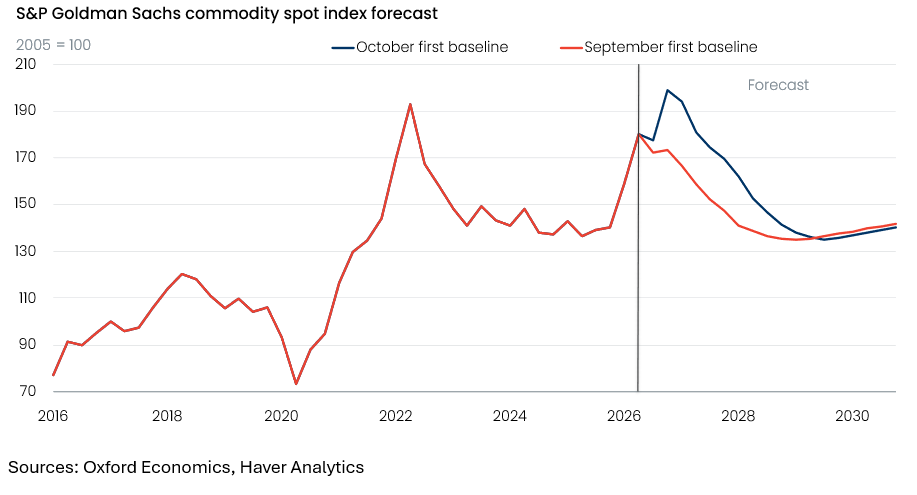
We forecast the S&P GSCI spot index to rise by 28% in annual-average terms in 2026, reaching a record high in Q4. The increase is driven primarily by higher energy prices, although the impact is spreading across commodity markets as rising fuel, electricity and transport costs feed into production.
There are parallels with the supply shocks following the pandemic and Russia’s invasion of Ukraine, when disruption to production, trade and logistics affected multiple markets simultaneously. However, the current shock is particularly concentrated in energy, and the outlook for individual commodities differs considerably.
Our central forecast is for aggregate prices to decline gradually through 2027 as Middle Eastern exports recover and supply constraints ease. But the pace of that adjustment will depend on how quickly physical supply is restored and whether geopolitical risks subside.
Chart 1: The GSCI is forecast to hit its highest level in Q4 2026 due to energy supply
Oil prices to remain above $100 until mid-2027
Oil remains at the centre of the current commodity price shock. We now expect Brent crude to average above $100 per barrel through Q2 2027, following attacks on Red Sea export infrastructure and a more persistent geopolitical risk premium.
September’s attack on Saudi Arabia’s East-West pipeline highlighted the vulnerability of alternative export routes. The pipeline had been carrying around 4 million barrels per day, allowing Saudi exports to bypass the Strait of Hormuz. Although operations have partially resumed, the risk of renewed disruption continues to support prices.
Importantly, as export capacity recovers, the main obstacle to price normalisation is increasingly the geopolitical risk premium rather than physical crude availability. Even with sufficient supply reaching the market, continued uncertainty over regional security could keep prices elevated.
We still expect Brent to converge towards its long-run equilibrium of around $60 per barrel, but now anticipate this adjustment will be completed in 2029 rather than 2028.
The impact also extends beyond crude oil. Tight refined-product markets have pushed European diesel refining spreads close to $100 per barrel, amplifying transport and production cost pressures. Higher fuel costs affect diesel-intensive mining operations, agricultural machinery and freight, transmitting the energy shock into other commodity markets.
Natural gas faces a winter squeeze, with significant uncertainty
Natural gas remains particularly exposed to Middle Eastern disruption because LNG exports are harder to reroute than crude oil.
Qatar and the UAE accounted for around 20% of global LNG trade before the conflict, but exports have effectively been trapped inside the Strait of Hormuz since March. LNG-linked gas prices in Europe and Asia are consequently around 130% above pre-conflict levels, compared with a 45% increase in Brent.
We expect gas prices to remain elevated through winter 2026–27 before easing as global LNG supply expands. However, the outlook is particularly sensitive to weather, storage levels and further supply disruption.
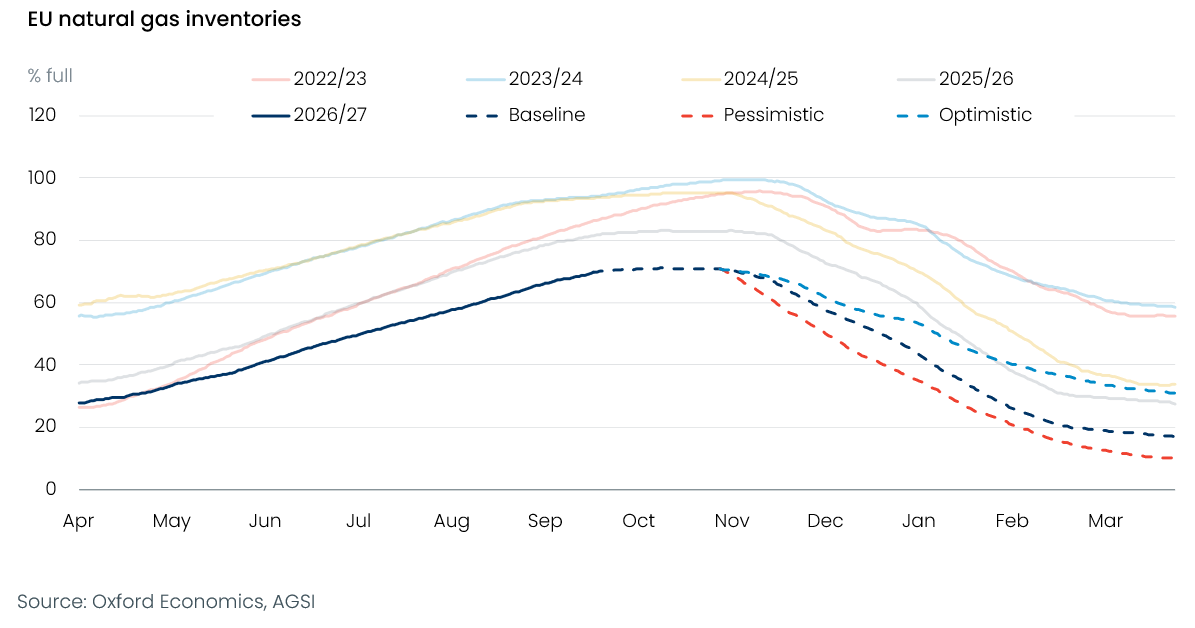
European gas inventories are at their lowest for this time of year in over a decade. Our baseline assumes storage will fall to just 17% of capacity by 1 April 2027, leaving the market exposed to a colder-than-expected winter.
A cold spell combined with disruption to US LNG or Norwegian pipeline supplies could push prices towards $35/MMBtu. Conversely, mild weather and continued growth in global LNG supply could limit the winter peak to around $21/MMBtu.
Europe is nevertheless better positioned than during the 2021–22 energy crisis. Gas demand is around a fifth below its 2021 level, while expanded LNG import capacity provides greater flexibility.
These contrasting outcomes illustrate why the trajectory of gas prices depends not just on Middle Eastern exports, but also on Europe’s ability to manage winter demand and secure alternative supplies.
Chart 2: A cold winter could squeeze EU natural gas inventories
Gold prices to rise as investment demand remains strong
Gold has not benefited from the Middle East shock as much as might have been expected. Higher oil prices have revived inflation concerns and reinforced expectations of tighter US monetary policy, supporting bond yields and the dollar and partly offsetting safe-haven demand.
Nevertheless, central-bank purchases and investor demand continue to underpin prices. We expect gold to average around $4,515 per ounce in 2026, rising to $4,840 in 2027 and $5,140 in 2028.
We anticipate fewer Federal Reserve rate increases than financial markets currently expect, reducing upward pressure on yields and the dollar. Meanwhile, emerging-market central banks should continue diversifying their reserves, providing sustained support to demand.
The outlook elsewhere in the precious-metals complex is more mixed. High silver prices are encouraging recycling and substitution, particularly in solar applications, while constrained mine supply supports platinum. Palladium faces weaker structural demand as internal-combustion-engine vehicles gradually lose market share.
Copper and aluminium to correct before strengthening again
Copper and aluminium prices should decline in early 2027 as supply disruptions ease and trade distortions unwind. However, prices are expected to remain close to historically high levels.
For aluminium, Gulf production and exports are recovering, while additional output from China and Indonesia has helped offset earlier losses. Nevertheless, China’s proximity to its effective capacity ceiling should limit further supply growth.
Copper presents a different picture. Despite weak mine production, stronger refined output and recycling have kept the global refined market in surplus. Yet regional availability remains distorted by US trade policy uncertainty.
Around 80% of exchange copper inventories are concentrated in the US, as expectations of import tariffs have encouraged metal to flow into the American market. Greater clarity over tariff policy could reduce the incentive to hold inventories there, easing tightness elsewhere and putting downward pressure on prices.
This distinction between global supply conditions and regional trade distortions is important in understanding the near-term outlook.
Further ahead, structural demand provides support. Investment in electricity grids, electrification and data centres should underpin copper consumption, while aluminium benefits from transport, aerospace and power infrastructure investment.
Combined with constraints on aluminium capacity expansion and persistent challenges increasing copper mine supply, these demand drivers should allow prices to strengthen again later in 2027.
Grain inventories cushion geopolitical and weather risks
Agricultural markets face a different balance of risks. Higher energy and fertiliser costs, Black Sea disruption and adverse weather could support prices, but relatively comfortable inventories should limit the impact.
We expect grain prices to remain broadly stable through 2027, following strong previous harvests that left sufficient stocks to absorb moderate supply disruptions.
Attacks on Black Sea ports and shipping continue to disrupt exports and raise freight costs. Meanwhile, a strong El Niño could threaten rice production in Asia and wheat yields in Australia.
However, fertiliser prices have eased as Gulf exports recovered and China relaxed some export restrictions, reducing agricultural input cost pressures.
Supply recovery will determine the pace of the correction
The aggregate commodity price cycle is approaching a peak, but the adjustment will vary significantly across markets.
Oil and gas prices should decline as disrupted supply recovers, while base metals face a near-term correction before structural demand and supply constraints become more supportive. Gold is expected to move higher, whereas comfortable inventories should limit grain price increases.
The key uncertainty is the pace of supply normalisation. A faster recovery in Middle Eastern exports could accelerate the decline in energy prices, reducing transport and production costs across other commodities. Conversely, renewed attacks on regional infrastructure could keep prices elevated and delay the correction.
For businesses exposed to commodity markets, understanding these differences will be critical. The challenge is not simply anticipating when prices will peak, but identifying which pressures are temporary, which may persist and how alternative supply scenarios could change the outlook.