

The top African cities in 2026
By Michael Becker
The 2026 Global Cities Index highlights the growing prominence of African cities in the global urban landscape. Africa is changing rapidly, driven by huge population growth, expanding labour markets, accelerating urbanisation, and the increasing adoption of new technologies.
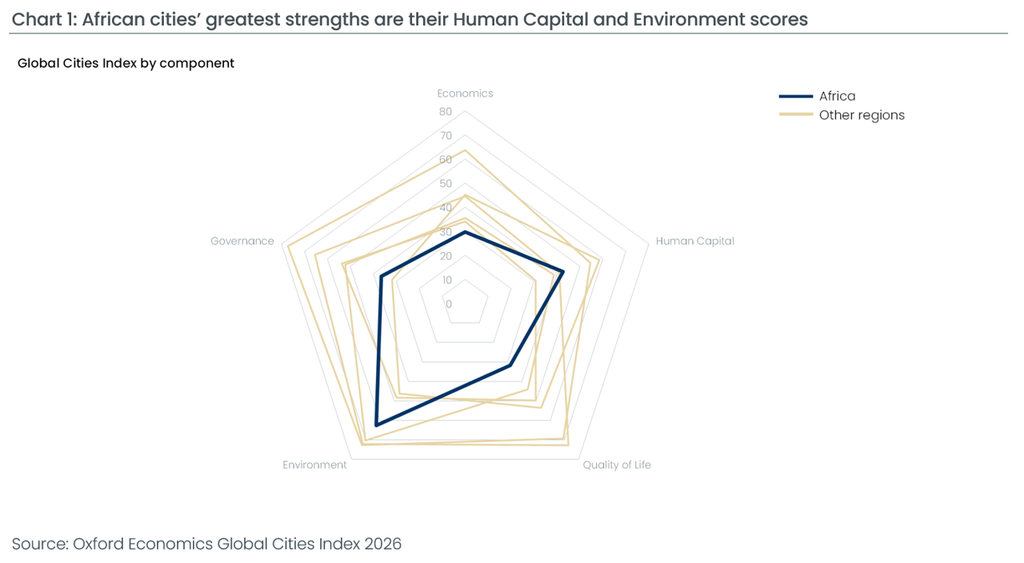
Africa’s leading cities united by rising IT and tech services activity
The new ‘Cities to Watch’ section of our 2026 Global Cities Index highlights five cities in the region – Accra, Cairo, Dakar, Luanda, and Nairobi – that we think are the most dynamic. They’re increasingly charting their own growth paths.
Cairo’s inclusion is unsurprising. Egypt’s capital is Africa’s highest-ranked city in the Index, coming in at 255th place. The city has Africa’s largest urban economy and, at 30mn people, is the most populous on the continent as well. Since we expect it to add 10mn people over the next 25 years (one of the largest population expansions in the world), it’s also unlikely to be dislodged any time soon. Located at a strategic crossroads between Africa, the Middle East, and Europe, and further bolstered by its proximity to the Suez Canal, Cairo has huge potential. The $58bn New Capital just to the east could support further growth and meaningfully improve quality of life in the city by reducing congestion, keeping a lid on housing expenditure, and modernising the city’s infrastructure.
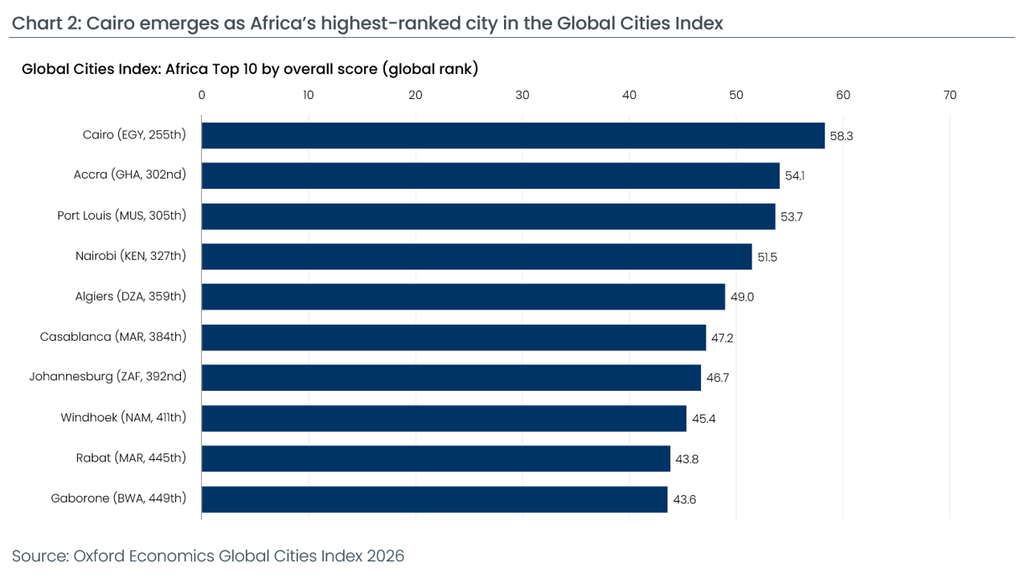
Accra (Ghana) and Nairobi (Kenya) are the continent’s second- and fourth-placed cities, ranking 302nd and 327th respectively. Both have seen significant growth in their ICT and finance sectors, positioning themselves as gateways to Africa’s huge consumer economy. For Accra, this is the result of over a decade of rapid growth in these knowledge sectors – ICT alone has grown by almost 19% per year since 2014. Kenya’s capital is set to add the 12th-largest increase in industrial jobs in the world, driven by robust gains in manufacturing employment. As Asian cities move their industrial production up the value chain towards advanced manufacturing and high-tech goods, they leave space in lower-value manufacturing. Nairobi is well placed to capitalise on this opening, creating new job opportunities for the country’s rapidly expanding population.
Beyond these standouts, the rest of Africa’s top 10 broadly tracks levels of economic development. Port Louis, the capital of Mauritius, ranks 305th – an island outlier whose high quality of life, favourable environment, and stable governance reflect its more advanced level of economic development. North Africa’s larger, more established economies come next: Algiers (Algeria, 359th) and Casablanca (Morocco, 384th) perform relatively well across most categories. Southern Africa follows, with Johannesburg (South Africa, 392nd) and Windhoek (Namibia, 411th) supported by strong human capital and environment scores, respectively – both would rank higher still but for weaker scores for Quality of Life. Rounding off the top 10 are Rabat (Morocco, 445th) and Gaborone (Botswana, 449th).
Human capital is the continent’s key strength
The strongest-performing category for Africa’s cities is Human Capital. Five African cities rank among the global top 50 in the category. Johannesburg and Nairobi place 25th and 26th, respectively, supported by deep education ecosystems and their importance as regional business centres. Uganda’s Kampala ranks 41st, Cairo 42nd, and Nigeria’s Lagos 50th. In fact, strong performance in this category has led to 97 of Africa’s 113 cities in the Global Cities Index moving up the rankings this year.
A key driver of this is Africa’s demographic momentum. Unlike many advanced economies facing ageing populations and slowing labour force growth, Africa is home to the world’s youngest population and fastest-growing urban workforce. Over the next 25 years, we project major African cities will add 213mn residents, with around 70% of that growth coming from working-age populations. This is 200mn more people than we expect Europe’s major cities to add over the same timeframe. Few other regions can match the scale of labour force expansion likely across Africa’s urban centres.
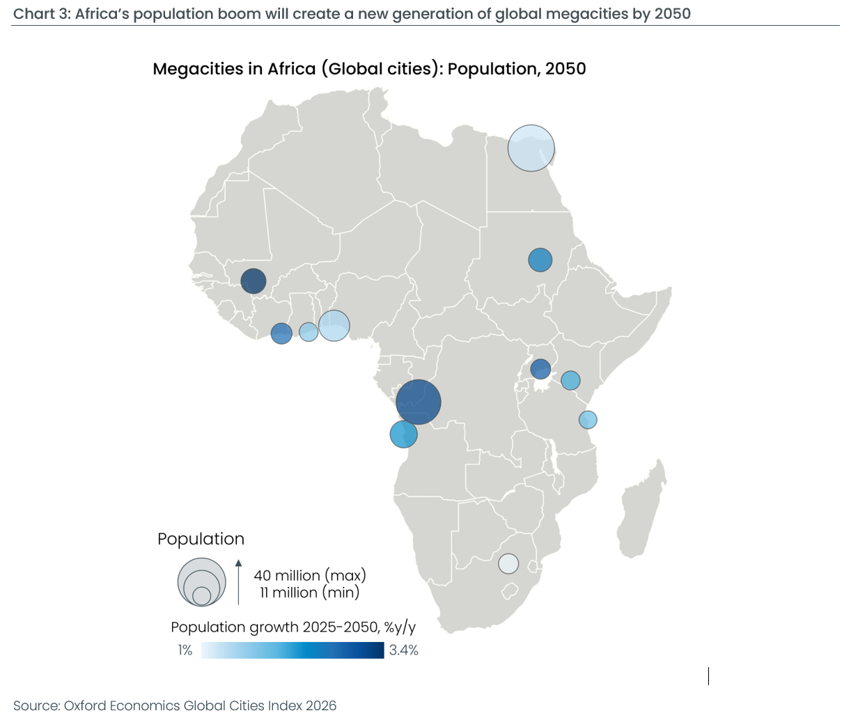
This labour market and population expansion will boost consumer markets and raise investment potential, increasing Africa’s contribution to the global economy over time. As part of this shift, Cairo and Kinshasa, the capital of the Democratic Republic of Congo, will become the fourth- and fifth-most-populous cities in the world by 2050, while Lagos and Luanda (Angola) will enter the global top 20. A further seven African cities will evolve into megacities (defined as those with a population greater than 10mn) over the next 25 years. Overall, we expect Africa’s 12 megacities alone to account for more than 20% of global urban population growth over the period.
But this rapid growth in the continent’s population and labour market size will present a significant challenge. In particular, Africa’s position in future editions of the Global Cities Index will increasingly be determined by its ability to convert demographic strength into economic performance – something it hasn’t done well historically. In fact, the massive increase in population could actually undermine the performance of African cities, particularly given weak governance, climate pressures, and the long-standing fiscal constraints many face. This could see rapid urbanisation alongside weak infrastructure delivery, low-value job creation, and poor service access. Failure to overcome this challenge would reverberate well beyond Africa’s borders.
GDP growth is becoming concentrated in a subset of cities
The other challenge facing Africa is that future economic prospects appear to be becoming increasingly concentrated around a small set of major cities. This includes the Cairo, Accra, and Nairobi, alongside Senegal’s Dakar and Angola’s Luanda. Together, we project these five cities will generate one-third of all GDP growth among African cities in the Global Cities Index over the next 25 years, highlighting the scale and pace of urban transformation.
These rapid changes explain why these five cities form our Cities to Watch for the region. The reason for Dakar’s inclusion is similar to that for Nairobi and Accra – strong growth in professional services sectors. However, the city is also strategically located on the westernmost point of Africa and is undertaking significant educational reform to raise skill levels. This should deepen its labour market and raise export potential. Luanda, by contrast, is more a story of leveraging hydrocarbon revenue to raise infrastructure investment and diversify the economy. The Port of Luanda is at the centre of this as it seeks to embed the city at the heart of southern Atlantic logistics network.
Overall, Africa is a rapidly changing continent, and its population size and growth represent a significant opportunity. Its leading cities exemplify this, combining improving economic diversification, rising skill levels, and increasing population size. The big challenge is ensuring that everywhere can convert youthful population booms into sustainable economic development — that won’t be easy in a continent grappling with weak investment, deep poverty, and high crime rates.
Top 10 African cities in 2026 Global Cities Index
- Cairo
- Accra
- Port Louis
- Nairobi
- Algiers
- Casablanca
- Johannesburg
- Windhoek
- Rabat
- Gaborone
To explore the full rankings and see how other cities perform, visit the 2026 Global Cities Index site.
You might also be interested in
Explore the 2026 Global Cities Index
REQUEST A TRIAL
Access detailed city analysis and forecasts with a free trial of our cities and regions services.